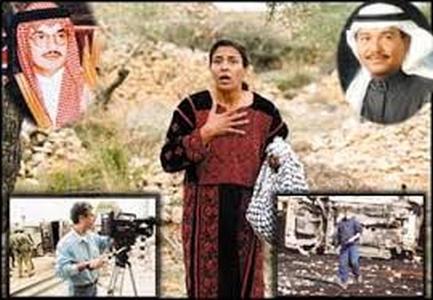
Filming the external scenes of the song in 2001 – social networking sites
“Hey, hey, Zion, how can you belittle my mother’s tears?” With this poignant phrase, the famous Saudi singer Muhammad Abdo arouses the feelings of his viewers in his most prominent song for the Palestinian issue (At Here, Mother), which was directed by the Jordanian director Hussein Daibes, and whose lyrics were written by the Saudi poet, Prince Khaled bin Talal. Although the artist Muhammad Abdo is not a supporter of video clips, he presented a distinctive video clip for this song specifically, which was filmed inside the occupied territories, and expressed the brutality and Israeli attacks on women, children, and the elderly in the occupied territories. Regarding this work, the artist Muhammad Abdo said, in an interview he conducted with the Emirati newspaper Al-Bayan on May 17, 2001: “My issue with Palestine arose from my birth, as I was born in 1948, which was the beginning of the major setback and the bitter echo that prevailed in the Arab world, and it left me with great frustration.” He continues: “The years passed, and the uprising began to revive in us the flame of struggle through these stone-throwing children who restored confidence in ourselves and did what adults could not do… with simple stones and small bodies… This uprising erased the frustration that I had been living in over the past years, so I began to make some national attempts.” He continues: “Until the idea of the clip came to me, and I had discussed it with the poet Prince Khaled bin Talal so that we would present together a song for the Palestinian mother and at the same time talk about the Palestinian child participating in the intifada. We presented this song and it was filmed in a way that was specific to the occupied territories and from the reality of the intifada. It was directed by Jordanian director Hussein Daibes.”
Song lyrics
Here you are, my mother, here you are.. and let me kiss your palms. You are not humble, but rather humble.. who brought tears to your eyes. Wait, wait, Zion, my mother’s tears. How would you be at ease if they gathered the whole universe for me? Your account remains with me. If the oppressor was you.. and my people remained silent, and with my death you ruled.. so the flying stone brought me back, oath by oath. I will never forget how. With your foot stepping on Al-Aqsa, I will show you what is harsher. Injustice has crossed my limit. I will make you feel the pain of bitterness.. Time after time, so that you may live injustice and its freedom.. In that my answer and my response in that cannon. It was a dialogue between the child and the fire. I will never reject this disgrace, my family. This is my promise. Will justice be the cannon? And the eyes of children shed tears. A day will come when you will pay. .. Regrets since the beginning
Difficult situations
The clip included multiple symbols, most notably the idea of meeting the mother, which expresses Palestine’s need to help the nation’s children, and sets an important standard for the issue represented by its hostility to Zionism and not Judaism as a religion, with the idea of insisting on restoring the right no matter how severe the injustice is, and the reluctance of many Muslims, and the symbolism of the child in indicating the generational transmission of the issue. Muhammad Abdo says, “The pictures and footage that appeared in the work were taken from within the uprising, and one of the children who participated in the song was actually martyred during filming. I was careful not to appear in the work until I proved that the word and sound could serve the work, especially such a dramatic work.”
Thanks to Al Jazeera and blame for the new generation
The artist Muhammad Abdo said, “The Arab media reacted to the issue, especially Al Jazeera, but I blame the new singing generation that did not interact with the issue of displaced children, and I did not talk about all of them, but rather about most of them. We must now focus on the humanitarian aspects, as we should, and the most important thing is that the Palestinian leadership pay attention to its children because it is already negligent with them.”
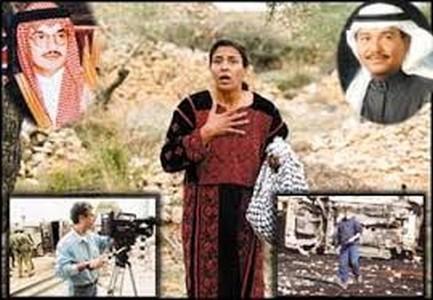
The complete song
Playing connects your browser to YouTube. Privacy