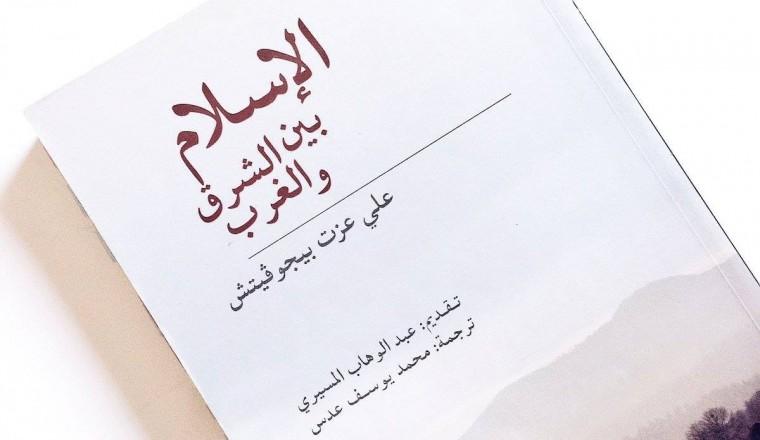
Cover of the sixth edition of the book – social networking sites
“Islam is not only a religion, but rather it is all of humanity.” With this broad, comprehensive concept of Islam, the book “Islam between East and West” sets out to establish what can truly be considered a complete intellectual philosophical encyclopedia. It deals with the most important contemporary philosophical and intellectual issues that occupy the world so far, and is not just a partial issue limited in place and time. It deserves to be elevated to the ranks of global intellectual books, not narrow national ones that address a limited segment of religion, race, or nation. The book is about 317 pages. Its sixth edition, which is in our hands, was printed by Dar Al-Shorouk in the Egyptian capital, Cairo, in 2015 AD, translated by: Muhammad Youssef Adas, and presented by: Abdel Wahab Al-Mesiri.
Introduction to the author
Its author, the great thinker Alija Izetbegovic (1925-2003), the former president of Bosnia, is not an ordinary thinker. He is, as Abdel-Wahab El-Messiri described him in his book An Introduction to Reading the Thought of Alija Izetbegovic: “He is not only a mujtahid, but he is also a mujahid. He is a thinker and a head of state. He analyzes Western civilization and shows the nihilistic materialistic cognitive model inherent in its sciences and its dominant model, and then confronts it and resists its attempt to annihilate his people.” It is also clear that he has studied Western philosophies in depth, and has an unusual familiarity with them. “This is not the same as the familiarity of philosophy professors who present different philosophical ideas in a neutral manner. Rather, it is the familiarity of the true philosopher who stands on solid philosophical ground and looks at the other and realizes the essence of the cognitive model that dominates him. We see him speaking with unusual fluency about (Nietzsche), (Jaspers), and (Kerkegaard), in a few lines that show the extent of his understanding.” For their philosophical visions, as well as the extent to which it reaches its depths and its destructive nihilistic material structure, or its complete faith structure,” according to Al-Mesiri’s description.
Book content
The book includes an introduction by the author, two main sections, and a conclusion. The first section is approximately 191 pages; It constitutes approximately two-thirds of the book, and is titled: (Introductions: Views on Religion), and contains six chapters, in which the author discusses the position of both religion and atheism on the issue of the origin of man and other issues related to it, such as the issue of evolution and the issue of creation. The titles of the chapters of the first section are as follows: Chapter One: Creation and Evolution. Chapter Two: Culture and Civilization. Chapter Three: The phenomenon of art. Chapter Four: Ethics. Chapter Five: Culture and History. Chapter Six: Drama and Utopia. The second section is about 111 pages, and constitutes approximately a third of the book. It is entitled: (Islam: Bipolar Unity), and contains five chapters. We can consider this section an application of the theoretical introductions addressed in the first section, and its chapter titles are as follows: Chapter One: Moses, Jesus, and Muhammad. Chapter Two: Islam and Religion. Chapter Three: The Islamic nature of law. Chapter Four: Ideas and Reality. Chapter Five: The third way outside Islam.
Excerpts from the book
Throughout the book, you can quote great wisdom and inspiring sayings from him that alone could form a comprehensive research topic, and perhaps it would be good to highlight some of them in this presentation: * “If man is the son of nature as they say, how could he begin to oppose nature? The idea of man sacrificing himself for the sake of others, or rejecting some of his desires, or reducing the intensity of his physical pleasures, all of this does not come from his mind. The principle of the existence of animals is benefit and efficiency, not This is the case with man… On the contrary, we find that moral principles in both civilized society and primitive society weaken man’s (animal) efficiency.” * “The decisive difference between man and animal is neither physical nor mental. Above all, it is a spiritual matter that reveals itself in the presence of a religious, moral, or artistic conscience. Man does not behave in his life as a child of nature, but rather as one alienated from it. His basic feeling is fear. However, it is not a biological fear like that felt by animals. Rather, it is a primitive, cosmic spiritual fear connected to the secrets and mysteries of human existence…” * “If we find in an archaeological discovery two stones placed in a certain order, or cut for a certain purpose, then we all certainly conclude that this is the work of a human being in ancient times. If we find near the stone a human skull that is more perfect and incomparably more complex than the stone, some of us will not think that it was the work of a conscious being. Rather, they look at this complete skull or complete structure as if they had arisen by themselves or by chance, thus without the intervention of a mind or Awareness, isn’t there a clear passion in man’s denial of God? * “The issue of creation is in fact the issue of human freedom. If we accept the idea that man has no freedom, and that all his actions are predetermined – either by an inner or external force – then in this case divinity is not necessary to explain and understand the universe. But if we accept man’s freedom and responsibility for his actions, then we acknowledge the existence of God, either implicitly or explicitly. Only God is able to create a free creature, and freedom cannot exist except by the act of creation.” * “Man is not fit to live by his senses alone, as materialism claims… Civilization is far from giving our lives meaning, but in fact it is part of the nonsense in our existence… This criticism of civilization is not a call to reject it; civilization cannot be rejected even if we wish to do so, but the only necessary and possible thing is to destroy the myth that surrounds it. Destroying this myth will lead to further humanization of this world, which is A task that inherently belongs to the culture.” * “Europe will still think in terms of choices Christianity: Either the Kingdom of God or the Kingdom of Earth. Europe will continue to bitterly deny science or religion, but there is a part of the Western world – because of its geographical location and history – that remains free from the direct influences of medieval Christianity, free from the intractable complexes of this era. This part of the Western world was always searching for a third way, and it was guided to it, and it carries within it features of the third way of Islam, and the country I mean is England, and to some extent also the Anglo-Saxon world. In general.” * “From the point of view of the philosophy of history, the emergence of England and the Anglo-Saxon spirit in the history of the West is similar to the emergence of Islam in the history of the East, and perhaps this is what Spengler meant in his comparison between the Prophet Muhammad, may God bless him and grant him peace, and Cromwell… The unification between the English church and the state, as well as the emergence of the English as a global power, all began with Cromwell, and so did the unity of religion and state and the emergence of the global power of Islam, and they were both pure believers and founders of an empire. Great, and this seems to be a very natural thing for the Islamic mind and the Anglo-Saxon mind, but it is very strange for the European mind…”
Summary of the book
The book revolves around analyzing the strict dualities into which the contemporary world is divided (matter/spirit, atheism/religion, evolution/creation, civilization/culture, science/art, utopia/morality). These dualities represent two opposite sides that do not come together rationally. A person is either a believer or an atheist, materialistic or spiritual, etc. But what is the position of Islam in relation to these dualities? The question is rather: What is the position of man in these dualities? Alija Izetbegovic distinguished between three concepts: (materialism – religion – Islam). Religion and materialism are two opposite sides that never meet, and Islam is the link between them. Begovic dealt with the term religion in the European sense. It is a personal spiritual relationship between the servant and his Lord through individual rites and rituals, unlike Islam, which contains all of life. Begovic was able to demonstrate, in his wonderful style, the defect and problem occurring in the purely materialistic, or purely religious, system, explaining the serious disorder and imbalance that has spread throughout humanity. Because of her feeling of lack of verification in either system (religion or materialism), the author concludes with us that Islam is humanity.