Orabi in the Abdeen demonstration – Wikipedia
Among thousands of Egyptian military personnel, Admiral Ahmed Orabi engraved his name in golden letters in the record of Egyptian military history with the revolution he led in the period 1879-1882 against Khedive Tawfiq and foreign intervention in Egypt, which was called at that time in government circles as “Hawjah Orabi.” The events began as a reaction of the Egyptian officers against their Turkish leaders who did not want to promote them to high ranks, and represented the largest clash between Egyptian Arab nationalism and Turkish nationalism, and its spark was launched during the reign of the head of the Circassian jihadism, Othman Refki Pasha, in what was known as the “Circassian conspiracy,” during which the Circassian officers incited the soldiers to disobey their high-ranking Egyptian officers.
The rise of Orabi
After Admiral Ahmed Orabi learned of this plot, he met at his home with a group of fellow army commanders on the night of January 16, 1881, and they began discussing among themselves about confronting the persecution of Egyptian officers by the Jihadi Superintendent. They agreed to choose Ahmed Orabi as their representative. Orabi wrote a petition demanding the dismissal of the Jihadi Superintendent, Othman Rifqi, and he and Admiral Ali Fahmy and Abdel-Al Helmy signed it. On the morning of January 17, they went to the headquarters of the Interior Ministry and handed over the petition and asked to submit it to Riad Pasha. On January 31, the Council of Ministers met under the chairmanship of the Khedive and decided to assign the Minister of War to arrest the three officers and bring them to military trial. On February 1, 1881, the Minister of War invited the three officers to the Nile Palace, where they were arrested, stripped of their weapons, and placed in the prison hall in preparation for their trial. When the first Alai, Qashlaq Abdeen, learned of the arrest of the three officers, he ordered Al-Bakbashi Muhammad Ubaid to quickly go to the Nile Palace to liberate their colleagues. The Alai soldiers attacked the palace, and Othman Rifqi escaped from one of the windows, and Al-Bakbashi Muhammad Ubaid freed the three officers. They all went out, led by Ahmed Orabi, and headed to Abdeen Square in what was known as the first Abdeen demonstration, and here the Khedive found himself forced to accept the requests of Orabi and his companions. This incident resulted in the Khedive’s approval and he was forced to dismiss Othman Rifqi and appoint Mahmoud Sami Al-Baroudi in his place, and the rise of Orabi’s status as a national leader representing the Egyptian will and opposing foreign influence.
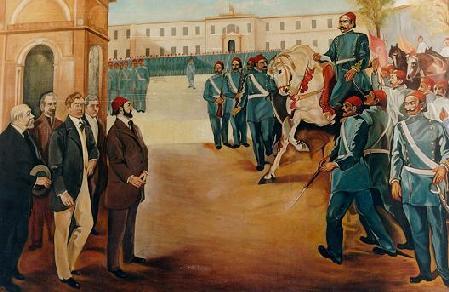
Abdeen demonstration 1881
As a result of the growth of national awareness and the people’s discontent with the poor economic conditions, and the harsh treatment of the Egyptians by the Khedive’s entourage, the Orabi Revolt reached its climax on September 9, 1881, when all the military units stationed in Cairo moved to Abdeen Square with Ahmed Orabi, and it also included the participation of the Egyptian people of all sects. Ahmed Orabi arrived in front of Abdeen Palace, and Khedive Tawfiq came out with the British Consul and the British Financial Controller, surrounded by his personal guards. Ahmed Orabi announced the demands of the army and the Egyptian people to Khedive Tawfiq, which included the dismissal of Riad Pasha’s ministry, the establishment of a European-style House of Representatives, and increasing the number of the army to 18,000 soldiers “in accordance with the Royal Decree.” Orabi said his famous phrase: “God created us free and did not create us with heritage or property. By God, besides whom there is no god, we will not be heirs and we will not be enslaved after today.” The Khedive responded to the nation’s demands, removed Riad Pasha from the presidency of the ministry, and entrusted Sharif Pasha with forming the ministry. He was a generous man known for his patriotism and integrity. He formed his ministry on September 14, 1881 AD, and Mahmoud Sami Al-Baroudi was its Minister of War. He sought to draw up a constitution for the country, and succeeded in completing it and presenting it to the House of Representatives, which approved most of its articles. This effort was undermined by the interference of England and France in the affairs of the country by sending the first joint memorandum on January 7, 1882, in which they declared their support for the Khedive. Things became more difficult, and Sharif Pasha submitted his resignation on February 2, 1882 AD due to the Khedive’s acceptance of that memorandum.
Ministry of Revolution
A new government was formed headed by Mahmoud Sami Al-Baroudi, in which Orabi served as Minister of War. Al-Baroudi’s ministry was met with satisfaction and acceptance from various military and civilian circles. Because it was the fulfillment of the nation’s desire, and the highest hopes, and it was based on good expectations, so it announced the constitution, and the Khedive’s decree regarding it was issued on February 7, 1882 AD. This ministry was called the Ministry of the Revolution because it achieved the satisfaction of both the people and the army. Orabi remained in his position after the Alexandria garrison announced that it would not accept anyone other than Orabi as head of jihad, so the Khedive was forced to keep him in his position and assign him to maintain security in the country. However, Al-Baroudi quickly announced his resignation in objection to the Khedive’s refusal to ratify many of his decisions. This matter became clear after some Circassian soldiers attempted to assassinate Orabi, and a military court was formed to try the accused, which ruled that they be stripped of their ranks and exiled to the outskirts of Sudan. When “Al-Baroudi” submitted the ruling to Khedive Tawfiq for ratification, he refused at the instigation of the consuls of England and France. After that incident, Al-Baroudi presented the matter to the Council of Supervisors, which decided that the Khedive had no right to reject the decision of the Supreme Military Court in accordance with the constitution. Then the Ministry presented the matter to the House of Representatives, and its members met in Al-Baroudi’s house and declared their solidarity with the Ministry, and demanded the necessity of deposing the Khedive and prosecuting him if he continued his machinations. England and France took advantage of this dispute, and mobilized their fleets in Alexandria, under the pretext of protecting foreigners, and their consuls submitted a memorandum on May 25, 1882 AD to Alexandria demanding that they overthrow the Baroudi Ministry, exile Orabi abroad, and deport Ali Fahmy and Abdel-Al Hilmi to the countryside. Al-Baroudi’s ministry met these demands with rejection, while Khedive Tawfiq accepted them with approval. Al-Baroudi had no choice but to resign, and one of its results was the people’s rally around Orabi and his confirmation in his position as Minister of War with a popular support.
Bombing of Alexandria
The Egyptians’ adherence to Arabi called on England and France to hold the Astana Conference (the capital of the Ottoman Empire) to consider the Egyptian issue and its development. The Ottoman Sultan initially refused to participate in this conference on the grounds that the situation in Egypt did not require interference in its affairs, but the conference continued to hold its sessions. This conference was held on June 23, 1882, and the participating countries issued a resolution in which they pledged not to interfere in the affairs of Egypt, but the British delegate suggested that the phrase “except for extreme necessity” be added to the pledge. This proposal is considered a declaration of England’s intentions to occupy Egypt. England announced its skepticism about the new government’s ability to maintain security, and began to fabricate reasons to harass the Egyptian government and find a pretext to invade Egypt. It seized the opportunity to renovate Alexandria’s castles, strengthen their fortifications, and supply them with men and weapons. It sent the commander of the Alexandria garrison a warning on July 10, 1882 AD, to stop fortification and renovation operations, and to lower the cannons therein within 24 hours, otherwise Alexandria would be bombarded with cannons. When the Egyptian government rejected these threats, the next day the English fleet attacked Alexandria, destroying its castles, and destroying parts of Alexandria’s neighborhoods. Many people were forced to flee the city, and the fleet continued the bombing the next day. The city was forced to surrender and raise white flags after most of the city was destroyed. Ahmed Orabi was forced to move with his forces to Kafr al-Dawwar and reorganize his army. Instead of resisting the occupiers, the Khedive received Admiral Beauchamp Seymour, commander of the British fleet, at the Raml Palace in Alexandria. He sided with the British, and made himself and his governmental authority at their disposal even before they occupied Alexandria. During the fighting, the British sent a group of their soldiers wearing blue jackets to protect the Khedive as he moved from the Raml Palace to the Ras al-Tin Palace through the burning streets of Alexandria. Then the Khedive sent a message to Ahmed Orabi in Kafr al-Dawwar, ordering him to stop making military preparations, holding him accountable for the attack on Alexandria, and ordering him to appear before him at Ras al-Tin Palace. To receive his instructions from him. Orabi refused to submit to the Khedive after his position on the attack on Alexandria. He sent telegrams to all parts of the country accusing the Khedive of siding with the British, and warning against following his orders. He sent to Yaqub Sami Pasha, the agent of the Jihadi Supervisors, asking him to convene a national assembly represented by the country’s notables, princes, and scholars to consider the deteriorating situation and what should be done. The assembly met on July 17, 1882 AD, and the number of those gathered was about four hundred. They agreed to continue war preparations as long as battleships remained The English are on the coast, and its soldiers occupy Alexandria. On July 22, 1882 AD, a meeting was held in the Ministry of the Interior, attended by about five hundred members, led by the Sheikh of Al-Azhar, Egypt’s chief judge and mufti, the head of the nobility, the Coptic patriarch, the rabbi of the Jews, representatives, judges, inspectors, directors of directorates, senior notables, and many mayors, as well as three princes of the ruling family. At the meeting, three senior sheikhs of Al-Azhar, Muhammad Alish, Hassan Al-Adawi, and Al-Khalafawi, issued a fatwa against the Khedive about religion; Because he sided with the army fighting his country, and after deliberation, the Assembly issued its decision not to remove Orabi from his position, and to stop the orders of the Khedive and his supervisors and not implement them. Because it departed from the noble Sharia and the honorable law, and they were not satisfied with this, but rather gathered men, weapons, and horses from the villages, estates, and villages of the country. Mayor Muhammad Imam al-Hout, mayor of Salhiya Sharqiya, and Mayor Abdullah Bahadur, mayor of Juhayna Jirjawiyya, instilled enthusiasm among the people and gathered as many men and weapons as they could to support the defense of the country. Mayor Abdullah Bahadur provided about 600 fighters from Juhayna’s men, known for their bravery and bravery, 140 horses, 74 rifles, many other weapons, and large quantities of grains. Mayor Muhammad Imam al-Hout provided about 40 fighters in number, equipment, and foot Suleiman Zaki Hakim, a prominent figure in the Toukh Center, provided 41 horses, and Ahmed Hosni, the mayor of the Mit Ghamr Center, presented 33 rifles.
Battle of Kafr al-Dawwar
The Khedive’s reaction to this decision was to remove Orabi from his position, and appoint Omar Lotfy as governor of Alexandria in his place. However, Orabi did not comply with the decision, and continued to make preparations in Kafr al-Dawwar to resist the British, and actually succeeded in winning in its first round. On August 28, 1882, during the British army’s advance westward into the Ismailia Governorate under the leadership of General Graham, he was besieged by unarmed residents. He requested more ammunition at 4:30 p.m., which arrived at 8:45 p.m., enabling him to carry out a major massacre among the residents. The British army continued to advance until it reached Al-Tall Al-Kabir in Al-Sharqiya Governorate, and the battle took place on September 13, 1882 AD at 1:30 in the morning and lasted less than 30 minutes due to an epidemic of night blindness among the Egyptian soldiers, as the British surprised the Egyptian forces who had been stationed in their positions for days and who had been asleep at the time of the attack. Ahmed Orabi, who refused to flee the battle, was arrested. The British forces continued their rapid advance to Zagazig, where they regrouped at noon that day, then boarded the Egyptian Railways train to Cairo, where its garrison, led by Khunfs Pasha, commander of the Saladin Citadel, surrendered the same afternoon. This was the beginning of the British occupation of Egypt, which lasted 74 years.
Trial of revolutionaries
After the British entered the city of Cairo on September 14, 1882, and the Khedive arrived at Abdeen Palace on September 25, 1882, a trial was held for Ahmed Orabi, some of the army commanders in the battle, and some scholars and notables. Ahmed Orabi was detained in the Abbasiya barracks with his deputy, Tolba Pasha, until his trial was held on December 3, 1882, which ruled for his execution. The sentence was commuted immediately after that, based on an agreement. Prior between the British occupation authority and the Egyptian judges, he was exiled for life to the island of Serendip (Ceylon Island). The British ambassador to the Sublime Porte, Lord Duverne, moved to Cairo as the first High Commissioner and supervised the trial of Ahmed Orabi. Ahmed Orabi and his colleagues Abdullah al-Nadim and Mahmoud Sami al-Baroudi were exiled to the island of Sri Lanka (formerly Ceylon), where they settled in the city of Colombo. As for those who supported Arabi, fought with him, or incited the masses to fight, including scholars (such as Sheikh Muhammad Abduh), mayors, and notables, the ruling was first to kill those whom they called the heads of sedition among them, and to remove the rest. Then the sentence was commuted to remove everyone, so they were removed from their positions and stripped of their medals and medals. Orabi lived in exile alone, and returned 20 years after his exile due to the severity of his illness, just as Mahmoud Sami Al-Baroudi returned after 18 years, due to his near death and blindness. Despite the failure of the Urabi Revolution to achieve its main goals, it opened the eyes of the Egyptians to the coordination and cooperation taking place in the Khedive Palace with the British and the deliberate marginalization of the Egyptians. It moved their aspirations towards demanding basic rights to freedom, rising to the highest leadership positions in their country, and then carrying out the duty of defending the homeland from the foreign occupier.