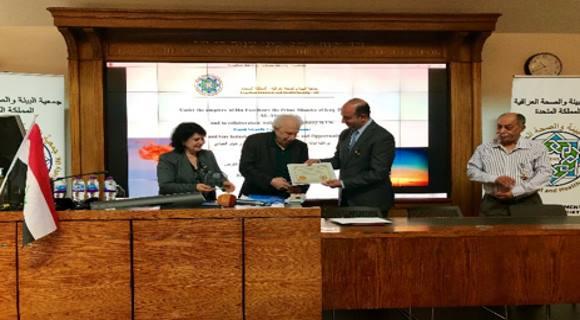
Iraq is witnessing a historical turning point in its rich oil revolution, as the current stage requires it to invest in optimal reconstruction and construction operations. In this regard, the British capital, London, hosted, on the morning of Sunday, July 8, 2018, a scientific conference organized by the “Iraqi Environment and Health Society in the United Kingdom” with the participation of the Iraqi Embassy in London, under the title “The oil and gas industry in Iraq… challenges and opportunities,” in the presence of a number of experts and researchers specialized in energy and environmental issues. The attendees called for the necessity of balancing between Iraq’s increasing need to exploit its huge oil resources to meet the needs of its citizens and relaunching the wheel of development and reconstruction in its regions, and taking into account protecting the environment and preserving public health from the collateral damage of the oil industry in its various stages. He reminded the audience of the central role of the oil and gas sector in the Iraqi economy, and the necessity of rationalizing its benefit to the maximum extent by properly managing the revenues that come from it and allocating a portion of those revenues to implementing a clearly defined and targeted environmental policy, in order for the oil industry to transform from a threat to the environment into a factor in its service. Among the attendees were prominent legal and academic figures, including Saleh Mushtat, professor of architecture at the University of Wolverhampton in England, and Faleh Al-Amiri, an oil expert and former general manager of SOMO in Iraq. In turn, the president of the association, Jihan Baban, highlighted in her speech at the opening of the conference, the strategic importance of the oil and gas sector in the rentier Iraqi economy and the necessity of benefiting from oil revenues to rebuild and build the country, provide services, repay local and international loans, and follow a wise investment policy that reduces unemployment and develops national industries and the agricultural and food sector. Baban also stressed the need for increasing oil production rates to be accompanied by environmental policies in all stages of exploration, drilling, extraction, transportation, storage and export, implementing agreed-upon environmental risk assessment frameworks, respecting and adhering to international laws and legislation, and adhering to an environmentally friendly oil policy. As for the Iraqi oil expert, Fadel Chalabi, he gave a lecture entitled “The History of Oil and Gas in Iraq,” in which he presented a historical overview of this wealth, considering that one of the reasons for the imbalance in its exploitation is the subjection of the oil economic decision to purely political wills and goals. The participation of the founding director of the Energy Institute in Iraq, Louay Al-Khatib, was entitled “Improving the building of Iraqi energy capabilities in a competitive world.” He presented a scientific view supported by statistics and followed it with a vision for the future Energy, considering that the world has changed since 2012 as a result of changes in the global energy market, which began to include oil, gas and alternative energy, which means that Iraq now has a golden opportunity to diversify energy sources. The conference issued a number of decisions and recommendations, including continuing attention to the crisis of water resource scarcity facing Iraq, continuing to study the impact of internal conflicts on the environment and health, and paying attention to sustainable alternative energy sciences.