
“The Crushing Massacre”: Awareness’s publication on the Egyptian military’s massacre of Copts at Maspero in 2011
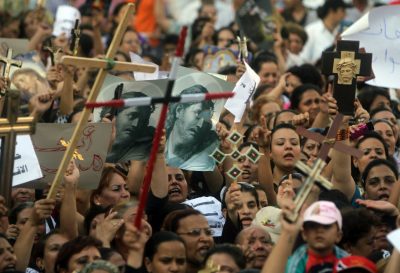 Demonstrations of Egypt’s Copts as they move from Shubra towards Maspero[1] In response to residents of the village of Al-Marinab in Aswan Governorate demolishing a church that they said was unlicensed, and statements by the Aswan Governor that were considered insulting to Copts, and the violent dispersal of the Copts’ sit-in on March 4, and military police soldiers severely beating the young man Raif Fahim, one of the demonstrators. (Image source: Platform website, October 11, 2016)
“In this work, we do not address the Maspero massacre – or as we called it the Al-Haras massacre, for reasons that will come later – isolated from the environment with all its elements: the historical background of the relationship of the ruling regimes with the Copts and the relationship of that to the revolution and the massacre. We cannot narrate any event apart from the political and social environment in which the event occurred, and the environment at that time was the environment of the January 25 revolution; the environment of demands for freedom and dignity, and the Coptic activists and behind them a wide audience were not heretics of the Egyptians. They wanted what every Egyptian wanted, and they dreamed of what every citizen dreamed of. Everyone wanted life, freedom, and social justice…” With these words, the scientific team documenting the 2011 Maspero massacre began narrating the massacre, which took about a full year to work on, and similar to what the Waaa Foundation did in documenting Republican Guard massacre In 2019, it completed the documentation of the Maspero massacre in 2020.
The importance of studying the 2011 Maspero incident:
The 2011 Maspero massacre represented one of the important and painful events experienced by the Egyptian state with all its components in the wake of the January 25, 2011 revolution at the hands of the counter-revolution. Although Maspero occurred before the actual direct coup in 2013, the indicators of the results of this massacre show that the perpetrator is the same in all the crimes and massacres that were committed before or after the coup, and the method is the same, and the propaganda is also the same, and that this crime was one of the preparatory means to create an environment Conducive to the coup by sowing division and causing resentment among the components of Egyptian society, and what is new is what the researchers discovered by tracking the details of the event, which makes Maspero a national issue and not a sectarian, factional, or conspiratorial issue as the military regime – represented by the Military Council at the time – tried to portray it. Diagnosing the Maspero complex – and other complexes – and describing them objectively would pave the way for Egyptian society for constructive dialogue and fruitful social and political negotiation between its components, and establish a climate that enables agreement on a real map of the future among its people away from arbitrary or political accusations, so that the facts are presented in an objective, inductive and transparent manner that explains the source of the error or sin, whether in dealing with the event in its entirety or in one of its parts. And the Maspero incident; It is a massacre according to the international classification, which this documentation has proven with various evidence, and the international custom of massacre means the deliberate mass killing of a group of people between five and six people, who do not have any equivalent force to defend themselves (see: Republican Guard massacre(The first comprehensive scientific documentation, 2019, Waei Foundation for Research and Development), and those killed here were 31 martyrs who fit that international description.
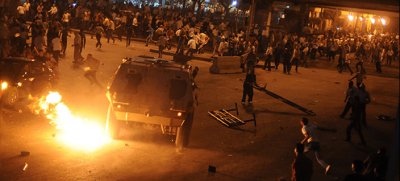 A picture from the events shows a number of Coptic demonstrators setting fire to an armored vehicle and throwing iron traffic barriers at it. (Image source: Arabic website / news B.B.C, October 9, 2011)
Cheering freedom for all Egyptians, and oppression as well
The Maspero massacre was not a surprise to those who looked at the behavior of the authoritarian regime and the regimes’ dealings with Coptic affairs, as the researchers explained in the introduction to the study. After the participation of the Copts in all their religious and secular groups – especially the youth – in the January 25 Revolution, side by side with their fellow Egyptian Muslims in all their religious and secular groups – especially the youth as well -, Tahrir Square witnessed in the eighteen days of the Egyptian Revolution wonderful scenes of national unity and the merging of Egyptian dreams into one dream, which is the salvation of Egypt from dictatorial-military rule and that injustices befall all Egyptians, and that bullying and tyranny are based on their care and nourishment. A group of Muslims and Copts together, and that the general public – Copts and Muslims – have one national feeling of the will for change and the demand for justice for all the people without distinction. The political environment in which the massacre took place was an environment of nascent, spontaneous and weak political life, high and legitimate popular aspirations, political parties still breathing freedom and others in the process of formation, an international community governed by interests that the Egyptian revolution might take some of for the benefit of the people, and regional countries in a state of panic and fear of a revolution that might blow in their countries, or that the political will might liberate Egypt and the people from dependency… and a military council that was lurking around Mubarak, who wanted to inherit his son’s inheritance. Then he – the Military Council – contained the people’s revolution against him in order to replace him, and Mubarak conceded to the Council and handed over the keys of power to him.
In the interpretation of the title “Al-Haras Massacre”
It is a mass crushing massacre. The section on the medical report on the victims’ injuries in the second chapter of this documentary work included seven data tables, in which the injuries of 31 victims – who died in this painful event – were classified to indicate the cause of death. Killing by crushing, running over armored vehicles, and bruising was the highest, as the percentage of killing by crushing and bruising reached 58% of the victims, of whom 35% were crushed and 23% were bruised, which is contrary to all expectations. What is expected is Murder by gunfire (it represented only 25%). This method – i.e. crushing and running over – is a rare method of mass killing. It was not the predominant method in all the massacres of the military rule prior to and following the 2013 coup, which prompted the authors to call it the “massacre of crushing” in the terminology of doctors, which is a rare characteristic of this massacre, in addition to the 16% of the victims for whom no real forensic report was written explaining the cause of death as a result of the pressures exerted by the authorities on the families of the victims. And forensic medicine, in which some Christian clerics who were followers of the authorities were assisted. The medical analysis of injuries in this study stated: “It is as if the victims in the killing of crushing and bruises had fallen on them with huge blocks of concrete and iron blocks,” which is what we observe in disasters and collapses of buildings and bridges. It seems that the concern to reduce gunshot wounds as they are the subject of investigations and convictions has brought about something new and horrific that is not usual in dispersing demonstrations or sit-ins. The highest percentage of joint fractures was followed by crushing of limbs and then cracking of ribs and spine.
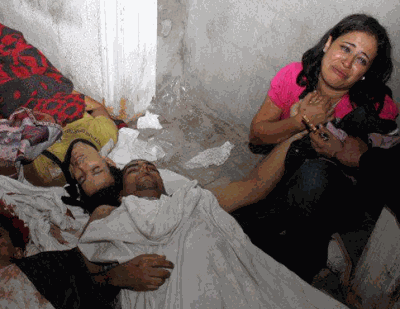
A picture of Vivian Magdy holding the hand of her fiancé, Michael Massad, one of the victims of the massacre, and next to him appear the bodies of other dead people. (Image source: Copts United website, October 10, 2011)
NoteWe framed the photo to hide some of the deformities in those killed as a result of being run over
What is new in “Awareness”’s documentation of the 2011 Maspero massacre?
In this new, detailed and comprehensive documentation carried out by the Waaa Foundation for Research and Development of the revolution of the people of Egypt, the Foundation presented this comprehensive documentary evidence of the Maspero massacre of October 2011. This work was distinguished from other previous publications about Maspero, firstly, by presenting a brief historical account of the relationship of the Copts with Muslims, and the relationship of the Church with the authority in Egypt, and where the Maspero complex lies in these intertwined relationships, and secondly, by creating comprehensive scientific documentation of the event that researchers and parties interested in the information and facts could be reassured about, in light of the abundance of interpretations, rumours, lies, and the obliteration of facts, or the buying of blame, coupled with the loss of justice, and the possibility of suspicion. And suspicion between groups of society or the exchange of accusations among them, through which the real criminal escapes punishment and the crime is repeated. Here we are not talking about an individual crime; Rather, it is a political crime that can be repeated by the ruling system whenever the necessity of its survival requires it. It is a narrative built on scientific and objective foundations in order to clarify the truth. It included historical and terminological introductions. It is a comprehensive scientific documentation of the event that does not suffice with narrating the incident according to one method, but rather narrates it through documents, the facts of the case’s circulation in court, through tracking video clips and archival photos, through the activities of funerals for the victims and examining the biographies of the martyrs, through lists of detainees and testimonies of witnesses, including the families of the martyrs, and news from Egyptian and regional newspapers. and international publications by human rights organizations and fact-finding committees, and even documented through artistic and literary works and annual memorial events. Which makes this work unique and comprehensive, and the reader and researcher can find in it what they want to track, verify, or explore, and they can easily differentiate between facts and rumors and solve the problems that the authoritarian authority tried to drag the people into. To forget, distort, or circumvent facts.
Work methodology
This documentary work was accomplished through a series of methodological procedures that included collecting the scientific material from its various sources, arranging it, classifying it, and tabulating it, and then starting to write it down in a final form and explaining it as follows:
- Making a very brief historical introduction to narrate the relationship of the Copts, the Church, and authority since the Islamic conquest, then focusing on the modern era up to the era of Muhammad Ali and the July 1952 coup, the periods of Sadat and Mubarak, then the revolution of January 25, 2011 AD, and the period of the military junta where the massacre occurred.
- Collecting previous efforts on the Maspero massacre and creating a brief description that shows information about the most important previous studies, their results, the parties responsible for them, and their perspective in narrating the event.
- Writing a brief narrative of the incident from the overall findings reached by the researchers, and the team decided to start with it. Because it is a summary that excites the reader and pushes him to continue verification, which is the task of the following sections and chapters.
- Documenting the martyrs, the injured, and the detainees, extracting statistical indicators regarding age, profession, job, and residence, and writing examples of the biographies of the martyrs.
- Conducting an analytical study of the type of injuries, wounds and fractures through a specialized medical team, and preparing an accurate report in accordance with international medical standards, which includes a comparative statistical analysis between the injury and the weapon used, the result of the injury and the recurrence factor.
- Collect a significant sample of media coverage accompanying the massacre, then classify, describe, summarize, and write it in a condensed summary while preserving and preserving the origins of these materials.
- Collecting local, regional, and international reactions, then describing, analyzing, arranging, and preserving.
- Documenting hundreds of photos and videos, creating an archive to preserve them in a scientific manner, clarifying their overall significance, classifying and numbering them according to the standards of storing and analyzing data in modern containers, placing them in the context of the incident, and making a summary of the photo and video archive. This summary will be a means of recalling that inventory for whoever wishes, through hyperlinks with the proposed project to build a complete encyclopedia about the massacre.
- Collecting artistic and literary works created by the public after the massacre and on its annual anniversary, and preparing a summary of them through which there are hyperlinks to recall them when needed.
- Preparing detailed indexes of sections, chapters, and chapter topics, and numbering pictures, illustrations, tables, lists, videos, models, and statistical percentages, arriving at the study indexes, including the names of people, places, knowledge, terms, and iconic or symbolic expressions, or otherwise.
- Writing the final results of the study and the necessary recommendations for producing and publishing the work.
Study contents:
The study is approximately 400 pages of average size, and comes in three chapters, with an average of three chapters for each chapter. The chapter includes several sections, and the study is equipped with pictures, statistical tables, illustrative figures, and detailed indexes. The study followed a specific approach in presenting, clarifying concepts and terminology, collecting, and documenting according to a scientific plan similar to what was done in the Wa’a Foundation’s documentation of2013 Republican Guard massacre. The first chapter dealt with two entries and a comprehensive account of the massacre, drawn from the results of this study. As for the first entry, it provided a general knowledge introduction to the reader about the Coptic issue in Egypt and its political use by the authorities in the various regimes and the accumulations of that over the decades. It began by presenting very brief, quick overviews of the first stages of this relationship after the Islamic conquest of Egypt, with an increase in the definition of that relationship as we approached the January 25 Revolution until the period of military council rule. As for the second entry, it is a special introduction that places the reader in the climate that preceded the massacre, starting where the efforts of others ended, and presents an example of a comprehensive documentation issued by the Foundation for Freedom of Thought and Expression entitled: “Maspero Massacre: Killing on the Basis of Identity,” reported by Sarah Ramadan and others, and edited by Tamer Mowafy. As for the narration, it is the summary of all the various chapters and documents. It tells the story extensively and motivates the reader to read the details and documents. It includes clarification of concepts and terminology, to enlighten the reader and help him read and explore. The authors have presented a chronological narration of arriving at Maspero under the title: The Road to Maspero. The second chapter, which is devoted to documentation, included lists of victims, including martyrs, injured, and detainees, and the first chapter was devoted to that. It presented 22 reference lists in which the names of the victims were presented in a descriptive way, the date of their appearance, and their sources. This was then followed by the process of merging the lists, sorting the repetitions, and investigating to reach the final number in a unified list of martyrs with accurate data about their names, titles, places of residence, etc. This is followed by a statistical analysis of age, occupation, and place of residence, then samples of the victims’ biographies, followed by a study of the injured, who numbered 339 according to the official census. The research team believed that the number was much higher, due to the fear of the injured that their names would be written in the demonstration register and that they would not be subjected to security prosecutions, as well as the detainees, who numbered 24 detainees. The authors added this by presenting the file of the case that was heard in the courts and its facts. As for the second chapter, it dealt with the medical report by analyzing the victims’ injuries. It explained the importance of having the medical report, its source, simplifying its reading, and the circumstances surrounding the partial reports on the victims. The report here is a comprehensive report on the massacre, then the analytical reading of the report’s results. The third chapter presents a reading of the video and photo archive of the event. The reading included studying and describing nearly five hundred images collected from more than fifty sources, and representing multiple categories of the event’s topics. A group of them includes 16 marches, vigils, and protests carried out by Copts before the massacre One picture, and another category for the events of the massacre and what happened in it, of demonstrators being run over with armored vehicles and being killed by gunfire in Al-Malyan, numbering 135 pictures, and another group of pictures that reviewed the reactions immediately after the massacre, the gatherings of people in front of the Coptic Hospital and in front of the St. Mark’s Cathedral in Abbasiya, the funeral of the victims, and the reactions of some public figures, numbering 47 pictures, and then the last category, which is the delayed reactions with the commemoration and the details that are revealed about the massacre. There are 278 photos, and this documentation is based on providing samples of these photos representing the different categories. As for all the photos of the massacre that the study collected, they were classified and preserved within the comprehensive encyclopedia of the event. In the same way, the video was documented, as the study collected dozens of videos according to a scientific classification that sets keywords and gives information about the duration of the video, its topic, its source, and its code in the archive of the Awareness Foundation about the massacre, so that it can be easily referred to and recalled. The fourth chapter presents the documentation of witness testimonies. The chapter deals with categories of witnesses, the quality of testimony, examining it and assessing its credibility within the framework of facts, and the distinction between testimonies and observations and within the framework of the security conditions to which the witnesses were subjected. It included: testimonies of some participants in the demonstration, testimonies of non-participants in the demonstrations, viewers of most of the events of the massacre event, viewers of specific cases, testimonies of some activists, testimonies of some soldiers and officers from the army and police forces, testimonies of some workers in satellite channels in the building. Maspero, testimonies of injured demonstrators or army and police forces, testimonies of victims’ families such as Vivian Magdy, the fiancée of Michael Massad, one of those killed in the events, or Wael Saber, the brother of Ayman Saber, who was also one of those killed in the events, or from friends and companions of the victims in the demonstration, in addition to some testimonies received in the investigations of the Maspero events case. Testimonies related to each stage of the events were collected, even if they were contradictory, because that gives a wider scope for perception. View more. The fifth chapter presents the documentation of the event through what he observed of the treatment of local, regional and international newspapers. He explained the trends of those newspapers and the relationships between them in the context of the events and in their classification and employment politically and socially. He derived from them some indications suggesting the existence of a link between their material and content at the level of local, regional or international newspapers. There were also differences, and he found that the context expressed by those newspapers in this massacre is very similar to the context of dealing with Republican Guard massacreBy demonizing the group of demonstrators – the Copts in the case of Maspero – and accusing them of being against the army, against the homeland, and against Islam. Samples of media coverage of the massacre were collected from government, party and private newspapers and some regional and international newspapers, and were archived and preserved within the framework of the comprehensive encyclopedia of the event with the possibility of making them available to researchers. The third chapter deals with the reactions and consists of three chapters: the first is the internal and external political reactions, the second is a presentation of the reports and statements of local and international human rights organizations, and the last chapter deals with the spontaneous literary and popular artistic works that expressed the event, whether immediately after it occurred or when it was commemorated over the years until the writing of this documentation.
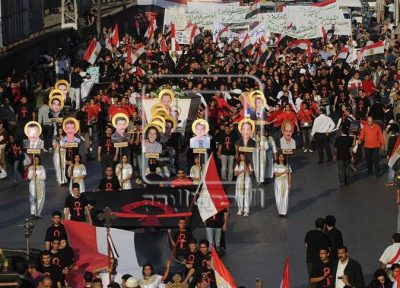 A funeral march to pay tribute to the victims of Maspero on November 11, 2011. (Image source: Al-Masry Al-Youm(November 11, 2011)
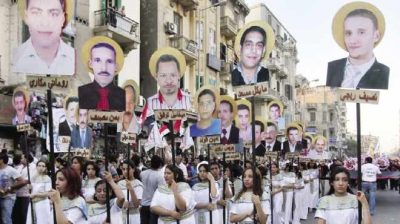 A march by Coptic women and girls to pay tribute to the victims of the massacre on its first anniversary. They wore white clothes and raised crosses bearing personal photos of the victims. (Image source: Rassd Website, October 9, 2014)
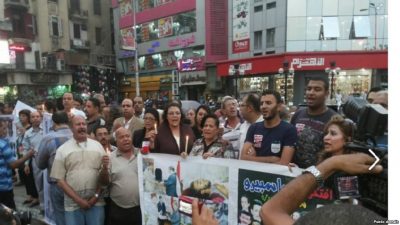 Dozens of Copts stood in the Shubra roundabout on the third anniversary of the Maspero massacre. The participants raised a banner reading, “Remember the martyrs of Maspero,” and another banner with pictures of Mina Daniel and pictures of President Morsi honoring Tantawi, the head of the military council at the time. (Image source: National website, October 10, 2014)
Biographies of the victims of the event are news material
This is also the methodology of the Waei Foundation in documenting important social incidents. This study chose various examples of victims to write their biographies, not because they were superior to the rest of the righteous, but because the circumstances of their killing expressed various cases that illustrate the enormity, cruelty, and barbarity of the crime. The study presented a model of Coptic youth between the ages of 20 and 37. What is surprising is that among them are young men who reached the age of thirty-seven (Mikhail Tawfiq Jundi) and thirty-nine (Ayman Saber Bishai) and were unable to get married! They are poor and employees, and some of the elderly who have reached the age of sixty have poor families and their children are weak, such as (Musaad Muhanna), and the example of (Michael Massad) whom they dragged, held his breath, and said the phrase of life, before George Floyd said it, “Let me breathe, I am dying,” and they did not leave him. The study also provided biographical examples of those who killed him by crushing and running over them with a tank, and those who threw him with live bullets, and those who denied him treatment and medicine and he continued to bleed to death, as they did with others, and there A model of the young revolutionary in Tahrir Square, Mina Daniel, who was with his Muslim friend composing songs and hugging each other for the sake of decent living and freedom during the days of the January 2011 revolution. He was in the Justice and Freedom Youth group that brought together Muslims and Christians in the squares of the Egyptian revolution. There is a biography model of the Christian young man (Subhi Gamal Nazim) who they killed, and he had archive photos of life, hope, and love with the army forces at the beginning of the revolution, influenced by what everyone thought that the military protected The revolution! Before the tyrants and corrupt people conspire against it and turn against it and turn every joy in it into a funeral and every happy person in it into a martyr. They are similar examples of Egyptians that you find in the martyrs of Maspero, the martyrs of sports clubs, the martyrs of Tahrir, Muhammad Mahmoud, and the martyrs. Republican Guard The platform, Rabaa, and Nahda represent Egypt from its cities, villages, and poor and destitute groups from all parts of it. These examples are revealing to all of society in the nature of its struggle with the corrupt, venal, tyrannical authority, which betrayed the revolution and turned against the popular will, and each massacre was an episode of the coup for which it was prepared from its first day.
And in conclusion
In conclusion; As the Waei Foundation continues its work in studying the facts and events of the Middle East region at the beginning of the third millennium within the axis of documentation and history, it is committed to its mission of addressing social phenomena and contemporary events according to a systematic study, and nevertheless places in its priorities human values, rights and freedoms, foremost of which are the right to life and the right to expression, which were wasted and even crushed during the barbaric aggression carried out by the military council authority against the Copts of Egypt, according to what was shown by the results of the study, which we hope will be made available to the public. Soon, God willing. Read the full text of Al-Maspero Massacre… “Maspero” Free now, and for a limited time
[1] Maspero is the name of the huge building on the bank of the Nile in Cairo, which is the headquarters of Egyptian Television, the oldest government television in the Middle East and Africa, after Iraq Television. Maspero is also the name of the street on which this building overlooks. This name was given to it after the French archaeologist Gaston Maspero, who served as head of the Egyptian Antiquities Authority. (Wikipedia)