
Detainees and missing persons in the Republican Guard… another massacre that does not want to stop
 Chapter Six of the Documentary Encyclopedia of the Republican Guard Massacre, issued by the Waei Foundation for Research and Development based in the British capital, London, begins, summarizing what the encyclopedia documented about the detainees of the massacre, their numbers, ages, occupations, and governorates, and how they were arrested and some of them were forcibly disappeared. It is the section to which we devote the following presentation: The tragedy of the detainees is one of the main components in any work documenting people’s revolutions and struggles – which includes the incident of the Republican Guard – and the importance of this description lies in the fact that the detainees are witnesses to the event like the injured, and because they bore the cost of the intensification of the political conflict between the revolution and the coup plotters. They received a large share of torture, oppression and fabrication, and the effects of the coup plotters on them were painful. The authorities viewed them with hostility, so they pursued them. By persecution, liquidation, and fabrication of cases, and their names were placed on the international terrorism and Interpol lists, which is what the judicial and legal authorities in different countries should be concerned with. The encyclopedia recorded the section on detainees, describing the scene of the event according to the accounts of the detainees, and briefly explaining the course of the event. It also described cases of torture and shock on the faces of the detainees due to mistreatment and humiliation by the army forces, especially with their belief in the propaganda that was being spread (the army protected the revolution!!), and their certainty that it refused to differentiate between citizens based on religion or political orientation, in addition to the mutual respect and high trust between the people and the army that was established in the Egyptians’ memory. The killing was horrific and cruel. Insult, torture, and insults are the first blow to all of these stable perceptions among the public and private. After the news spread, especially after a large number of detainees came out and gave their testimonies, these facts began to unfold among a large segment of those who rejected the July 3 statement at least, as well as the rest of the revolutionaries and the general public after that, through the succession of events and their discovery that the police, army, and judiciary had become tools of bloody generals with interests, influence, and networks of corruption and ramifications of tyranny inside and outside Egypt.
A. Summary of events
The events began in the courtyard of the famous Republican Guard Club building, known as the Guard House, surmounted by snipers hidden in the dark behind the walls, windows, and sandbags. It was surrounded by a wall and in front of the gate, large numbers of security forces and the army, armed with all types of weapons, to guard the building, prevent the protesters from storming it and prevent them from reaching the detained president inside – according to what the guard forces said – and the protesters’ insistence on remaining in the place as a peaceful means of protest and rejection of the path. The coup and demanding the president’s exit and his life to be spared is their first step in breaking the military coup and returning to the democratic path. The demonstrators confirmed during the sit-in that they were not intending to storm the building for many reasons, the most important of which was to prevent major acts of violence that would drag the sit-in and the revolution down a non-peaceful path, and the second was to preserve the safety of the president himself, the most important symbol of legitimacy, as well as the safety of his guards who are soldiers performing a routine service and have no involvement in the political dispute that must be resolved politically. There is also an obvious logistical factor; It is the presence of a fortified barrier (a solid fence of barbed wire surrounding the club, separating the protesters from the security forces), which the protesters did not cross, and that any approach that occurred from any of the demonstrators was either to place the Egyptian flag or a picture of President Morsi or to raise a protest statement, which was what was usual and customary in the revolution of January 25, 2011 with the army forces, and is not something new. The succession of events in the arena of the Guard Officers Club made it a focal point for the struggle of wills between the protesters and the coup plotters. While the demonstrators were performing the dawn prayer, the Egyptian army and police forces suddenly attacked the protesters. The massacre occurred, as stated in the narration, and as it was presented in detail, describing the martyrs and the injured. Some of the protesters tried to flee towards the Rabaa al-Adawiya sit-in, and the sit-in forces tried to besiege them, prevent them, use pincers on them, and cut off their field communication with the Rabaa sit-in. Some of them were able to arrive through the side streets, while some of them took shelter in trees, inside residential buildings, or in the surrounding government buildings, such as the Ministry of Planning and others. Those who were killed were killed, those who were injured were injured, and everyone who fell into the hands of the attacking forces was arrested.
The tragedy of the detainees:
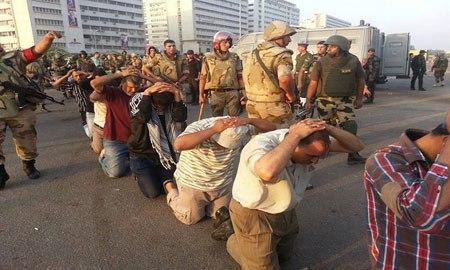
The forces took the detainees after sunrise to the Republican Guard Club building after seizing all their belongings, including money, mobile phones, and everything of value. Then they made them sit on their knees with their hands above their heads like prisoners of war and divided them into groups after long hours of thirst, hunger, and beatings. The deportation cars arrived around nine in the morning, and the cars were filled with detainees for several hours, with crowding inside the cars and the heat of the sun rising; Cases of severe fatigue have occurred. After the detainees’ pleas to some of the generals present at the place, knocking from inside the cars, shouts and chants; The doors of some cars were allowed to open, some people went to the bathrooms, and some sat on the floor, exhausted and tired. At one o’clock in the afternoon, the detainees, numbering 652, were transferred to a number of seventeen police stations in Cairo, described as follows:
| M | Police Department | Number of detainees |
| 1 | Al-Waili | 41 |
| 2 | Peace first* | 49 |
| 3 | Bab al-Shaariya | 20 |
| 4 | Bulaq | 49 |
| 5 | Rod El Farag | 24 |
| 6 | princely* | 51 |
| 7 | It seems | 20 |
| 8 | New Cairo, first department* | 40 |
| 9 | New Cairo Third* | 41 |
| 10 | Manshiyat Naser* | 40 |
| 11 | Al-Muski | 54 |
| 12 | El-Zeitoun* | 40 |
| 13 | Caliph | 59 |
| 14 | The Red Trail | 52 |
| 15 | The picnic | 40 |
| 16 | Shubra | 25 |
| 17 | Aesthetic | 2 |
| Total | 647 |
for. A general description of the detainees in police stations. The editors reviewed a document entitled “A List of the Names of Detainees in the Sections,” which consists of 15 pages stamped with the eagle stamp. It is considered part of the report of the charges against the detainees. It includes the names of the detainees in six sections out of a total of 17 sections to which the detainees were distributed, and explained them as follows: 1- Peace be upon you. The number of (49) detainees was counted, with their names and ages indicated. Their jobs and residential addresses. It was found from the inventory that all the detainees were male, and their ages ranged from 19 to 57 years, most of whom were young men and students, and that the majority of them had higher qualifications and good jobs, and were distributed across many governorates. 2- New Cairo, the third. The number of (41) detainees was counted, indicating their names, ages, jobs, and residential addresses. It was found from the inventory that all the detainees were male, and their ages ranged from 19 to 55 years, most of whom were young men and students, and that the majority of them had higher qualifications and good jobs, and were distributed across many governorates. 3- New Cairo: First, the number of (40) detainees was counted, indicating their names, ages, jobs, and residential addresses. It was found from the inventory that all the detainees were male, and their ages ranged between 19 and 50 years. This list contains dates of birth for some of the detainees. Most of them were young men and students, and the majority of them had advanced qualifications and good jobs, and were distributed across many governorates. 4- Al-Zaytoun: The number of (40) detainees was counted, indicating their names, ages, jobs, and residential addresses. It was found from the inventory that all the detainees were male, and their ages ranged between 17 and 59 years. Most of them were young men and students, and had high qualifications and good jobs, and were distributed across many governorates. 5- Al-Amiriya: The number of (50) detainees was counted, indicating their names, ages, jobs, and residential addresses. It was revealed from the inventory that all the detainees were male, and their ages ranged between 18 and 58 years. Most of them were young men and students, and the majority of them had higher qualifications and good jobs, and were distributed across many governorates. 6- Nasser facility. The number of (40) detainees was counted, indicating their names, ages, jobs, and residential addresses. It was revealed from the inventory that all the detainees were male, and their ages ranged between 17 and 54 years. Most of them were young men and students, and the majority of them had higher qualifications and good jobs, and were distributed across many governorates. C. Listing the police procedures in the arrest process when the detainees arrived at the police stations and – according to the testimonies available – they were taken out of the cars and beaten They then distributed insults to the cells that had been emptied of criminal prisoners and then crowded them with politicians, opponents, or those who happened to pass by on the way to the sit-in or at the time of the dispersal. In the evening, the detainees were called to be interrogated by the security services, and each individual was asked about his personal information and the reason for his presence in the sit-in. This interrogation was accompanied by some insults, sarcasm, and insults, and sometimes they were asked to let everyone accept the status quo and submit to it and that no sit-ins or demonstrations would be effective… after spending long hours of more than 12 hours or more for some groups without food or drink and great difficulties in entering the bathrooms; Some detainees were able, through the guards present in the department, to bring in some food within the limits of what they allowed. On the morning of Tuesday, July 9, 2013, the prosecution came to the police stations to investigate the detainees. They were charged with demonstrating, gathering, disturbing public peace, blocking roads, threatening the security of citizens, bullying, possessing weapons and explosives, murder, attempted murder, assaulting security personnel and the police, storming a military building, etc. It ordered the defendants to be detained for four days pending the case (Al-Fajr newspaper website, 2013) (see also the report of the charges against the detainees in the documents appendix). The prosecution also ordered the arrest and summons of ten other defendants, including the General Guide of the Muslim Brotherhood, Dr. Mohamed Badie, Safwat Hegazy, Mohamed El-Beltagy, Assem Abdel-Majed, and Tariq Al-Zumar… (Aswat Masriya website, 2013). On Thursday, July 11, 2013, the East Cairo Prosecution ordered the release of (446) defendants on bail (2000) Egyptian pounds for each detainee, and also ordered the imprisonment of (206) detainees pending the case… (Al-Fajr newspaper website, 2013). The detainees whom the prosecution ordered to be detained were transferred to Tora Prison, and as was usual before the revolution of January 25, 2011, what was known as a reception party was held for them!! On Sunday, July 14, from the platform of the protesters in Rabaa Square, the defense force for the detainees announced its withdrawal because they were not allowed to attend the investigation sessions with the accused and were unable to meet them… (Al-Masry, 2013). On Monday, July 15, 2013, the prosecution issued a decision to release (206) detainees in Tora Prison after paying bail (5,000) five thousand pounds for each detainee (Al-Fajr newspaper website, 2013), then transferring the released detainees from Tora Prison to the Cairo Security Directorate to complete the procedures for their release pending a case. The judicial procedures and the course of the case after that proved that they were moved according to the development of political events. Catherine Ashton (the European Union Commissioner) was coordinating with the countries The sponsors of the coup (the UAE and the Kingdom of Saudi Arabia) were preparing to negotiate on the basis of containing the revolution of January 25, 2011 and the recognition of the coup by President Morsi and the Muslim Brotherhood leaders, which did not happen, so the misdemeanors turned into felonies later, which is what happened with this case, as it was transferred in October 2014 to the military court (Anani, 2014). D. The difference between the arrests after the January 25, 2011 revolution and the arrests of the Republican Guard Club massacre. The arrests that coincided with that massacre differed from those that preceded it, in that they crossed all the taboos and red lines created by the January 25, 2011 revolution and settled for several years in stopping torture and enforced disappearance, completely preventing insults, and respecting human rights standards. It is true that there were incidents of killing and massacres by the army and police after the revolution during the period of the military council, but they were not followed by arrests, and they were not supported by the media, but rather massive popular masses came out denouncing them, and the authority at that time was either taking a step back or fulfilling one of the obligations of the 25 revolution and forming committees to investigate and deceive and pretend to search for the perpetrators and those whom they shot. Third partyIt was already arresting some of those involved (they were released, honored, and assumed high positions after the July 3 coup). There are many who were deceived, and few were aware that the authority of the Military Council was the one who was planning and facilitating these massacres to prolong the transitional period, in preparation for splitting the revolutionary ranks or cooling the revolution and then pounced at the appropriate moment. But after the election of the president, these massacres decreased in the first half year of his term, including the treacherous martyrdom of 15 soldiers in Sinai, which resulted in the dismissal of the Minister of Defense, the Chief of Staff, and the Commander of the Military Police, but the third party that is skilled at killing began to escalate the killing. Before the coup against the Brotherhood in their headquarters and against activists from the majority party, his blatant face was only revealed in this massacre and the massacres and measures that followed..
Second: The missing
The document recorded one case of enforced disappearance, which coincided with the massacre of the Republican Guard. On March 21, 2017, Al Jazeera Mubasher broadcast an episode about this case through a direct interview with the mother of the young man (Amr Ibrahim Metwally), who stated that he had come down from his house to help transport the wounded in the Dar Al-Haras Club massacre and provide relief, and had not returned since then. She stated that witnesses had informed her of his presence with the Guard detainees, but the police denied! Then some other witnesses told her that they had seen him in Wadi Natroun prison; When she visited Wadi El-Natroun, the informants told her that he had been transferred to the high-security Al-Azouli prison, so she filed reports with all concerned authorities without any responses or mentioning any information about her missing son, whose fate remains unknown until the printing of this document.
Introduction to the institution
The importance of scientific investigation and condensation of the narrative and documentation of this massacre lies in the large number of repercussions it had, whether in the number of martyrs, injured, and detainees, or in the reactions of the local and international community. Because it represented a clear political change in the course of the coup leaders’ dealing with the red lines of the January 25, 2011 revolution, transgressing all the taboos of the revolution, and daring to demolish its most important gains, which are the freedom of assembly, demonstration, and sit-in. “Awareness Foundation for Research and Development” is an independent scientific body that cares for all types of knowledge related to building individual and collective awareness. It is not limited to analyzing and anticipating the future in scientific, political, economic, and other issues, but rather makes history, documentation, monitoring, and blogging platforms a prominent axis of its launch. The driving motive for creating this ambitious project is an integrated, civilized institutional vision for humanity in the twenty-first century, a vision that seeks life in the best possible ways and raises the importance of the basic values and principles common to human beings. The Foundation is committed to publishing facts and monitoring events, and in doing so it respects specialization, addresses issues objectively, takes into account intellectual diversity and natural difference, and recognizes the value of the human being who has been honored by his Creator and appointed as successor on earth. In doing so, it seeks to meet the need of society in its various segments to spread culture, awareness and understanding among the general public and not among the elite alone.