
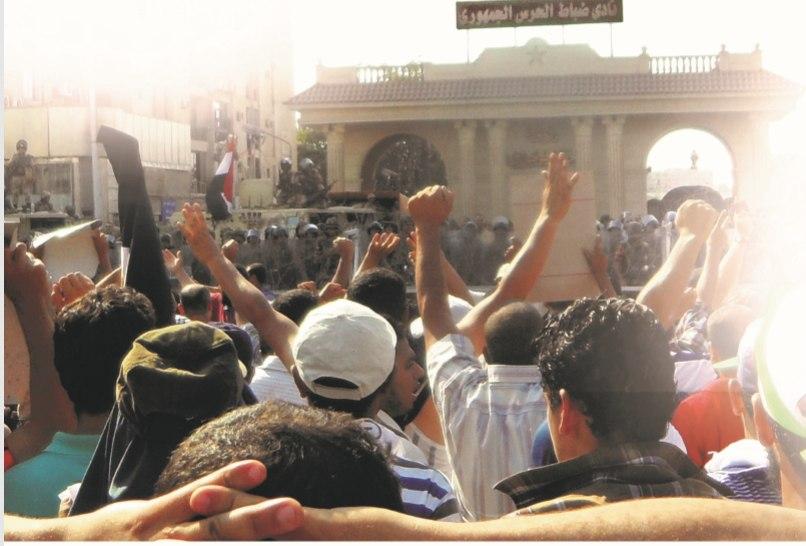
The wounded in the Republican Guard… bare chests facing the military killing machine
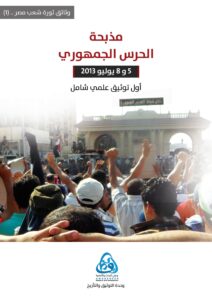
“The tragedy of those injured in the guards was truly horrific…” With this phrase begins the third chapter of the documentary encyclopedia of the Republican Guard massacre issued by the Waei Foundation for Research and Development, headquartered in the British capital, London, to summarize what the encyclopedia documented about those injured in the massacre. Their numbers, ages, occupations, governorates, and how this happened to them. This is the section to which we devote the following presentation: The tragedy of those injured in the guards was truly horrific. They were fired upon heavily, saw death with their own eyes, and saw it present in their friends and comrades. When they were injured, a group of them fell into the hands of the police and the army, who increased their physical injuries by beating and kicking without mercy, and increased their moral injuries by ill-treating, cursing, and ridiculing them, the elected president whom they came to defend, and the pacifism they adopted as an approach, and they repeated words that degraded their human value (Nabad Rabaa Channel, 2013). Which means that they do not have any rights. Some soldiers and officers memorized these offensive phrases and repeated them by heart. These are the typical phrases that the Egyptian media used to repeat day and night. These phrases appear with every attack and abuse that befalls those who fell at their brutal hands – as stated in the testimonies of the injured, which the editors recorded from their mouths. There is a section of the injured who went to the hospitals and were subjected to arrest, and some of them testified that the doctors were advising them to leave quickly for fear of leaving. Get them arrested! Even those who went to hospitals and private clinics found an environment of caution, apprehension, and fear around them! This is the general climate that the infected people experienced in all its details. In the section on the injured in the documentary encyclopedia of the massacre of the Republican Guard on July 5 and 8, 2013; The editors collected everything they could about the numbers of injured people, the type of injury, their distribution lists to hospitals, medical reports, a map of the hospitals that the injured went to, and the role of the ambulance service. It became clear to the editors that hospitals differed in explaining the type of injuries. There are stereotypical reports that mention a fixed formula for all cases of injury! There are reports that contain some discrepancies in describing injuries, and there are reports that were more professional. The encyclopedia has completed a unified list of the wounded and injured, arranged alphabetically, showing the following: information about the injury, age, place of residence, duration of treatment, lists of injured people in critical condition, those who died due to the injury, and other data. The editors objectively described the authority lists of the injured in terms of form and content, compared them according to the source and information contained in them, and extracted the meanings in them, as well as coding, classifying and developing them. An appropriate symbol for each medical document, whether issued by a public government hospital or a private hospital, and writing the most important notes and names repeated among hospital lists and names shared with lists of martyrs and with lists of arrests, editing that and extracting statistical significance in topics related to them from governorates, ages, and social segments. The editors provided the injured file with illustrative pictures and a content reading of the phrases that were said by the injured and matched them with what was stated in the description of the documents that relate to this important field of documentation.
Methodology for documenting injured people in the encyclopedia
The research team investigated and documented the cases of those injured in the two massacres (July 5 and 8), and then prepared a unified list that included 811 injured people. It is the largest and most comprehensive list among the lists of injured people available from various sources. This documentation was through the following procedural steps: First: Collecting all possible documents and data of those who were injured in the Republican Guard Club massacre on July 5 and 8, 2013 from various sources, which amounted to 62 authority lists. For the infected. Second: Coding the authority lists and arranging them chronologically according to the date of their publication. Third: Write a description of each document separately, explaining the date of its issuance, the source of issue, the type of data available, and the most important notes. Fourth: Matching and purifying the sixty-two (62) documents that were available to the research team, where duplicates were excluded, and at the same time the frequency and rate of repetition of a name in more than one document was taken into account. Fifth: Issuing the unified list of the injured, based on a summary of the documents and data that were consulted. None of the sixty-two supporting documents contain data like what this list, which collected various data from all the documents combined, contains.
Shocking results
The list documented 811 casualties from the first and second Dar Al-Haras club massacres, and included data on the national ID number of 16 injured, the occupation of 17 injured, testimonies from the injured about the circumstances of the injury for 18 injured, medical report documents for 21 injured, political affiliation for 12 injured, time of hospitalization for 8 injured, time of injury for one injured, and exact location of the injury for 92 injured, such as: (in front of a club The Republican Guard, in front of the Ministry of Defense gate on Tayaran Street, in front of the Sonesta Hotel, in front of the Qadir Factory, in front of the National Planning Institute, at the beginning of Tayaran Street, at Al-Mustafa Mosque, at the Tayaran Street Tunnel…), diagnosis for 756 injured people, marital status for 5 injured people, age for 447 injured people, address for 519 injured people, and contact information for 215 injured people. The research team concluded that the total number of injured in the first and second Dar Al-Haras Club massacres is no less than 1,064 injured, of whom 811 were injured and documented by the unified list, and 110 injured were mentioned in a numerical statement in the document (P.O.B.18) issued by the Ministry of Health and Population, without their data being available from the 14 hospitals affiliated with the Ministry, and 143 from the July 5th massacre, which sources indicated documented via Arab Organization for Human Rights in Britain.
Statistical significance
The various statistical significances can be read from the unified list of infected people as follows: A. According to the date of injury: The list included 7 injured on July 5, and 804 injured on July 8. It is noted in this statistic that the number of injured documented by the unified list in the July 5 massacre is very small compared to what was documented by other parties such as the Arab Organization for Human Rights in Britain, which documented 150 injured on this day. for. By gender: The list included 16 females and 795 males, a percentage that represents a significant difference between the number of infected people by gender. C. According to age levels: The infected people were classified according to the age-based list into 6 categories. It showed that the number of infected people whose ages are known is (447), with a percentage of (55%) of the total, and the number of unknown ages with unknown infections (364), with a percentage of (45%) of the total. Statistical significance is derived from the data of the number of known ages (447) – after excluding the unknown number (364) of the total number of people injured in the massacre (811) – meaning that the age group from 18-30 (young people) is the highest ever at 40.9%, followed by the age group from 31-40 (close to youth) at 31.5%, followed by the age group from 41-60. (middle age) by 22.6%, then the age group under 18 years (children) by 3.8%, and finally the age group over sixty (elderly) by 1.1%. D. By governorate: The infected were classified according to governorates, and it became clear that the infected were distributed among 23 of Egypt’s 27 governorates, accounting for 85.2%, and that the known number of infected people in their governorates was (519), equivalent to (64%) of the total infected people, and the number of unknown governorates in their governorates was (292), equivalent to (36%) of the total infected people. It also became clear that there is a statistically significant percentage, as it shows the size of participation and the large geographical representation in the distribution of the percentage of infected people throughout the Egyptian country. The distribution of data on the belonging of the injured to the Egyptian governorates represents a significant number in the known number (519 injured) after excluding the unknown number (292 injured) from the total number of injured in the massacre (811). The ranking of the governorates in terms of representation of the infected was as follows: Cairo came in first place with (100) infected people with a rate of 19.2%, Sharkia in second place with (87) infected people with a rate of 16.7%, Qalyubia came in third place with (56) infected people with a rate of 10.8%, then Beheira in fourth place with (31) infected people with a rate of 6%, then Beni Suef and Gharbia in fifth place with (29) infected people each with a percentage. 5.9%, then Dakahlia ranked sixth With (26) infected people, at a rate of 5%, then Giza ranked seventh with (22) infected people, with a rate of 4.2%. Then Menoufia and Alexandria ranked eighth with (21) infected people each, with a rate of 4%. Then Fayoum ranked ninth with (20) infected people, with a rate of 3.8%. Then Kafr El Sheikh ranked tenth with (18) infected people, with a rate of 3.5%. Then Minya ranked eleventh with (17) infected people. by 3.3%, then the governorates of Damietta, Aswan, Suez, Sohag, and Assiut, with an average of 1.5% each, and finally the governorates of Ismailia, Luxor, North Sinai, the Red Sea, and Port Said, with an average of less than 1% each. e. According to profession: The injured were classified according to professions, and it became clear that the final list of injured included only (17) injured persons whose profession was available, which is a very modest number, as it does not exceed 2% of the total number of injured on the list. This reflects the lack of interest in any of the reference lists in adequately recording this field of knowledge, which requires the completion of this information from its owners later, so that the informed person can learn more about the professional identity of the injured, which is an important field of knowledge in documenting the Egyptian revolution.
The importance of the incident
The importance of scientific investigation and condensation of the narrative and documentation of this massacre lies in the large number of repercussions it had, whether in the number of martyrs, injured, and detainees, or in the reactions of the local and international community. Because it represented a clear political change in the course of the coup leaders’ dealing with the red lines of the January 25, 2011 revolution, transgressing all the taboos of the revolution, and daring to demolish its most important gains, which are the freedom of assembly, demonstration, and sit-in.
Introduction to the institution
“Awareness Foundation for Research and Development” is an independent scientific body that cares for all types of knowledge related to building individual and collective awareness. It is not limited to analyzing and anticipating the future in scientific, political, economic, and other issues, but rather makes history, documentation, monitoring, and blogging platforms a prominent axis of its launch. The driving motive for creating this ambitious project is an integrated, civilized institutional vision for humanity in the twenty-first century, a vision that seeks life in the best possible ways and raises the importance of the basic values and principles common to human beings. The Foundation is committed to publishing facts and monitoring events, and in doing so it respects specialization, addresses issues objectively, takes into account intellectual diversity and natural difference, and recognizes the value of the human being who has been honored by his Creator and appointed as successor on earth. In doing so, it seeks to meet the need of society in its various segments to spread culture, awareness and understanding among the general public and not among the elite alone.