
Eyewitness to the Republican Guard massacre: moment by moment
At midnight on Friday, July 5, 2013, and two days after the coup statement on July 3, 2013, which was read by Lieutenant General Abdel Fattah al-Sisi, the Egyptian Minister of Defense at the time; Hundreds of supporters of former Egyptian President Mohamed Morsi and those who joined them in rejecting the coup against him, peacefully protesting in Rabaa Al-Adawiya Square in Nasr City, are moving to the Republican Guard Club, at the intersection of Salah Salem Street and Al-Tayaran Street, 1,500 meters away from the main sit-in center, after they received information that President Morsi is detained inside the club, to stage a sit-in in front of the building, demanding the president’s release. The army command quickly imposed a tight cordon of heavily armed soldiers guarding the building. The sit-in continued for only three days, until it was forcibly dispersed on its fourth day, specifically on Monday morning, July 8, 2013, leaving hundreds of victims, including dozens of women and children. This incident became known as the Republican Guard massacre. Shooting peaceful protesters and killing and wounding large numbers of them was a dangerous precedent that harmed the national history of the Egyptian military and stigmatized its honorable record, which was imprinted in the imagination of Egyptians for many decades. This bloody event also created a deep rift in the wall of national unity, and dashed many ambitious hopes for restoring harmony between the army and the people, not to mention achieving national reconciliation. In addition to the above, the violation of the sanctity of Egyptian blood by Egyptian hands has opened the door to the growth of a strange phenomenon of violence that is contrary to the peaceful nature of Egyptians. In view of the sensitivity of this incident, and the reasons mentioned above, the Waaa Foundation for Research and Development, based in the British capital, London, entrusted it with issuing a comprehensive and comprehensive documentation of this painful incident, in a scientific document entitled: “The Massacre of the Republican Guard, July 5 and 8, 2013: The First Comprehensive Scientific Documentation.”
The importance of the incident
The importance of scientific investigation and condensation of the narrative and documentation of this massacre lies in the large number of repercussions it had, whether in the number of martyrs, injured, and detainees, or in the reactions of the local and international community. Because it represented a clear political change in the course of the military coup leaders’ dealing with the red lines of the January 25, 2011 revolution, transgressing all the taboos of the revolution, and daring to demolish its most important gains, which are the freedom of assembly, demonstration, and sit-in. Although the army indirectly prevented the anti-coup marches by thugs directed by the security services before this incident, the losses were not this many and this serious. On the eighth of July, the military authority began to appear clearly bloody and blatantly challenge the gains of the revolution and overthrow it, after it had continued during the three years of the revolution preceding the coup to hide under what was known among the Egyptians as (the third party), and then began to hide behind the thugs in the preliminary stage. The coup, the “armed Black Bloc” groups, and some sham or cartoon parties that were run by the security services and pushed them into a violent confrontation with the Freedom and Justice Party, which won the majority in the post-revolution elections, in order to lure it into violence, create justification for the coup, and stop the democratic path. When this did not work, an advanced step was taken – in what was known as the security-style and regionally funded “rebellion” movement – in a process of major strategic deception managed by the forces of the coup plotters at home and abroad. Not only to the mosaic of power, the blocs of revolutionaries, and the nascent popular parties, but also to sectors of the people whose demands and expectations have risen, and the manipulation of their feelings has become widespread.
The first massacre: July 5, 2013
The place: The intersection of Salah Salem Street and Al-Tayaran Street, and 1,500 meters from the main sit-in center in Rabaa Al-Adawiya Square; Where is the Social Club for Republican Guard Officers.
Time: On July 5, 2013 AD – after performing Friday prayers in the city of Cairo and its suburbs (it was called “Friday of Rejection,” i.e., rejecting the statement of the military coup on July 3, 2013).
EventLarge crowds of supporters of President Mohamed Morsi – rejecting the statement of the Armed Forces on 7/3/2013 – headed to the courtyard of the Republican Guard House Club, after news spread to the protesters in Rabaa – the main sit-in center – that the president had been detained inside the club by army commanders. The demonstrators, including the sit-ins and their sympathizers, headed from various governorates of Egypt, demanding the immediate release of the president, the return of the democratic path, and the cessation of military measures. It represents an attack on the outcomes of the popular revolution that began on January 25, and enabled the Egyptian people, for the first time in history, to choose who will rule them through free, direct suffrage in fair elections and under full judicial supervision and comprehensive and equal popular oversight. On that day, there was no noticeable military presence in front of the Dar Al-Haras Club building other than traditional guards, and approaching the building often did not cause embarrassment or tension that was apparent to people. The documents testified that on July 3, immediately after the announcement of the military coup statement by the Minister of Defense, a celebration was held by supporters of the coup at the club’s gate, and the guard soldiers danced with the demonstrators inside the main gate itself. After the peaceful demonstrators coming from Rabaa al-Adawiya Square and other sit-in squares arrived at the place – where Salah Salem Street was separating the demonstrators on one side from the barbed wire and the club’s security forces on the other – one of the demonstrators placed a picture of President Mohamed Morsi on the barbed wire separating the street from the forces… An officer with the rank of major removed it in a humiliating and provocative manner, then tore it… So one of the demonstrators, “Mohamed Sobhi Mohamed Al-Haddad,” tried to place a picture Another one instead… Meanwhile, there was a dialogue between the demonstrators and the officers that this was an expression of our opinion, and it was an act of protest and not an attack. The intensity of the discussion increased, and the blacksmith came forward to place a picture of the president… The answer this time was a bullet in the face below the right eye, as a result of which the martyr Muhammad Subhi Al-Haddad fell, a lifeless body, lying in his blood across the road and in the large space between the protesters and the security and military forces, which was documented by the French channel DFI with audio and video in French as well as (Network Rasd, 2013, a) in Arabic. There was a commotion in the ranks of the demonstrators and shouts of “Allahu Akbar” and some of them tried to advance to carry the bleeding wounded man. The forces only fired a barrage of live bullets at anyone approaching the injured person, and strong volleys of gas bombs and birdshot to disperse the angry demonstrators… The result was the fall of four other martyrs and dozens of direct casualties (it was counted). According to the Arab Organization for Human Rights in Britain, 150 of them were injured by gunfire and birdshot, causing suffocation among hundreds of other demonstrators and all those who happened to pass by on Salah Salem Street, and the roads and buildings adjacent to and surrounding the scene of events. During these events, Dr. Muhammad Wahdan (a member of the Muslim Brotherhood’s Guidance Office) quickly advanced to the ranks of the demonstrators and broadcast a speech through the mobile car’s microphone to calm the situation and emphasize peace. Then a group of the leaders of the Rabaa al-Adawiya sit-in arrived – as some witnesses mentioned – such as Dr. (Mohamed Al-Beltagy), Sheikh (Salama Abdel-Qawi) and others… and the situation was brought under control between the two parties, and they were actually able to calm the situation and direct the enthusiasm of the demonstrators into speeches and chants, and they took the oath and pledge from the demonstrators to be peaceful, and not to bear any hatred or violence “towards our brothers in the Republican Guard,” and to turn the protest demonstration into a protest. To a sit-in. This was followed by some dialogue with the forces present at the scene to confirm the peaceful position of the demonstrators, and that there was no intention to storm the building, and in return, a conciliatory tone came from the force leadership to reduce tension. After the demonstrators counted the martyrs (five martyrs) and the wounded (150 injured), darkness fell over the city of Cairo on July 5, and the first massacre in this context was revealed, with dozens of casualties and the loss of five innocent young lives. Four of them died on the fifth of July, and the fifth died of his wounds on the seventh of July… The five nobles left the narrow demonstration square to a paradise as wide as the heavens and the earth.
Media Neglect
This event on the fifth of July did not receive much attention from the press and media, as it coincided with the fall of a larger number of victims in the headquarters of the Freedom and Justice Party, as well as in the service institutions of the Muslim Brotherhood throughout the Republic (schools, hospitals, solidarity and welfare associations, political and party headquarters…) These institutions were attacked in a coordinated manner by groups of thugs, accompanied by chants of the Salvation Front and the Tamarod Movement (which was created and financed by the military coup cell with Egyptian coordination. and regional), and instead of covering the event; The Egyptian and Arab newspapers and all media outlets that supported the coup or were deceived by its propaganda began to pave the way for something greater. They began to demonize the protesters, and they contented themselves with the event by focusing on some of its marginal results, such as the oath of (Al-Beltagy) and the protesters to continue the peaceful sit-in after the occurrence of this first massacre. They distorted it and described it as incitement, reported false news, and left out the essence of the event. This is the fall of this number of innocent people between martyr and wounded.
A sit-in in front of the club
The decision to stage a sit-in in front of Dar Al-Haras Club – as some of the protesters said in their testimonies – was a peaceful response to the killing of five young people and the wounding of dozens of them in a peaceful protest demonstration. The leadership of a fourth sit-in in these circumstances – according to their account – had no choice but to challenge and continue the peaceful sit-in to stop the dominance of the coup authority over the masses and its attempt to suppress the outcomes of the January 25, 2011 revolution, and its most important outcomes; Including the right to peaceful demonstration and sit-in, so that forcefully dispersing and suppressing demonstrations does not become an easy process for the authorities! The field command stated that among the goals of the sit-in in front of the Guard House was to protect the large sit-in in Rabaa al-Adawiya, in which El-Beltagy and others were warning against repeating the new Battle of the Camel, thinking that the security services might call them thugs and criminals without direct intervention from them, as happened in the famous Battle of the Camel! So they prepared for it and benefited from the experience of Tahrir Square in the January Revolution. None of the revolutionaries and supporters of legitimacy had thought that dispersing the sit-in might be carried out by the army and police themselves and not by a third party. So the consideration was directed towards the acts of bullying, although there was apprehension – according to witness statements – from the police and the army after their silence over the scenes of burning and killing in headquarters, funerals and demonstrations in support of the democratic path and the legitimacy of the electoral fund that produced the first civilian president. Elected.
The second massacre: July 8, 2013
The days of July 6 and 7 passed with relative calm, interspersed with chants and peaceful protest activities, with an increase in anger, not only against the coup; Rather, a new element of the effects of the coup was added to it, which is (the massacre of the fifth of July)… The status quo of the sit-in continued… There is material for discussion among the demonstrators among themselves, as well as between themselves and the soldiers via loudspeakers, reminding them of the sanctity of the blood of the protesters, and that the soldiers were not targeted, and that those who ordered the killing on the fifth of July were nothing but a coup group that wanted to return to what was before the revolution of January 25, 2011… The popular and media discussion about the massacre increased, and rumors abounded, and it appeared through Media propaganda in Egypt and the countries sponsoring the coup seemed as if the massacre on July 5 was a preliminary experience for the grave events that would happen after that. On the side of the protesters, the discussion and debate was about the event and how it happened. Searching to avoid any justification for bloodshed, there has been stricter monitoring and follow-up to determine whether there is an intention by the coup plotters to disperse the sit-in by force! As the cautious movement of soldiers and employees continues to flow in and out and change shifts to their workplaces, which have not been touched since the beginning of the sit-in! The protesters did not leave in front of the club as news continued to circulate that Dr. Mohamed Morsi, the first elected president after the revolution – who was detained by the Minister of Defense – is still in the same place. The numbers increased as the place became crowded, and some of the protesters resorted to using some of the surrounding facilities, such as Al-Mustafa Mosque and Al-Sayyeda Safia Mosque, for some logistical needs. Before the attack, approximately 2,000 people were protesting in front of the Guard Club, in addition to approximately 1,500, who had spent the night at night, distributed among Al-Mustafa Mosque (located to the west of the sit-in) and Sayyida Safiya Mosque (located to the east of the sit-in). Note that estimates of crowds at peak times – from afternoon until eleven in the evening – according to eyewitness estimates – reach one hundred thousand; The crowds connect with each other along a continuous stretch from the sit-in center in Rabaa to the sit-in square in front of the Guard Club.
Turbulent atmosphere
In the same place where the first massacre occurred, at the intersection of Salah Salem Street and Al-Tayaran Street, 1,500 meters away from the main sit-in center in Rabaa Al-Adawiya Square, and at three in the morning on Monday, July 8, 2013, the second massacre occurred. On that promised day, and that last night, and in that decisive hour in the course of the Egyptian revolution, several thousand protesters stood waiting for the dawn of a new day, and after they had drunk the cup of death by losing five of the best young men on the fifth of July, and seeing horrific injuries for the wounded, and at that time they also inhaled the thick smoke from the bombs of the army and police forces, and under the blazing heat and extreme thirst, and chasing anxious calls from their families and loved ones, among the crying, the feasting counselor, and the inquirer… The guard club was surrounded… With large army and armored forces on the ground, and equipped with many snipers who were occupying the guard building and nearby military and civil buildings, as recorded by witnesses. They were surrounded by heavily armed forces charged with hatred for the demonstrators, according to the fatwas issued by (Ali Jumah), the former mufti who supported the coup. He allowed the soldiers to kill the demonstrators without mercy, and described them as “brothers” and “Kharijites” and incited them., His fatwa permitting the killing of peaceful demonstrators was leaked, and he later acknowledged it and insisted on it. Leaks of other muftis were also broadcast. Some of them remained silent about it, while others denied it.
In the second rak’ah
It was a night of faith par excellence, between prayers, crying, hope, and supplication that no harm would happen to Egypt, or that the protesters would be harmed. The crowd of protesters was from all sects of people. The Cairo night was black except for some of the few columns that remained steadfast as the protesters stood, and most of those who rejected the coup went to their homes, some of them to Rab’a, and a small number of them remained in the tents to continue the protest to meet their demands, and some of them to the two mosques referred to… While the forces were gathering, the demonstrators were in their tents, somewhere between resting and exhausted from the activities of a long, hot day, or between kneeling and prostrating and praying, until the prayer came and the muezzin gave the call to prayer, Life came alive and the tents and faces were illuminated for prayer. The tents increased after the martyrdom of five young men on the fifth of July, as the protesters and protesters thought that the large number was a bulwark preventing the bloodthirsty group from the corruption of Mubarak’s state from committing what they did not want to imagine, due to their belief in the army that protected the revolution, as the media repeated this over and over again, and as most of the protesters tried to convince themselves of this without any evidence on the ground. Suddenly, in the second rak’ah of prayer, army and police forces attacked the sit-in protesters, and beat the sit-in parties who were late or advanced, or those preparing to pray, or members of the sit-in guard who were guarding it against thugs or intruders. A great commotion occurred, accompanied by knocking on electricity poles from the sit-in security personnel to stop the advance of the forces on the sit-in protesters, but the sounds of bullets, bomb showers, and the smell of smoke began to approach the prayer gathering. It affects those who kneel, some of whom are suffocated by treachery, suffocated by smoke, or covered in blood, with the remnants of remembrance and prayer on their tongue… So the imam began to interrupt the supplication, and hasten to end the prayer in order to say salaam to his right, but he finds nothing but treachery in the prayer. People dispersed from the horrors of what they saw, each in his own direction, not knowing what God would do to him… Those who could withstand the gas and the fear of shock and the sound of bullets had removed from their hearts returned to transfer the martyrs and wounded who they could to the field hospital, and they began to defend themselves with some stones or shouts of “Allah is great”… until the protesters gathered in small groups, retreating and advancing, taking shelter from death and terror coming from everywhere. Those of them who sided with one of the buildings were followed by forces. Then he found himself in the hands of brutal, brutal soldiers, killing the one who shouted and the stunned silent one who did not turn around for anything, kicking the wounded with their feet and tying them up as if they were in a war devoid of all rules of morality and engagement… And the shock occurred, even if the intimidation that the coup plotters had planned to confront the people using the army did not occur, and it became clear that they were committing these massacres repeatedly to achieve the same goal, but the people were quickly waking up and did not care at times and were understanding. Shock, and he has demands in mind: completing the democratic path and removing the military council that Mubarak put in power and took over later…
Detail the course of the event
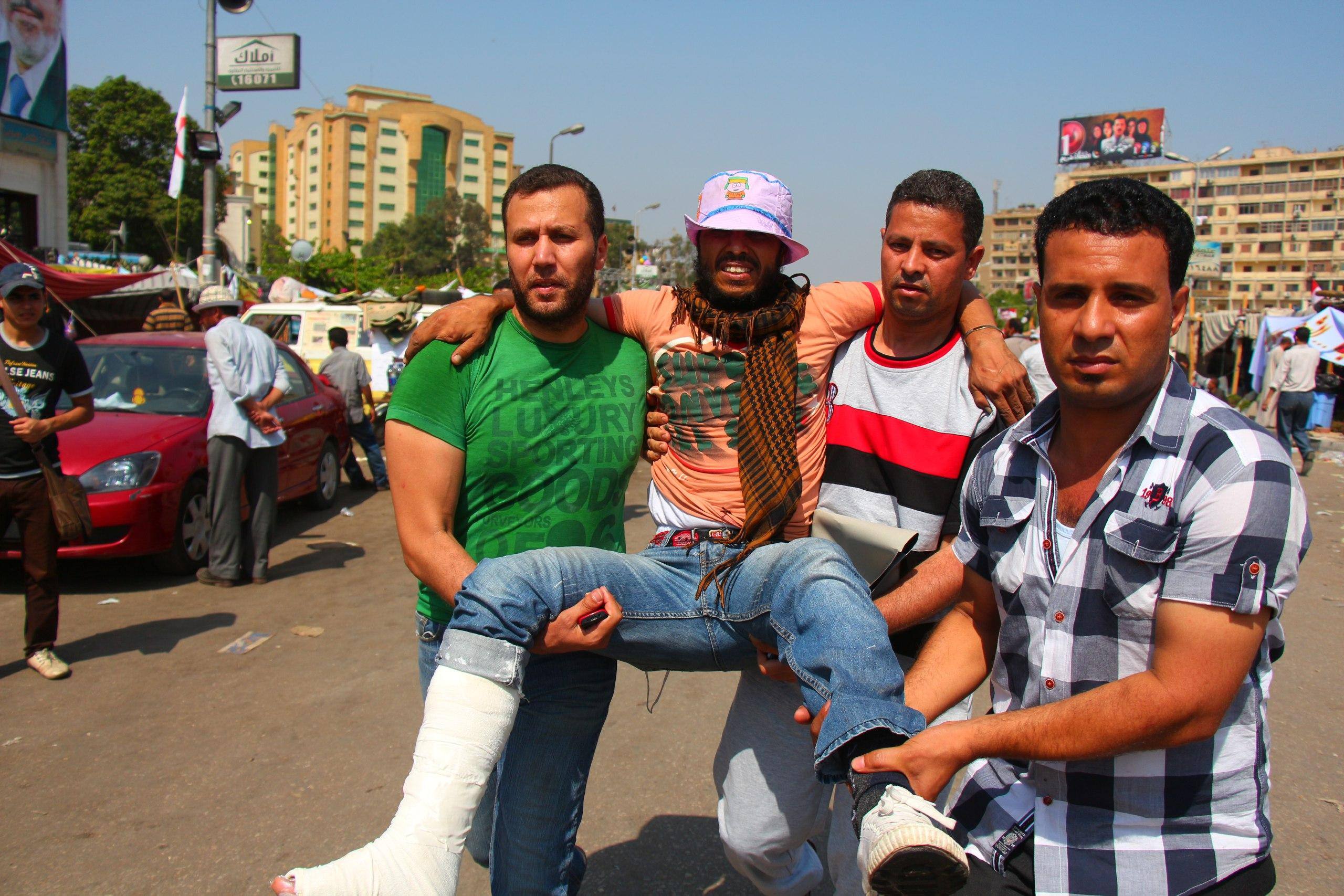
They stopped to pray and pray for Qunoot, and the dawn call to prayer sounded, and the soldiers began to move slowly towards the sit-in, as stated in eyewitness accounts of some drivers and individuals from outside the sit-ins warning the sit-in security committees, that there are movements and you may be betrayed. Due to the lack of time, it seems that this news has not been verified due to the large number of rumours. While the demonstrators were performing the dawn prayer and in the second rak’ah, the police and army forces, heavily armed, armored vehicles, and armored vehicles, attacked. Peaceful protesters from both sides used pincers to disperse the sit-in by force suddenly. Some of the protesters’ guard personnel on the outskirts of the sit-in made noise and knocked on electricity poles and iron traffic lights, to alert the protesters that there was an upcoming danger, an act that the revolutionaries had become accustomed to from the experiences of the January Revolution. The imam noticed the noise of the voices, so he reduced the supplication of Qunoot, prostration, and tashahhud, and hastened the prayer. Where he felt the worshipers leaving their prayers. The security forces surprised the worshipers by throwing tear gas bombs, incendiary bombs, and live bullets at them, causing fear and panic among the protesters, causing fires in the tents, causing complete chaos and causing dozens of martyrs and injuries among them. The attack on the sit-in headquarters – in the square opposite the Guards Club – coincided with the storming of the outer courtyard of the Mustafa Mosque to the west, and they penetrated the worshipers who were in the final tashahhud at the time, killing, injuring, and arresting them, while those who remained of them fled inside the mosque, where they succeeded in closing the doors, and people saw with their own eyes how anyone who tried to leave the mosque was being sniped or arrested, so the people piled inside the mosque, and they were overcome by calling out the takbir with their help. Children and women in the ladies’ prayer room. Combat groups of the attacking forces advanced with catapults towards the sit-in protesters from both sides of the sit-in, and then the attack began through the guard forces in the middle of the sit-in. They fired live bullets at the sit-in and aimed at them, killing them in the head and chest, as was evident from witness testimonies, and confirmed by the killing incidents, medical reports, and photos of critical cases in surgery – within the framework of a planned military operation for the purpose of dispersing the sit-in and inflicting the greatest amount of loss of life and serious injuries to create intimidation. And the shock. The protesters fled to nearby places. Such as residential buildings and some government buildings, including: the Ministry of Planning building, to protect themselves from bullets. A group of them headed towards Al-Tayaran Street towards the main sit-in in Rabaa Al-Adawiya, pursued by security forces. A state of pandemonium… The survivors of the sit-ins tried to carry the dead The wounded or trying to escape or call for help and ambulance from the protesters in Rabaa Al-Adawiya Square via Al-Tayaran Street and Abbas Helmy Street, especially since the forces did not allow ambulances belonging to the Ministry of Health to enter to treat the wounded trapped in Al-Mustafa Mosque or in the sit-in square. Some protesters tried to make a barricade out of wood and sidewalk tiles; To impede the advance of the attacking forces, or to provide a simple form of protection amidst the shouts, shouts of takbir, calls for help, and the occurrence of suffocation and chaos in the crowds due to the density of tear bombs, birdshot volleys, and live bullets. Through monitoring the events, witness testimonies, and video recordings, we can see that the second massacre took place in two stages: the stage of dispersing the sit-in, and the stage of brutally combing the sit-in area by killing some of the wounded and arresting those who could be arrested, because there were cases being prepared for all those opposing the coup in general, and for those affiliated with the Freedom and Justice Party and the Alliance for Supporting Legitimacy in particular.
Al-Mustafa Mosque
Some of the protesters who were besieged in the Al-Mustafa Mosque complex shouted for help to nearby residents through loudspeakers, and others tried to escape to the surrounding buildings. A group of forces headed and surrounded the protesters inside the mosque, and arrested some of them from the outer courtyard of the mosque. They were also able to surround small groups who were not familiar with the area, most of them from outside the Cairo and Giza governorates or non-residents of the area – who entered some government buildings such as the Air Forces Club. And the Military Factories Club Mosque, the Ministry of Planning, and the residential buildings they entered to take shelter from the flames of bombs, birdshot, and bullets – and demanded that they surrender and not resist, while using expressions of severe abuse, sarcasm, cursing, and cursing, and treating them like prisoners of war, by sleeping on their stomachs, placing their hands behind their backs, and severely beating them. The worshipers in the Sayyida Safiya Mosque did not pay attention well, as most of them were detained, unlike the Mustafa Mosque, where the protesters inside resisted the arrest process, until they were able to leave the mosque and head to the main sit-in headquarters in Rabaa al-Adawiya after the afternoon prayer on July 8, with the help of some residents who trusted them from the people of the area. The forces had gradually moved away from the mosque after the increase in the movement of people in the street with the start of working hours, and some witnesses attributed the reason for the attack. The two mosques represent the closest points to the protesters in front of the Dar Al-Haras Club, where the protesters used to visit the two mosques to take advantage of the services and facilities.
Arrests
The detainees were taken after sunrise to the Republican Guard Club building, after all their belongings were confiscated, including money, mobile phones, and everything of value. They then made them sit on their knees with their hands placed above their heads, and deportation cars piled up with them later. Witnesses reported that they remained in this state from the time of arrest, from the beginning of the attack on the sit-in until eleven o’clock in the morning, until they suffocated and found it difficult to breathe, so they knocked on the walls of the car (the car’s capacity is 20 people, but they They put 50 people in it), and according to some witnesses, the detainees remained until sunset without first aid or being provided with food or drink, with continued insults, cursing, cursing, and cursing, until the investigation with them was completed and they were then divided into groups and deported to the various police stations in Cairo.
The last scene
The events moved to Tayaran Street after the dispersal of the sit-in in front of the Guards Club and the escape of the survivors of the sit-ins towards the Rab’a sit-in, and they were surrounded by those who came from the Raba’a sit-ins to provide them with water and medicine, under the fire of snipers that were waiting for them on top of the army buildings on Tayaran Street, and the military and police armored vehicles and vehicles chasing them from behind. In the face of this attack – which extended to the middle of Al-Tayaran Street, approaching the main sit-in center in Rabaa Al-Adawiya – the protesters feared that there was a premeditated intention to break up the Rabaa sit-in, so they tried to repel it with everything they could, and they began building barricades, and climbed onto some buildings, where they threw solid objects and some fireworks at the attacking forces. This place witnessed many sniping operations against demonstrators, as a result of which most of the martyrs and wounded fell. Among those killed there was the journalist (Ahmed Samir Abbas Asim Al-Senussi), whose killer was the last thing his lens captured. This scene of intense killing and sniping continued, until the bullets hit everything in the place, including people, plants, and inanimate objects. Whoever took shelter in a tree, they opened fire on it from everywhere, as well as whoever took shelter in a lamppost, an ambulance, or anything else. He hid in a wall, a building entrance, or something else, until the place was filled with the smell of death, bullets, holes in trees and walls, and fires in cars and buildings.
A new path of violations
These massacres have occurred before at the spherical altar[1] Al-Kani and Muhammad Mahmoud[2] And Maspero[3] And others, but this massacre (Guard Club) was the beginning of a new phase in which the coup plotters openly confronted the revolution. The authority did not acknowledge in this massacre that a mistake had occurred on its part or on the part of some of its security agencies, unlike previous massacres! Likewise, the media did not follow up on the issue as it had done before! And the parties remained silent!… And the arrest happened to the victims!… This is what is new, two days after the July 3 coup in the first massacre, and three days after the second massacre.
Introduction to the institution
“Awareness Foundation for Research and Development” is an independent scientific body that cares for all types of knowledge related to building individual and collective awareness. It is not limited to analyzing and anticipating the future in scientific, political, economic, and other issues, but rather makes history, documentation, monitoring, and blogging platforms a prominent axis of its launch. The driving motive for creating this ambitious project is an integrated, civilized institutional vision for humanity in the twenty-first century, a vision that seeks life in the best possible ways and raises the importance of the basic values and principles common to human beings. The Foundation is committed to publishing facts and monitoring events, and in doing so it respects specialization, addresses issues objectively, takes into account intellectual diversity and natural difference, and recognizes the value of the human being who has been honored by his Creator and appointed as successor on earth. In doing so, it seeks to meet the need of society in its various segments to spread culture, awareness and understanding among the general public and not among the elite alone.
[1] A horrific massacre of Al-Ahly club fans took place in Port Said Stadium on the evening of Wednesday, February 1, 2012 (the first anniversary of the Battle of the Camel) during the era of the military junta headed by Field Marshal Tantawi, following a football match between the Al-Masry and Al-Ahly clubs, in which 72 martyrs were killed and hundreds of injured, according to what was announced by the Directorate of Health Affairs in Port Said. It is the largest disaster in the history of Egyptian sports.
[2] A famous massacre took place on Mohamed Mahmoud Street, close to Tahrir Square in Cairo. The events began on November 9, 2011 (the era of the military junta headed by Field Marshal Tantawi) with a peaceful protest against the dispersal of the tent for the wounded of the revolution in Tahrir Square, using excessive force on the part of the security and military services. Then it developed into a back-and-forth between the peaceful demonstrators and the forces, and resulted in the fall of dozens of martyrs among the demonstrators, hundreds of wounded and disabled people, and hundreds of detainees. It was estimated that Human rights bodies: The number of victims ranges from 70 to 100 martyrs
[3] This massacre took place at the radio and television building known as “Maspero” as part of the activities of the Coptic Day of Rage, which coincided with fabricated sectarian events in the village of Al-Marinab in Aswan Governorate, and the issuance of statements from the governor that were considered offensive against Copts. A demonstration took place from the Shubra area, heading towards “Maspero”, in which Christians and quite a few Muslims in solidarity with them participated, where the massacre took place, resulting in the martyrdom of between 24 and 35. Most of them are Copts