
From suffocation to saturation…the narrative of corruption in the study “Egypt between Two Paths”
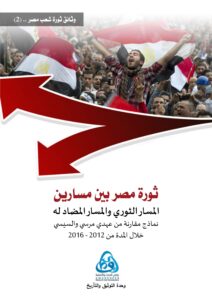
Before July 3, 2013, Egypt was no longer the same Egypt that was formed after it. Since the army generals overthrew the elected president, Mohamed Morsi, corruption has spread in the corridors of Egyptian life in an unprecedented manner, starting with the corruption of the head of the new authority coming through a military coup, and reaching the lowest levels of the state in its governmental and popular structure, after corruption was in “Morsi’s Egypt.” It is experiencing what can be described as a stifling siege that has affected all levels. As part of its endeavor to build a follow-up comparison of the process of conflict between the two paths: the revolutionary path and the path opposing it through the eras of Morsi and Sisi, which represent practical manifestations of the outcomes of each path; The study of the “Wa’a” Foundation for Research and Development – entitled (Egypt’s Revolution between Two Tracks… The Revolutionary Track and the Counter-Track: Comparative Models from the Morsi and Sisi Reigns during the Period from 2012 – 2016) – paid attention to the axis of corruption between the two tracks. The narrative of corruption has represented the focus of practical friction between the revolution and the forces hostile to it. This is the narrative that Egypt has been experiencing for decades. We are not in the field of delving into its details, talking about its symbols, the factors for its continuation, its destructive effects on the nation and citizens, and ways to confront it, as researchers seek to explain and clarify. Rather, we take a comparative overview of it in the literature of the 25 Revolution, and in the forces hostile to it, as mentioned in the approaches of the two tracks. Regarding social injustice and the loss of confidence in the government, and its position on the spread of corruption, the study – based on the results of the study conducted by the Ministry of Administrative Development in 2009 on a large sample of the Egyptian people – reached a set of results that explained in numbers the presence of a high sense of injustice within Egyptian society. The deterioration of the social and economic aspects and the government’s position on corruption, moral values and religion, loss of transparency in society, the decline in the value of participation, the priority of personal interest over the public interest, fear of collective action, fear of confronting corruption, and stagnation. Fear within the souls of Egyptians in general is one of the prominent features of Mubarak’s state at this time. Regarding the value of trust in society, the sample expressed its opinion about the decline in the value of trust in society during the years 2005/2009 AD, and that the reasons for this are: concern for personal interest, the spread of hypocrisy, loss of conscience, and loss of religious motivation, and by asking them: Which groups are more deserving of doubt? 48% said they doubted government officials, while 33% said they doubted political parties.
The siege of corruption during Morsi’s era
During the year of President Mohamed Morsi’s rule, the anti-revolutionary forces worked to undermine society’s confidence in the president, in the Freedom and Justice Party, as well as in the government of Hisham Qandil, which was dominated by technocrats, considering all of this as an outcome of the January 25 revolution in the democratic curve. They based their misleading rhetoric on the natural negative attitude stored in the memory of the Egyptians towards the government and authority, whatever it may be, as stated in the Administrative Development Report referred to a moment ago, and the Prime Minister was not Party-wise and not affiliated with the Muslim Brotherhood, the majority party only had a small number of ministers, most notably the Minister of Supply, the Minister of Youth, and the Minister of Local Government. They were known for their competence and integrity, and they were even offered to continue in the government after the July 3 coup. President Mohamed Morsi – one of the outcomes of the January 25 Revolution – appointed Counselor Hisham Genena as head of the Central Auditing Organization (the largest oversight body over all Egyptian state institutions). He is considered one of the highly qualified people who showed great activity and clear seriousness in exposing corruption at the time, and the agency showed courage and boldness in opening the files of the ruling authority. After President Mohamed Morsi called on the head of the agency and his cadres to begin their oversight work within the presidential institution, and lifted all restrictions and red lines on the agency’s employees, who were chosen by Counselor Genena based on criteria, their tasks were defined freely and professionally, and they began their work, and the wheel of real oversight work began. Other committees moved in parallel to carry out their work in accordance with the constitution in the institutions of the judiciary, the interior, the National Security Service, General Intelligence, and others. The elite and the masses considered the appointment of Counselor Hisham Genena, who had a leftist orientation contrary to the orientation of President Morsi’s party, to be one of the most important gains of the 25 revolution, as the agencies remained silent at that time, and their objection and stored anger did not appear until after the overthrow of the elected civilian president. The harassment and complications began facing the head of the apparatus and all his assistants little by little, until the anti-revolution forces – which after July 3, 2013 turned into a full-fledged coup force – opened their mouthpieces against Counselor Genena personally in preparation for his removal (these are the same steps that were taken with all the outcomes of the revolutionary path before, such as the People’s Assembly, the Constitution, and President Morsi).
Corruption… the slogan of the coup
The governments after the July 3 coup also enjoyed – and an increase – a greater share of inherited distrust, especially in the years 2015 and 2016, when the people did not find any documents to sell the canal, Sinai, or other claims. Rather, it was found that some of these allegations that they made against the authority of the elected president became practical procedures and steps by the military coup authority. The people’s confidence in the coup’s authority was greatly shaken over the “Tiran and Sanafir” issue, which took the people by surprise. There were no border demarcation committees that were heard of, no agreements were published, no real role for Parliament, and no popular referendum befitting these serious issues. The announcement of its waiver was accompanied by a large aid package and investment projects from the Kingdom of Saudi Arabia during the visit of King Salman, who continued sponsoring the coup after the death of his brother, King Abdullah, and quickly The issue of Tiran and Sanafir itself became a factor in weakening confidence in the government, not only internally, but also with the Kingdom of Saudi Arabia itself, because of the way in which the government tried to evade and benefit from financial support, and to back away through various means from the promise of the two islands, not for fear of the anger of the people, but rather out of greed for more financial support from the Kingdom. Indeed, the expansion of the ban on publishing government corruption and some cases of assassinations of influential figures in the July 3rd regime in the police, army and judiciary represented a weakening of confidence within the July 3rd Alliance itself, and the predominant character of its components became one of ambush and caution…and every day the loss of confidence in the coup authority deepens in parallel with the incidents of liquidating opponents throughout Egypt and claiming clashes, including the liquidation of ten young men detained in Sinai in January 2017, which It aroused the ire of the tribes in an unprecedented way, and they called in a massive tribal meeting for the withdrawal of their representatives from Parliament and to stop dealing with the authorities, which is an extremely dangerous development that affects the territorial integrity of Egypt. The loss of confidence extended to the Arab world as a whole after shameful leaks about those who supported the coup itself and those who did not (their authenticity was proven according to the International Voices Laboratory “JP French Associates” at the request of the British-based legal office ITN), and this extended to the Western world after the killing of the Italian student (Regeni) and the evasions and maneuvers that the government made to obscure the truth in this case, and it also included the killing of Mexican tourists, the incident of the Russian plane crash and other incidents that cast a shadow on the situation. Egypt’s foreign relations, as confidence in Egypt as a state is eroding day after day, and its role is receding in the Arab world and abroad. It is noteworthy that the study of “consciousness” aims To raise awareness of the facts of the conflict between the paths of the revolution and the coup in a language based on numbers and statistics related to the Egyptian situation carried out by specialists in scientific centers, field studies, and conclusions of respected international organizations in economics, politics, human rights, and others. The study relied on a group of diverse sources, theoretical and field studies that dealt with the Egyptian situation in all its details during the various stages of the revolution, and included statistics, comparisons and critical analyzes by experts and specialists, including economic reports such as: reports of the Central Bank of Egypt, the World Bank, the European Union, the Economist magazine, reports of the Ministry of Administrative Development in Egypt, the Central Auditing Organization, human rights organizations, the Mobilization and Statistics Authority, documentary reports and periodical books, and analysis of letters and data. Political and economic reports issued by relevant authorities and other sources. To obtain your copy of the study (Egypt between two paths) (Click here)