
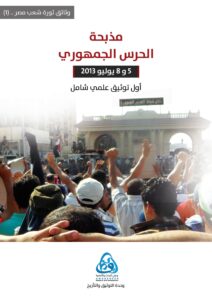
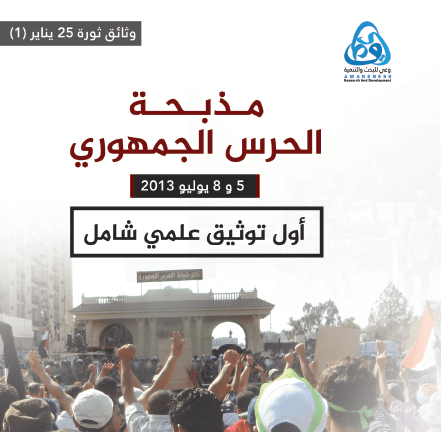
“The Republican Guard massacre…the first comprehensive scientific documentation”
This book, which is 400 pages long, is a brief summary of a large documentary encyclopedia containing approximately 5,000 medium-sized pages. It deals with the first massacre that occurred after the coup of July 3, 2013 in Egypt, which is the massacre known as (the Republican Guard Club Massacre), in which 140 martyrs and 811 were wounded, in addition to 652 political detainees from the peaceful protesters in front of the Guard House, on days 5 and 8. July 2013. The book represents a descriptive study of the encyclopedia that informs the reader of the documentation methodology it contains, its procedures followed, and the contents of its chapters, which include: the introduction to the historical narrative, the chapters on the martyrs, the injured, the medical report on injuries, detainees, witness testimonies, qualitative documents, photo and video descriptions, the media, and political positions, in addition to human rights reports, legal procedures, and creative works. Then came the conclusion, including recommendations, then appendices, sources and references. The editors followed the method of simple analytical description of the encyclopedia, starting from describing the form and external thresholds represented by the cover, dedication, contents, sources, and terminology, then moving on to describing the content, and making multiple statistical summaries for each chapter. The book is also provided with a set of tables, illustrations, drawings, pictures, quotations, footnote explanations, symbols, and documentation. To give the full picture of the event. The book presented a summary of what was mentioned in the encyclopedia about the parties to the event (the protesters, the security forces, including the army and police, the political, party and religious forces, and the media), and the political and popular reactions and positions that resulted from the event locally and internationally. This was then followed by a summary of what was stated in the human rights reports of local and international organizations. He introduced it, introduced it, and documented it. The book also presented a general census of what was contained in the document in general, and this book expressed it as a summary under the document in numbers. The document included 5,000 pages, including this entry. It included 14 terms and descriptors, and approximately 1,000 field photographs, 50% of which the editors described, as in the photos section, and the rest was placed in the archive of appendices. It contained approximately 1,100 videos, including more than 70 hours of broadcast, of which the editors described 25% and released them in the appendices. There are 175 illustrative figures between Drawings of the place and scanned photos of documents, and 35 tables displaying statistical percentages and lists of martyrs, injured, detainees, etc. The document also recorded 140 martyrs in a unified document compiled from 42 authority lists. A brief and condensed biography was also written that included all the martyrs, occupying 200 pages, as well as a unified document for the injured, amounting to more than 800 injured from Those registered, based on 62 authority lists, and 652 detainees. The encyclopedia also monitored 57 artistic, literary and creative works, varying between professional work and spontaneous expression. The documentary encyclopedia concluded with a number of artistic and creative public activities that documented the massacre, which were classified into several different forms and expressions. Then the summary was concluded with some recommendations, appendices, and a list of sources and references. This short book is considered an introduction to reading and simplifying the encyclopedia. It is not a critical or analytical study of the encyclopedia, but it is a reading tool in the manner of indicative abbreviations at the same time, for considerations including: The scientific team that supervised the construction of the documents and their classification in the encyclopedia is the same one that submitted this summary at the request of the (Waa Foundation); also, the encyclopedia has not yet been released to the beneficiaries, which makes writing a summary of it a good opportunity to introduce it and conduct critical, analytical and historical studies. Transfer it as soon as it is available to beneficiaries. In this regard, we should pay a quick visit to the main chapters and topics of this work, to introduce it and shed light on its approach and content.
Curriculum:
It becomes clear to the viewer of this work that he followed a clear approach to the process of documentation, presentation, analysis, and description. The authors mentioned this approach briefly in the introduction to the book. It is an approach that relied on a mechanism that is compatible with the characteristics of the contemporary event that some contemporary researchers have called for. The Waei Foundation saw it as a valid method for documenting this event, and one of its most important features is that it relies on a multidisciplinary team. The introduction to the book showed all the procedural and applied steps through which the process of investigation, documentation, and collection passed, and then the process of narration, description, and writing. The methodological arrangement is clear in dividing the book into an introduction, fifteen chapters, approximately 70 sub-sections, and a conclusion, in addition to 175 figures and illustrative images, followed by an index containing 35 graphic tables that included an introduction to the encyclopedia, and an index of contents, combining textual and digital tabulation through the integration of the two systems. We can look at this large encyclopedic work from a comprehensive perspective to see the integration between the chapters and chapters in a systematic, serial manner. Each chapter leads to the next chapter, and the same applies to the topics in one chapter. If we look at the first chapter, we will find that it is a lengthy, methodological introduction to the encyclopedia, and at the same time it is an explanatory guide for the reader of this book as well. Likewise, we find that the group of chapters 2 through 6 came within an integrative framework. To explain the situation of the sit-in, narrate the event, and the fate of the protesters who were killed, injured, and detained, along with the comprehensive medical report of the massacre, which is the result of all of that. The same applies to the logical sequence of chapters. We find that Chapters 7 to 10 are an integrated body of knowledge that includes various documentary evidence, including eyewitness testimonies, qualitative documents, and recording the event in pictures (through the pictures section) and audio (through the videos section), while Chapters 11 to 15 address the positions and effects resulting from the event in the media, political and legal positions, and popular conscience.
Content:
The first chapter included several sections that dealt with an explanation of the method, concepts, and terminology that we referred to a little while ago in the previous paragraph, including a description of the form and content. The authors made it a separate chapter in presenting the summary of the encyclopedia. In the encyclopedia itself, it is a methodological introduction. Because it represents a reading guide for the encyclopedia, and an applied guide for documenting any similar events. The second chapter was entitled: Description of the content of the narrative, and included several topics; One of them dealt with the narration of the events of the massacre of the Guard Club on the fifth of July 2013 AD, or what the encyclopedia defined as (the First Guard Massacre), and the second section dealt with the narration of the events of the massacre on the eighth of July 2013 AD, known as the (Second Guard Massacre), and the rest of the sections presented a narration of the course of events and the most important observations of the researchers regarding the components of this event. Then the chapter concluded with a brief presentation of a detailed chronological account that was recorded by a field documentarian at the time of the massacre, and a copy of which was obtained by the Foundation. In the third chapter, the book presents the section on martyrs and victims in the encyclopedia, and provides useful summaries in seven basic sections. One of them discussed the problem of counting martyrs by all parties, whether the authorities or civil society organizations (local and international). The documentarians were able to build a unified, audited list that collects victim data through 42 different documents from multiple sources. The document recorded a total number of more than one hundred and forty victims. The document’s editors described every authority list they consulted in producing the unified list of victims, verifying it, and identifying its source, which is undoubtedly a wonderful effort, making this work the first comprehensive scientific documentation of the martyrs. The list presented, among the twenty-four fields about the martyrs, the important fields for readers, such as name, age, profession, and region. This was then followed by a statistical reading of the unified list and an exploration of its human, social, geographic, and political significance. This section concludes with a study that presents the biographies of the victims and the way they are treated in the encyclopedia. The book chose nine examples of victims. In a page or a page and a half, extensive information was written about each victim, in terms of his life and the circumstances of his death, and an example of some pictures of the martyrs. Similar to the investigations in Bab al-Shuhada, the section on the injured came, and followed the method of the previous chapter, including the process of enumerating the numbers of the injured, checking their names, the most important hospitals to which they were distributed, the type of injuries, and a descriptive study of the authority lists – which amounted to 62 lists – and an explanation of their sources and content. These lists were relied upon by the comprehensive unified list, followed by a statistical analysis of the content of the unified list, its significance, and its various cognitive fields, according to the date of injury, gender, age stages, and governorate. And the profession. The book devotes a separate fifth section to the study of casualties and their statistical analysis, which is the sum of information in the field of casualties in the two previous unified lists in both the sections of martyrs and injured. This section is one of the qualitative classifications that a number of specialized doctors participated in preparing with the scientific team supervising the encyclopedia. The chapter presented the information contained in it through objective reports that were characterized by official correspondence between (Waa Foundation), the document’s editors, and the doctors entrusted with studying and classifying the cases. Reading the report shows that its editors were keen to combine specialized professional and scientific terminology on the one hand, and simplify it for the reader on the other hand. The drafting of the medical report began with a brief introduction that would help in the correct and easy reading of it. The information was collected by studying the injury case for each martyr and wounded person and for each partial medical report issued by a hospital. Whether governmental, civil, or other documents. The cases studied in the report amounted to 800 detailed cases, including 140 martyrs, and included them in detailed statistical data. The report was divided into three sections with eight main sections, from which other sub-sections branched out. The first section dealt with the analysis of the injuries of the dead victims, the second section dealt with the analysis of the cases of injured survivors of murder, and the third section dealt with the detailed medical aspects of the outcome of all these cases. In each section, the report presented the level of injury and its causes, comparing that statistically with the number of victims (injured/martyrs). It also studied the relationship between the type of weapon used (firearm: penetrator, drummer/shotgun) and the level of injury and the number and multiplicity of places of injury (head/chest/abdomen/extremities), providing a summary of the statistical significance for each section, then summarizing the summary of the significant results in both sections, by asking statistically significant questions about the accuracy of receiving patients and the use of force. Excessive aggression, the accuracy of laser targeting, repeated attacks, and whether or not genocide was intended. Chapter Six, about those detained in connection with the dispersal of the sit-in, was integrated with Chapters Three and Four, in that it dealt with the fate of all those protesting in front of the Republican Guard Club. It followed the same methodological pace in terms of listing the names and numbers of detainees, the prisons in which they were distributed, and stating the names of the police stations in which they remained during the first stage of detention, through official lists and police reports, the type of treatment they were subjected to, the charges brought against them, the sentences with which they were tried, and monitoring violations. Al-Bab documented all the detainees after the massacre through Official lists, lists of human rights organizations, and statements from the Egyptian authorities themselves. He presented a summary of the consolidated list, arranged alphabetically, with the names of detainees and the fate of the cases in which they were placed. The chapter dealt with several topics, including the progress of the arrest events, and the condition of one of the missing persons after his arrest. The chapter concluded with a reading of the semantic differences between the arrests after the January 25, 2011 revolution and the arrests after the Republican Guard Club massacre. Chapter Seven was devoted to testimonies, and presented different types of testimonies and eyewitnesses, their sources and degrees of authentication, and presented testimonies contained in published sources, such as investigations conducted by reputable international organizations, as well as civil society organizations and human rights organizations. The chapter presented the types of testimonies, their classification, an analysis of their content, and how the encyclopedia editors used these testimonies in the narration process. In the eighth chapter, the method of presenting it is similar to the previous chapter in presenting different groups of qualitative documents, classifying them, then analyzing them and providing recommendations for their use in documenting the event and writing the narrative of the massacre based on concrete and highly authoritative material evidence. In Chapters Nine and Ten, the documentary work deals with archives of photos and videos taken by protesters, amateurs, field documentarians, journalists, correspondents (local and international) from all directions, and news agencies, which number in the hundreds. In these two sections, the encyclopedia presented more than a thousand pictures and a thousand videos, and presented them in an appropriate manner, and defined methodological frameworks for reading the pictures, and used eyewitnesses who attended the massacre to identify the occasion of the picture and the situation, and to interpret some of the scenes. Hence, we can say with confidence that the images were read and the contents of more than 70 broadcast hours were transcribed from different angles in order to follow up on the progress of the events and the sit-in, document the testimonies of witnesses, and analyze the content of the images and videos in general, and simplify them for viewing, and the elements of the event they expressed, as well as distributing these images among their sources, classifying them temporally and objectively, analyzing different models of them, and making them available to be an important source of documentation. The editors in the two chapters followed a unified method in explaining the sources, models of reading and analysis, and different models of photos and videos and how to use them in narration and investigation. The encyclopedia devoted the eleventh chapter to explaining the positions taken by the local, regional and international media towards this massacre, and what the paths of media coverage were like inside Egypt, by presenting two models of the media loyal to the coup, and the media loyal to constitutional legitimacy. The section also presented different models of external media. The encyclopedia was also presented As a presentation of the new media, I collected in a special archive the tweets and blog posts of politicians, opinion and thought leaders, and presidents, and their reactions to the massacre, in what is known as the new media, and presented brief examples of it. In Chapter Twelve, the encyclopedia addressed the political and popular positions inside and outside Egypt towards the massacre. The document divided the methodological framework into a framework that brings together the coalition of June 30 and July 3, 2013, another framework that brings together the coalition to support legitimacy, and a third framework that brings together union and civil society forces and public figures. The document attempted to differentiate between the positions of the components organizing each alliance, and was then followed by presenting the various international positions. In the thirteenth and fourteenth chapters, the work dealt with two issues: the first, documenting the reports of the various human rights bodies, collecting and summarizing them, and providing a comprehensive reading of them through what they agreed upon and what they disagreed about about this event, the results of their reports and how to deal with them scientifically and objectively through a comprehensive reading of the event and the angles through which those bodies looked, and the second is the most important local and international legal procedures regarding this massacre. As for the fifteenth and final chapter, it monitored all the artistic, creative, and communicative works that were collected that accompanied the event or expressed it shortly after the massacre or during its anniversary. Until the completion of the encyclopedia in June 2018, these works amounted to more than fifty works, ranging from a short film, a chant, a song, and a news program that mixes art, narration, digital memory, promos, and the like. The role of documentation here was descriptive and not an evaluation of the quality of the works. Rather, it aimed primarily to record the popular sentiment accompanying the event. Then the conclusion came with a set of general and detailed results for each section, and the editors presented a set of recommendations on how to use this document in writing the history of the Egyptian revolution, the methodology for writing it, and the dangers to which the history of the revolution is exposed, as well as presenting it for reading and benefiting in various legitimate ways in preserving rights and ensuring the facts are revealed.