 In southern Spain today, the Andalusian metropolis settled for about six centuries, reaching its peak in 754 AD. Its most prominent cultural monuments were represented by the Mosque of Cordoba, which for hundreds of years bore the name “Masquita,” meaning the mosque in Spanish, and the name is still spoken by local residents to this day. Cordoba still bears the same Arabic name today, despite the departure of the Arabs from it centuries ago, and in the middle of the city stands a cathedral that officially bears its ecclesiastical name: Cathedral of Our Lady of the Assumption (in Spanish: Catedral de Nuestra Señora de la Asunción), as it is a Roman Catholic cathedral and the headquarters of the Bishop of the Diocese of Cordoba, dedicated to the memory of the Assumption of the Virgin according to Christian beliefs in the Andalusian region. You will only find this long official name on maps, but locals know one name for this place, due to its status as a former Islamic place of worship. The building is known as the Great Mosque of Cordoba or “Mesquita” by the locals, and the word Mesquita (in Spanish: Mezquita) means mosque in Spanish, as the building is considered one of the most monumental monuments of Morisco architecture, and it is included in the list of World Heritage Sites, as issued in 2007. List of the Twelve Treasures of Spain.
Catholic justification for converting the mosque into a church
Traditional ecclesiastical accounts claim that the site was originally a Visigothic Christian church under the name of the Church of St. Vincent. In 784, Abd al-Rahman I ordered the conversion of the church into a mosque during Umayyad rule in Andalusia and the rebuilding of the building, which was greatly expanded by other Muslim rulers later. However, this claim is not supported by any documents other than ecclesiastical claims. Later, Cordoba returned to Christian rule during the Reconquista in 1236, and the Spanish later converted the mosque into a Roman Catholic church, culminating in the construction of the cathedral’s nave during the Renaissance in the 16th century. The cathedral was a model for the intersection of Islamic and Christian architecture. Cordoba Cathedral is considered one of the most famous monuments of Islamic architecture in Spain.
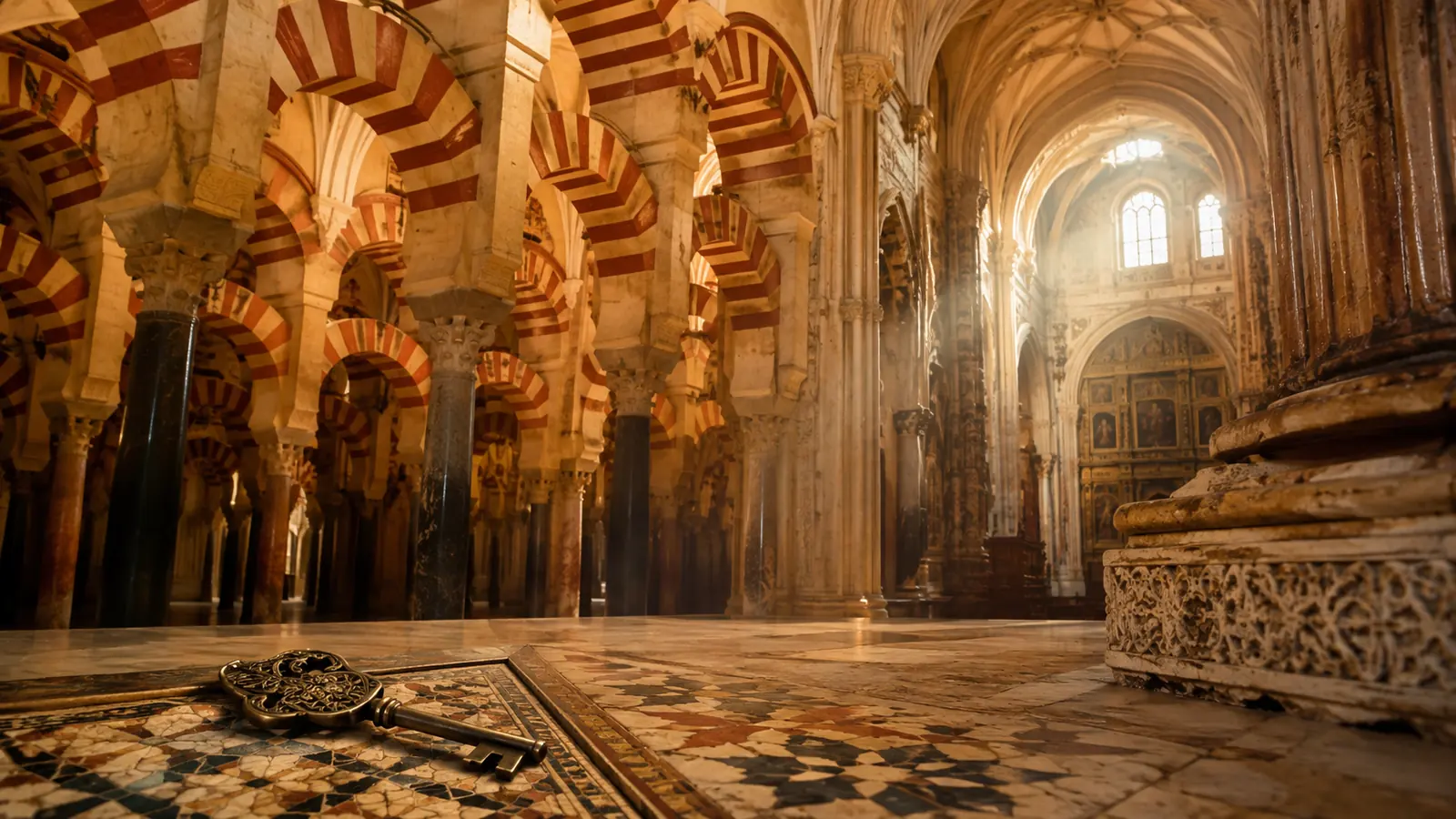
The mosque from the inside
This mosque was built over a period of approximately two and a half centuries, and the foundation of the mosque dates back to the year 92 AH when the Umayyads made Cordoba the capital of the Umayyad Caliphate in Andalusia, where the Muslims shared their great church with the Christians of Cordoba, so they built a mosque in one half of them and the other half remained for the Romans. When the city was crowded with Muslims and their armies, Abd al-Rahman al-Dakhil bought the half of the church that belonged to the Romans in exchange for rebuilding what had been demolished. Their churches at the time of invasion. Abd al-Rahman al-Dakhel ordered its construction in the year 785 AD, and its area at that time was 4,875 square metres. In the past, the mosque was called the Al-Hadra Mosque, meaning the Caliph Mosque. Today, it is called the Cathedral Mosque after the Spaniards converted it into a Christian cathedral. The most important thing that distinguishes this mosque and makes it unique in the history of architectural art is that all additions, modifications, and decorative works were moving in one direction and at one pace, so that it was consistent with its basic form.
Iwan Mosque of Cordoba
The original shape of the Abdul Rahman Mosque in 170 AH consisted of a sanctuary 73.5 meters wide and 36.8 meters deep, divided into 11 corridors, by 10 rows of arches, each of which included 12 arches resting on marble columns and extending vertically along the back wall. These rows consist of two layers of arches, the lower arches of which are in the shape of a horseshoe, and the upper arches are slightly less than a semicircle. They have a flat roof, 9.8 meters high from the floor, and above them are 11 parallel aesthetic roofs, including deep canals lined with lead. The sanctuary opens onto the courtyard through 11 border arches, supported by T-shaped pillars. The courtyard is 73.21 meters wide and 60.7 meters deep. The mosque has a western door and a northern door on the north-south axis, and it also probably has an eastern door that corresponds to the first. The sanctuary had one door, known today as (Puer Tade San Esteban). The sanctuary also had 3 eastern and western pillars, protruding 1.5 metres, and two corner pillars, and most likely 10 on the southern side, to withstand the pressure of the rows of arches. The thickness of the walls is 1.14 metres.
Architectural expansion
The dimensions of the first mosque were (75 m In the year 951 AD, Abd al-Rahman al-Nasser built a new minaret in the farthest courtyard of the mosque towards the north. It is in the form of a huge tower with two balconies for the call to prayer and one can ascend to it by an internal staircase. This minaret is still standing and has been transformed into a bell tower. During the reign of Muhammad bin Abi Amer Al-Mansur, in the era of Prince Hashim Al-Muayyad in 987 AD, the mosque was expanded and its dimensions became (125 meters x 180 metres), making its area 22,500 square meters, or five acres. In the year 400 AH: The mosque was looted by mobs, after people left Cordoba, as a result of the fighting that broke out between Muhammad al-Mahdi and Suleiman bin al-Hakam. Then in the year 633 AH / 1236 AD: the priests of Cordoba invaded its mosques and palaces.
The Courtyard of the Orange Trees
The courtyard of the Great Mosque is considered a piece of Islamic art. It is surrounded by a wall with seven doors, and on its northern side is the minaret. Part of it was built a cathedral where Christians come to worship. As for the Great Mosque, which contains more than 800 columns, it has become a museum visited by tourists. People planted orange trees and lemon trees in it, and that is why it is called the Citrus Saucer. One of the works of governance in the Mosque of Cordoba is extending water channels to the watering cans. And the flashes that he created, and the water was brought to the mosque through a canal that was extended from the foot of Mount Al-Arous near Cordoba. Al-Hakam also created a number of shrines, including the shrine of “Dar Al-Sadafa” to the west of the mosque, which he made a center for distributing alms, and another shrine in front of the western door that the poor used as their residence.