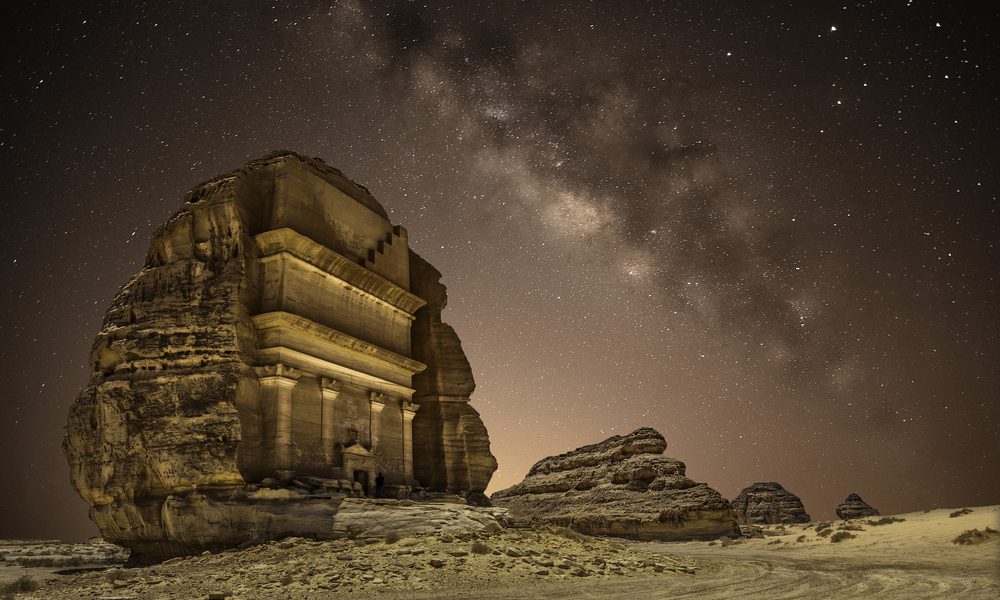

The place is quiet now, but it was once a thriving city located on a major international trade route, and this wonderful city was the sister city of the more famous Petra in neighboring Jordan… Al-Hijr. Al-Hijr, Mada’in Saleh, or Qara Saleh, are all names given to a place mentioned in the Qur’an as the home of the people of Thamud who responded to the call of the Prophet Saleh, then they apostatized from their religion and slaughtered the she-camel that God sent to them, thus destroying them. The archaeological city of Al-Hijr is located in the middle of the desert in the Al-Ula Governorate of the Emirate of Medina, northwest of the Kingdom of Saudi Arabia. It is one of the most important archaeological areas in the world and has been classified by UNESCO as a world heritage site. Previously, ordinary people were not allowed to visit the archaeological city of Al-Hijr except with official approval and for a specific reason, but now, for the first time, ordinary people are allowed to visit this archaeological site without restrictions and see the remains of this wonderful and mysterious civilization at the same time.
Long history
Al-Hijr was the second city of the Nabatean civilization, a nomadic Arab Bedouin who controlled the spice trade. They decided to settle and built an amazing civilization in the desert. The Nabataeans were known to be experts in hydraulics, as they were able to direct rainwater from the mountains into cisterns that allowed them to build amazing cities in some of the harshest environments in the world. In his book, “The Pre-Islamic Era in Arabic Literature,” the writer and linguist Shawqi Deif pointed out that the region of western Arabia was, at a period before Christ, subject to the influence of the Assyrians, whose kings always boasted of their victory over the Thamudics, who belonged to the defunct Arabs and who resided in Al-Hijr and the neighboring Al-Ula. The same book also mentioned that Aramaic inscriptions were discovered in the Tayma region north of Al-Hijr, indicating that an Aramaic commercial colony was established there in the fifth century BC, in addition to other inscriptions indicating that the Ma’inites lived there and in Al-Ula, which was then called Ma’in Misran. The inhabitants of Al-Hejar at that time were Arabs of the south, and they transferred their worship and sacred structures to it, and they remained active in trade until the Nabataean state came.
Huge empire
After the Nabataeans took control of Hegra, the city became more prosperous and its residents amassed great wealth, especially after they began trading in Bedouin frankincense (frankincense) and other spices, which helped them build a huge empire in the desert from the fourth century BC to the first century AD until Emperor Trajan conquered them and they became subjects of the Romans. Despite their many accomplishments, we know very little about the Nabataeans. “The reason we don’t know much about them is because we don’t have books or sources written by them that tell us about the way they lived, how they died, and how they worshiped their gods,” said Leila Nehme, an archaeologist working at the Al-Hejar archaeological site. “This is why sites like Al-Hejar are so important, as much of what we know about this desert civilization comes from studying their magnificent construction.”
Urban cemetery
Today, Al-Hajar has turned into a cemetery after it was an urban capital, where there are many tombs and funerary memorials from the fourth century BC until the first century AD. These graves bear wonderful artistic features and are extremely beautiful. The tomb is owned by the owners of the stone and belongs to its owner and his family, generation after generation. A plaque was carved on top of it, on which he recorded his will, and that this tomb belongs to him and his family. Perhaps the most famous tomb there is the Farid Palace (belonging to the Nabataeans), which may have been the last tomb of an important family member. Although it is incomplete, it is a huge structure that demonstrates great craftsmanship, and its height is almost 4 stories. It contains 4 columns in its facade, one on each side, and two additional in the middle. The rest of the tomb has only two columns, and appears to have been built from top to bottom, as is the case with other stone memorials. There are 111 tombs in total at this site, including more than 90 decorated tombs. There are also inscriptions on many of the tombs, written in ancient Arabic script, warning the living not to tamper with the tombs. One of the graves was written: “May the curse of the Lord fall on anyone who tampers with or opens the cemetery.”