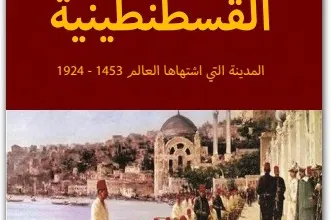
What would a review of history be like if it were written in the form of a narrative narration that embodies the city of Constantine for you, to take you there as a companion, not a visitor, to interact with it, and to feel its conflicts as if you were authorized to make a decision? This is what we can find out in the book of the English historian Philip Mansell, “Constantinople: The City That the World Desired (1453 – 1924),” which was issued by the National Council for Culture, Arts and Letters in Kuwait, in two parts of 407 pages, translated within the World of Knowledge series by the translator Dr. Mustafa Muhammad Qasim. The book presents to you the history of the ancient city in the form of “a story that comes from the tongue of its owner,” the city itself! History here is a kind of entertaining narrative, a story of the rise The collapse of a city and a family together… It contained fifteen chapters, beginning with a chapter about Muhammad the Conqueror, who established this city’s status since his entry into it in 1453, and ending with the fall of the city in the fifteenth chapter, “The Death of a Capital,” and the family’s dispersion in exile and the death of the rest of them.
Book methodology
Between the “conqueror” Muhammad, who triumphantly entered Constantinople in the year 1543 on a white horse, and the “exile” Abd al-Majid, who left it in the year 1924, expelled on the Orient Express, the book tells in its first part the story of the love of a ruling dynasty for a city that transformed them from princes of an unknown emirate to emperors and then to one of the most powerful empires in the world, the longest-lived, and the most present on the scene of global events. The book thus covers the five centuries of the Ottoman capital, Constantinople, by delving beneath the cosmopolitan imperial surface of a city that was at the same time an imperial capital, a holy city, a commercial center, and a pleasure paradise. The author assumes the role of an investigator at times, a critic who draws comparisons between the nature of the city in its pluralism and the sultans in their rule at other times, and a narrator at other times, as he presents history in the form of a story, but it is not separated from its historical reference, and for this reason it contains documents and testimonies from narrators who lived through the events, which is what ended up with the book in its form to be a combination of the historical biography of the city and the personal biography of the sultans who took turns over it.
Exclusive details
The book reveals many secrets about the City of Marvels, its sultans, its women, and the power of their influence. Indeed, in many parts of the book, the author draws comparisons between what this city contains and major cities of its time such as London, Paris, and Austria, highlighting the status and importance that the women of this city enjoyed. The writer emphasizes that the Othman family was not the first ruling Turkish dynasty, and Constantinople was not the first capital of a Turkish state, nor was the Othman family themselves, but the conjunction between the Othman family and Constantinople produced the strongest and largest Turkish Islamic empire and perhaps in the history of the world. The author attributes credit to the Othman family for the city’s strength, greatness, and role, for what they did starting with bringing the population to it, imbuing it with an Islamic color, and also for its palaces. The luxurious building was built as a kind of splendor for the Sultan to dazzle the city, and it monitors the customs of the Sultans in their private lives, their food, their sitting, and also with their ministers and subjects, and the laws that govern the relationship between them and their people. The city’s name goes back to the Roman Emperor Constantine, and it was founded on the site of the ancient city of Byzantium during the period of Roman colonial expansion. Since then, the city became the capital of the Roman Empire, then the capital of Byzantium or the Eastern Greek Empire, then the capital of the Latin Empire. And throughout its history, Constantinople was indisputably the largest and richest city in all of Europe, and then it was called “the city that the world desires,” as one Byzantine wrote. But with the entry of Mehmed the Conqueror on the afternoon of May 29, 1453, the city he had dreamed of before with his white horse, and from that moment his dream preceded it, the love began. Ottoman city.
A unique presence of Islam
Islam gave the Ottoman family an aura of holiness. Inside the mosques, sermons were delivered in the name of the Sultan, and from the early seventeenth century until the end of the empire, part of the sultan’s inauguration ritual was that one of the most senior sheikhs imitate him. The largest annual ceremony in Constantinople was the departure of the Hajj caravan to Mecca on the twelfth of Rajab every year. The author monitors the variables that led to the end of the Beni Othman state, and how between 1918 and 1924 it became a game between two parties and on two fronts: first, the game of nations between the empire, the Greeks, and the West, and second, the game of power between the Ottoman Empire and its Muslim subjects. In his search for the relationship between the city and the Othman family, the writer discovers that they are a meeting place of opposites. The writer ends his huge book by pointing out that Istanbul represented to the world, in its role and model, an example of a major capital, but what was most striking about this city was that after 1924 it did not look to the past and did not feel sorrow, unlike many cities. After 1926, it canceled the old name and the post office no longer accepted anything other than the name “Istanbul”… its new identity.