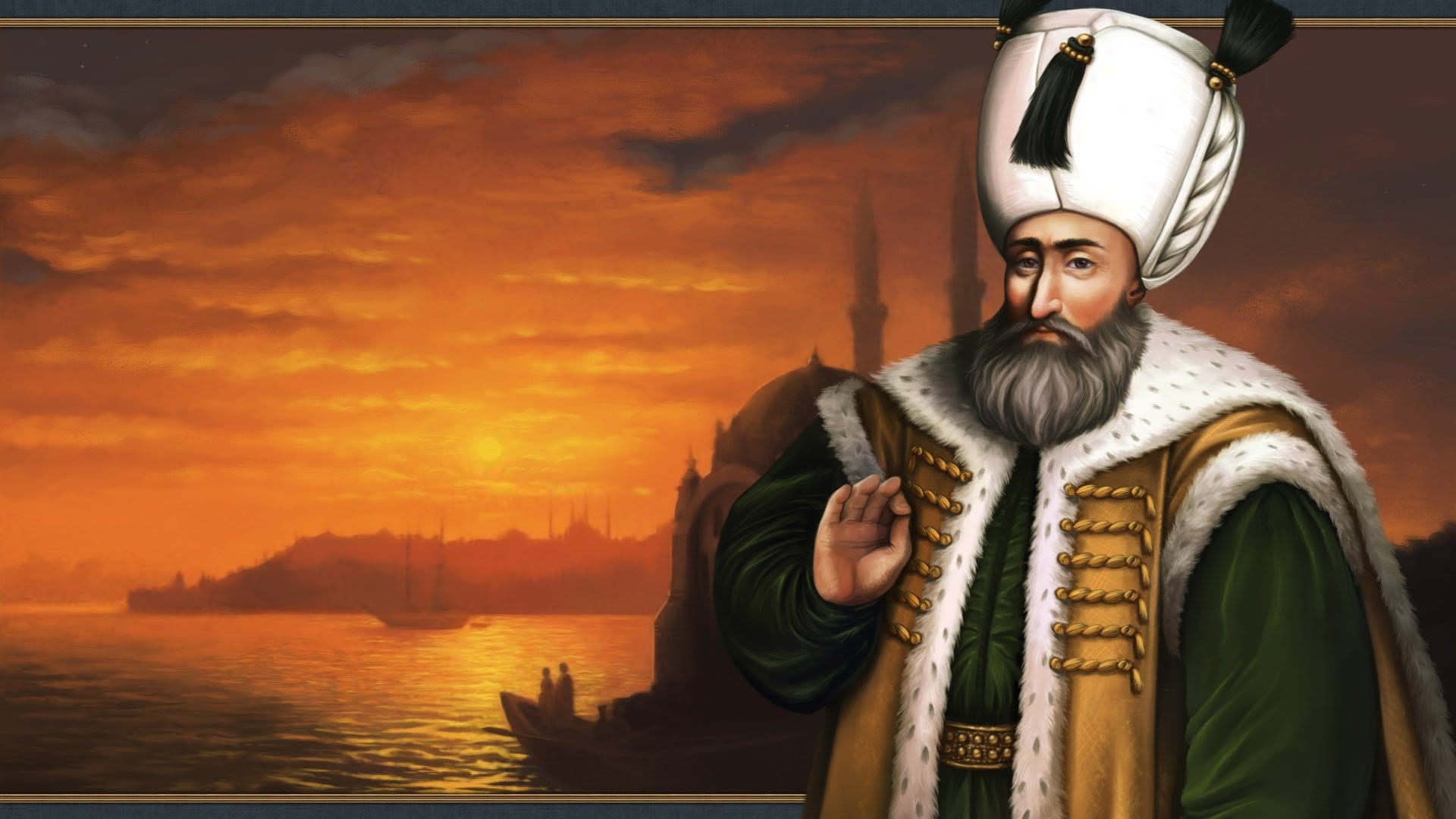

Suleiman Khan I bin Selim Khan I, the tenth of the Ottoman Sultans, known to the Arabs as “Suleiman the Magnificent,” and to the West as “Suleiman the Magnificent,” one of the most important and famous sultans in the Ottoman Empire, whose period of rule is the longest of the state. Where he ruled the Ottoman Empire for forty-eight years.
Growing up
Suleiman the Magnificent was born in the year 900 AH in Trabzon. He is the only son of Sultan Selim I, who took care of his upbringing and upbringing from a young age. So Solomon became a lover of knowledge, scholars, literature, writers, and jurists. Knowing that he was famous for his dignity and seriousness in his youth, Suleiman had a close friend with whom he spent time when he was young, his breastfeeding brother (Yahya), where they learned to craft jewels together, and when he became a young man, he began observing the military operations taking place around him, and it is believed that he participated in one of these operations alongside his father, Sultan Selim I.
Judgment
Suleiman the Magnificent assumed power after the death of Sultan Selim I in the year 926 AH, and began directing policies in the state, noting that his speeches began with a verse from the Holy Qur’an, which is the Almighty’s saying: (Indeed, it is from Solomon, and it is in the name of God, the Most Gracious, the Most Merciful). At the beginning of his rule, he was able to impose the prestige of the state. He eliminated those who opposed it, and all the governors who were trying to gain independence from it. He demonstrated his strong determination when he eliminated the rebellion of Al-Ghazali in the Levant, the rebellion of Ahmed Pasha in Egypt, in addition to the rebellion of Qalandar Çelebi in Konya and Maraş.
His achievements
The reign of Sultan Suleiman the Magnificent is considered a golden era for the Islamic State. His state included a large group of cities and capitals in Africa, Asia, and Europe. His state also came to control the Red Sea, the Black Sea, and the Mediterranean Sea. In the Arab countries: he annexed Aden, Sana’a, and the Bab al-Mandab Strait to his state, and was able to protect Africa from the danger surrounding them (the danger of the Spaniards and the Portuguese). Under the leadership of Khair al-Din Barbaros, Tunisia was annexed to his state. He was able to confront the interventions of the Safavids in Iraq, and invaded their capital, Tabriz, in the year 942 AH. In Europe, he controlled the Crimean country located north of the Black Sea. He was also able to enter the capital of Serbia (Belgrade), besiege the capital of Austria (Vienna), and was able to control several islands in the Red Sea, such as the island of Rhodes, and concluded an agreement with France. To ensure that she would stand by his side in his war against Spain, Portugal, and Austria.
Death
Suleiman the Magnificent was over the age of seven when his illness became severe, and he became unable to ride a horse. However, this did not prevent him from continuing jihad. Where he led an army; To take revenge on the Habsburg king who raided Muslim borders, even though his doctor did not advise him to leave. His illness was severe, but he said: “I would love to die as a fighter for the sake of God,” and this was what was for him. Where he was able to invade the Hungarian city of Sectoir, displaying his usual strength before his enemies, and he died during his invasion of it in the year 1566 AD.