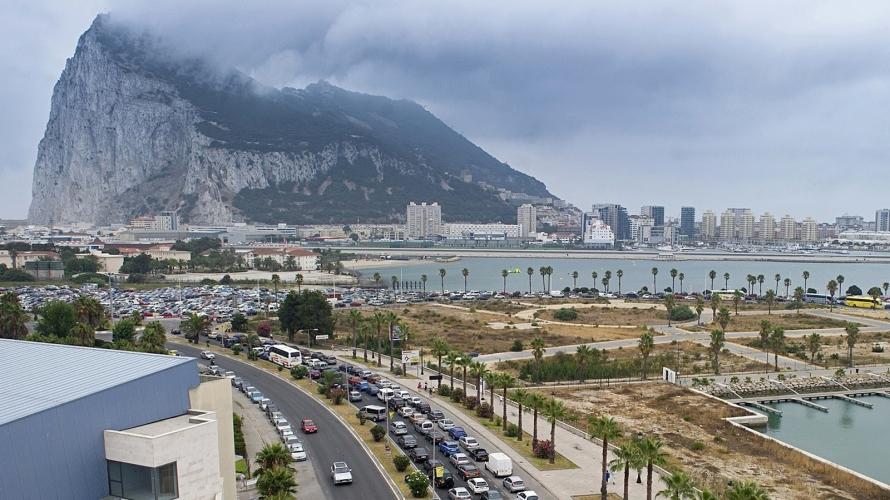
 Above a rocky area deep into the waters of the Mediterranean Sea, in the far south of the Iberian Peninsula, the residents of an island belonging to the British Crown know very well who is the Emir of the city of Tangier, Tariq bin Ziyad, under whose rule their island flourished when he ruled it in the first century AH, and from which it derived its name to this day.. It is the region of Gibraltar, or “Gibraltar” as its people call it. The region has been inhabited since ancient times, and the Phoenicians are considered one of the first peoples to settle in the region around 950 BC. After the Phoenicians, the Romans established a small settlement there that continued until the fall of the Roman Empire. After that, it was ruled by Gabrieltar the Vandals, and then it was annexed to the Spanish Kingdom until the Islamic conquest in the year 711 AD. Before the Islamic era, it was known as Mount Calpe.
Islamic conquest
During the reign of Al-Walid bin Abdul Malik, the Umayyad Caliph, the Muslims crossed from Morocco under the leadership of the Umayyad leader Tariq bin Ziyad, in the year 711 AD. For 4 centuries, no urban modification occurred in Gibraltar, but as of 1150 AD, during the reign of Sultan Abdul Mu’min, one of the Sultans of the Almohad state, a city was established there and fortified, and traces of the city and the wall are still clear in the Moorish palace located in the city. Later, Gibraltar was annexed to the Kingdom of Granada until the year 1309 AD, when Spanish forces invaded the city. This invasion continued until 1333 AD, and the city was re-liberated by the Beni Marin tribe, who in turn returned it in 1374 AD to the Kingdom of Granada, which kept the city until its final fall to the Spanish in the year 1492 AD, thus ending 750 years of Islamic rule over the city.
Spanish era
After the recovery of Gibraltar by the Spaniards, a group of converted Spanish Jews (i.e. those who converted their religion from Judaism to Catholic Christianity after the Inquisition) was settled. One of them, Pedro de Herrera, led 4,350 Jews and worked to establish a state in Gibraltar, which lasted for only 3 years before these Jews were returned to Granada and Gibraltar was permanently annexed to the Spanish crown. In 1501, the island witnessed one of the famous naval battles that took place between the Dutch fleet and the Spanish fleet in 1607 and resulted in the Spanish loss of its entire naval fleet anchored in Gibraltar within only 4 hours because the Dutch fleet surprised the Spanish ships while they were anchored in Cunha, during the Spanish war against the European trio, England, Netherlands and Austria.
British control
During the war launched by the countries represented by England, the Netherlands and Austria in order to stop a Spanish-French alliance that might affect the balance of power in Europe.. The three countries united their fleets and attacked southern and western Spain. An attack occurred on August 4, 1704, and after a bombardment that lasted 6 hours, led by Admiral George Rooke at the head of a force composed of 1,800 British and Dutch sailors, which resulted in the fall of Gibraltar, and a surrender agreement was signed under which the inhabitants of the region were allowed To leave her safely. Despite Spanish-French attempts, Spain was unable to regain the peninsula and in 1714 signed the Treaty of Utrecht, under which Spain ceded Gibraltar to England permanently and declared British sovereignty over the peninsula. Throughout history, Spain tried to regain Gibraltar, so in 1779 it besieged the region with the help of French artillery for a period of 3 years. However, the British fleet was able to break the siege and inflict losses on the French-Spanish forces, and a peace agreement was signed between the conflicting parties.
Conflict between Britain and Spain
The region was a British colony until 1981, when Britain abolished this status and decided to establish autonomous regions in what remained of its former colonies. After changing the method of governance in the Gibraltar region, Spain demanded that the region be returned to its sovereignty, noting that the agreement between the two countries stipulates that the region be returned to Spain in the event of a British cession of it. As for Britain, it announced that it had not ceded the region and that self-rule did not negate the region’s belonging to the British Crown. However, Britain agreed to open the port of Gibraltar to Spanish ships. Over the years, Spain renewed its demand to return Gibraltar to Spanish sovereignty and even negotiated this possibility with the British government, but the residents of the region strongly rejected it and demonstrated against it, as most of them were of British origin.
Its importance Historical
Throughout history, Gibraltar was one of the most important British bases, and its importance increased with the construction of the Egyptian Suez Canal, which prompted the British forces to establish a naval base there in order to protect their interests in the waters of the Mediterranean and on the road leading to its colonies in India and Australia.
Culture and identity
Gibraltar is one of the most densely populated regions in the world, with an estimated population in 2011 of 29,752, equivalent to about 4,959 inhabitants per square kilometer (12,840/sq mi). The growing demand for space is increasingly being met through reclamation of rocky lands. Gibraltar’s demographics reflect many European economic migrants and others who came to the Rock more than three hundred years ago, after the Spanish population left in 1704. English is the official language in Gibraltar, and is used by the government and in schools. Most of the local residents are bilingual, as they also speak Spanish due to Gibraltar’s proximity to Spain, but Gibraltar is made up of a diverse mix of ethnic groups that reside there, as other languages are also found such as Berber and Arabic in the Moroccan community, as well as Hindi and Sindhi in the Indian and Pakistani community. There is also the Hebrew language, which is spoken by members of the Jewish community, and the Maltese language is spoken by some families of Maltese origin. As well as the widely known Portuguese language.
Religion and ideologies
According to the 2012 census, approximately 72.1% of Gibraltar’s population are Roman Catholic. Other Christian denominations include the Church of England (7.7%), and 7.1% say they have no religion. Islam constitutes 3.6% of the population. Hindus (2%), Judaism represents 2.4% of the population. There are also 763 people who belong to the Baha’i faith. In the end, no matter how the identity of the rock and its inhabitants changes, and no matter how much the British-Spanish conflict over it increases, its Arab identity will remain constant in it by right of 750 years of Arab and Islamic presence, and by right of its name, which still bears the name of the man who gave it that cultural value that made it coveted by all international powers… He is Tariq bin Ziyad.