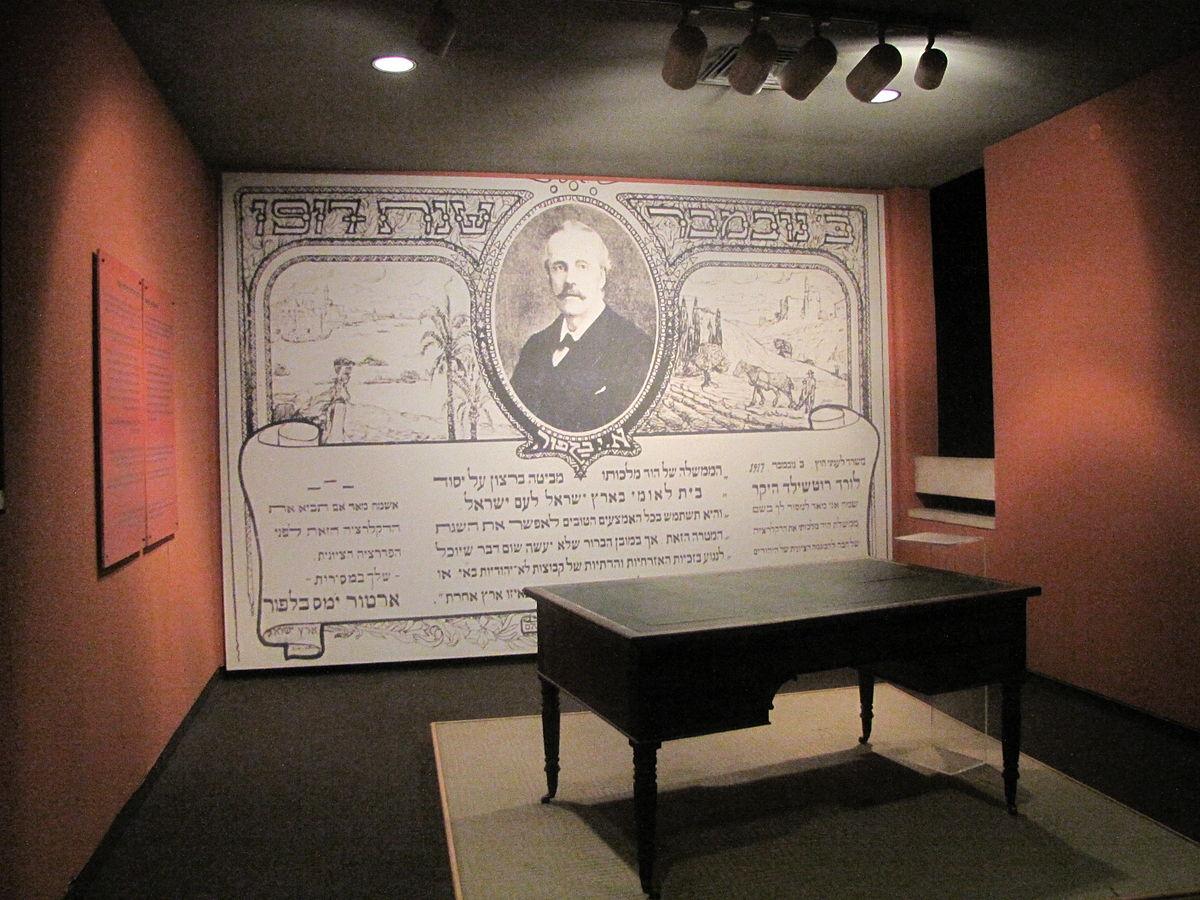
101 years ago this month (November 2, 1917), United Kingdom Foreign Secretary Arthur Balfour signed the Balfour Declaration, a letter addressed to Lord Lionel de Rothschild, one of the most prominent figures in the British Jewish community, for transmission to the Zionist Federation of Great Britain and Ireland. The text of the promise (or declaration) was published in the press on November 9, 1917, according to which Britain would support the establishment of a national home for the Jewish people in Palestine (the Land of Israel). For Zionism, which subsequently established the so-called “State of Israel” (1948), the promise was a historic breakthrough, and with its publication there was great joy in the Zionist world, as this represented a process of adoption and sponsorship of the Zionist idea by a great colonial empire emerging from a historic victory during the World War.
Historical background
After the United Kingdom declared war on the Ottoman Empire in November 1914, the British War Cabinet began considering the future of Palestine. By late 1917, shortly before the Balfour Declaration, World War I had reached a stalemate, as Britain’s two allies did not fully participate in the war. The United States had not suffered much damage from the war, and the Russians were in the midst of the 1917 Revolution. At this time, the first high-level negotiations between the British and Zionists began with a conference on February 7, 1917, which included Sir Mark Sykes and the Zionist leadership. The discussions that followed this conference led to Balfour’s request on 19 June for Rothschild and Chaim Weizmann to submit a draft general declaration. Other projects and proposals were discussed further by the British Cabinet during September and October with Zionist and anti-Zionist input, but without any representation of the local population of Palestine. The final declaration was authorized to be released by 31 October, and these cabinet discussions had the benefit of launching propaganda among Jews around the world of the Allies’ intent for war.
Text of the promise
Dear Lord Rothschild, I have great pleasure in conveying to you, on behalf of His Majesty’s Government, the following statement of sympathy with the aspirations of Jews and Zionism, which has been submitted to and approved by the Ministry: “His Majesty’s Government view with favor the establishment in Palestine of a national home for the Jewish people, and will use their best endeavors to facilitate the achievement of this object, it being clearly understood that nothing shall be done which would abridge the civil and religious rights enjoyed by the non-Jewish communities residing in Palestine, nor the rights or political status enjoyed by Jews in any other country.” I would be grateful if you would inform the Zionist Federation of this statement. Yours sincerely: Arthur James Balfour
The importance of the promise
The first words in the text of the promise represented the first public expression of support for Zionism by a major political force. The term “national home” (mentioned in the text of the Declaration in English as national home) had no precedent in international law, and the term was deliberately used vaguely without reference to the establishment of a Jewish state in Palestine. The borders of Palestine in question were also not specified, and the British government asserted that the phrase “in Palestine” indicated that the aforementioned Jewish national territory was not intended to cover all of Palestine. The second part of the promise was added to satisfy opponents of this policy, who claimed that this declaration would harm the situation of the local population of Palestine and encourage anti-Semitism directed against Jews throughout the world. The British government admitted in 1939 that the views of local residents should have been taken into account, and in 2017 it admitted that the declaration should have called for the protection of the political rights of Palestinian Arabs.
Palestine before the promise
Palestine before the Balfour Declaration was one thing, and after it it became something else. Before the promise, the Palestinians had one homeland, within one social, political, and geographical crucible, but nothing is as it was. The faces have changed, as have the places that were divided and their features changed falsely and slanderously, so that the salt of the earth, represented by the rejection of the promise and the promised, remains the most prominent witness to the steadfastness of this people and their right to their homeland after the first year after the hundred years of the Balfour Plot. The fateful Balfour Declaration was fulfilled, and Palestine was transformed into a “national homeland” for the Jews. Despite the text of the partition resolution issued by the United Nations into two equal states, Israel today is based on more than 70% of the land of historic Palestine and controls the rest by occupation as well, and the destructive and displacement project continues to aspire to more.
Western position
The West, and global capital, stood by Balfour’s vision, and did not hesitate for a moment to roll their eyes to help Israel with their money and weapons and issue promises for expansion. The West, represented by the British Mandate, did not only provide some of the human, logistical, military, financial, economic, and legal requirements to establish a national home for the Jews, but they also opened all locked doors to control the largest area of the land of Palestine. Although the Jews at that time did not need the land of Palestine, because they were already living in countries in which they were born and to which they belonged, and in which they absorbed the language and culture, the leaders of the capitalist countries wanted things to happen that way, and at the Campbell-Nipperman Conference in 1905/1907 they decided on the existence of a “national homeland,” and they breathed into the spirit of Judaism, to commit a holocaust against the Palestinians in particular, and the Arabs in general.
Notable effects
This promise had many long-term effects. This promise increased popular support for Zionism among Jewish communities around the world, and led to the establishment of Mandatory Palestine, the term that currently refers to “Israel” and the Palestinian territories. As a result, this promise caused the Arab-Zionist conflict, which is referred to as the world’s most protracted and complex conflict. Controversy still exists regarding the promise in many respects, for example whether the promise contradicted previous promises made by the British to the Sharif of Mecca during the Hussein-McMahon correspondence to grant the Arabs complete independence if they helped them against the Ottoman Turks.
Where did the landowners go?
Despite all this historical injustice exposed and exposed to the nations, which occurred against the Palestinian people, resulting in the Nakba of 1948, the result of which displaced the indigenous people of the land from their homeland in a scene that children had only seen in soap operas. About a million Palestinians left their homes barefoot, leaving everything in place in the hope of returning soon within a few days or weeks. One million refugees have now become nearly six million across the globe. The Palestinian leadership accepted the historic bargain, not on the basis of UN Partition Resolution No. 181, which was approved by international legitimacy on November 29, 1947, but rather on half of what was included in that resolution, that is, the establishment of a Palestinian state on an area of 22% of historic Palestine with East Jerusalem as its capital, and self-determination over it. However, Israel rejects what contradicts its project. The new American administration also identified with the Israeli positions.
Trump’s 2018 promise
Exactly 101 years after the Balfour Declaration, we have witnessed a new episode of empowerment for the occupying Zionist project with the promise of “Donald Trump,” which included the American President’s announcement to recognize Jerusalem as the eternal capital of Israel and the transfer of the American embassy there, and the subsequent measures to exercise influence to push other countries to adopt similar behavior. But if the Palestinian, Arab, and international climate allowed the West to pass the Balfour Declaration then, will it now also allow the passage of Trump’s promise or the so-called deal of the century?! Whatever the case, the Palestinians before the Balfour Declaration owned a homeland, and after the promise a stranger came to share with them their homeland’s space, resources, economy, trade, and tourism, tampering with its components out of greed and a colonial project. The Palestinians decline at times and rise in their resistance at other times, and the regional and international circumstances between now and then also play their role, so that Palestine remains a field of historical struggle for the wills of right and wrong.