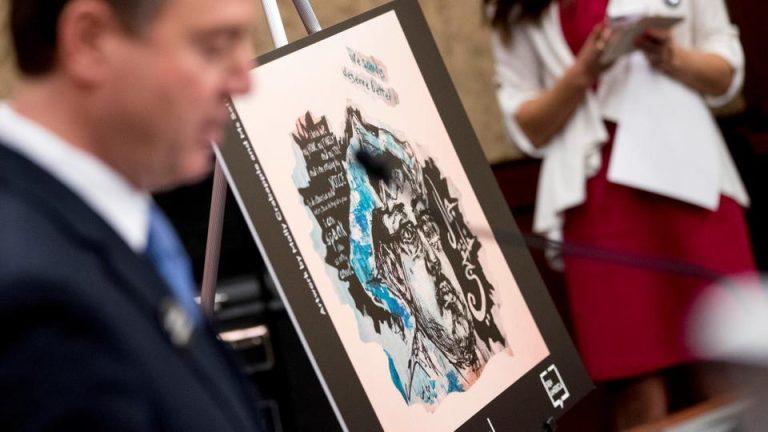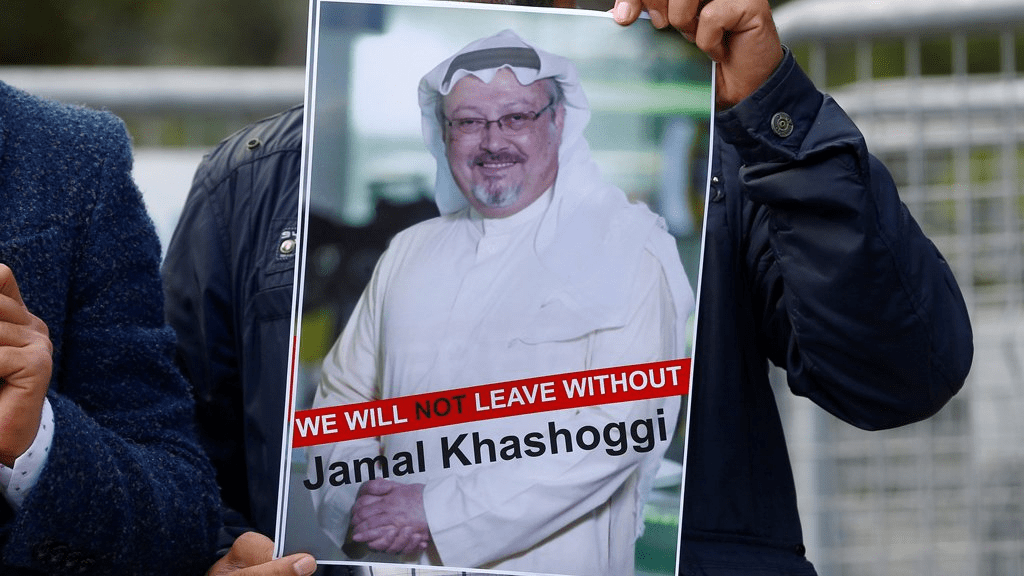
“Say your word…and walk.” This is how the Saudi writer Jamal Khashoggi wrote the title of the last stage of his life in describing his Twitter account, which he used as a platform for his opposition to the Saudi regime after the regime cut off all tools for peaceful expression of opinion, before it also cut off his last breath. Time stopped completely, at one o’clock in the afternoon, on Tuesday, October 2, with the life of Saudi writer Jamal Khashoggi, moments after he entered the Saudi consulate in Türkiye to complete an official transaction. Before he disappeared inside it amid speculation of his death, drawing the attention of the whole world, the matter remained an international mystery until the Saudi Public Prosecution announced his killing inside the consulate after investigations that lasted 15 days since the crime was carried out, and with a story that was rejected by the media and international governments, led by the American President in a number of his turbulent statements, and the Turkish President also rejected it publicly in his parliamentary speech on October 23, 2018. The beginning of the events was with a distress statement made by his fiancée. Turkish journalist Khashoggi, via Twitter, announced the disappearance of her fiancé after entering his country’s consulate. At the same time, the “Prisoners of Conscience” account, concerned with the affairs of kidnapped people in Saudi prisons, published news about the writer’s arrival in his country deported from Turkey, before the official Saudi Press Agency published news stating that Interpol had handed over “an accused in a case of bad check fraud,” without explicitly mentioning whether Khashoggi was the one concerned with the news or not. Later, Saudi Arabia officially announced that Khashoggi was killed inside his country’s consulate, retracting a torrent of statements that tried to convince the world that he had left the consulate safely after completing his treatment. However, the official story circulated by the Saudi media did not convince world public opinion, as Saudi Arabia said that Khashoggi, 60 years old, was killed in a quarrel with 15 people who went to meet him inside the consulate to return him to his country, which he left two years ago after opposing the policies of the Crown Prince. Saudi, Mohammed bin Salman.
Who is Khashoggi?
Jamal Khashoggi, the well-known Saudi writer in the Arab world, decided in September 2016 to leave the walls of the Kingdom, days before the start of the widespread arrest campaigns launched by the Saudi Crown Prince against everyone who violated his policy, without regard to his appearance and connections, which targeted princes from the House of Saud and prominent businessmen. Regarding the reasons for his departure, Khashoggi wrote an article in which he confirmed that he met the Crown Prince in mid-2016 at the time of the announcement of Vision 2030, as part of a delegation that included 30 intellectuals, journalists, and sheikhs from different ideological stripes. But Khashoggi realized at that time that the new young man would overthrow the entire old guard, in exchange for granting a new elite close to him broad influence and leadership positions. Khashoggi’s expectations came true, as he himself says – after he found that two of those who attended the intellectuals meeting with him are currently in detention… they are Issam Al-Zamil and Khaled Al-Alkami. Khashoggi took advantage of a security preoccupation loophole to arrange new arrests, until he succeeded in leaving the kingdom, months after a phone call from a security official at the royal court and close to the Crown Prince ordering him to remain silent, and before this call was followed by a decision from the Saudi Al-Hayat newspaper to stop publishing the writer’s articles.
Royal trip
Khashoggi was never far from the world of the House of Saud; He forged ties with them to entrust him with managing the major media outlets that express the official voice of the Kingdom. He became a writer and director of a number of major Saudi newspapers, and then moved on to work as a media advisor to Prince Turki Al-Faisal, the former Saudi ambassador to Britain. Indeed, his relations with the House of Saud were not severed even after leaving the country. Before his arrest, Prince Alwaleed bin Talal asked him to return to his country, saying: “My brother Jamal, the country needs bright minds.” Like you, now the fourth Saudi state is being built by the hand of my brother Mohammed bin Salman.
Different arrest
On his trip outside the Kingdom, Khashoggi moved between Washington and Turkey, and he was not a fierce opponent of the House of Saud like the dissident princes from the ruling family or Saudi activists who live in Europe and stress the need to dismantle the ruling regime. Rather, he was an adopter of a reformist vision from within the regime that clings to its individuals and sees their presence as a continuation of the kingdom’s existence, and a critic of the policies of the Crown Prince, who always stops short of describing him as “newly experienced in the world of politics.” But all of this did not help Khashoggi with the state of Bin Salman in its latest version, which could no longer tolerate a loud voice, as long as he had ever known the opposition. Even if he supports his decisions today, the seed of opposition is still inside him, and it could sprout one day. This was clearly demonstrated in the arrest of female activists demanding that women be granted the right to drive, despite their absolute support for the recent Salman decisions. As for Khashoggi, the move to arrest him from inside the Saudi consulate in Türkiye was not the Crown Prince’s first attempt to silence him. It was preceded by steps he took to strip him of all his powers and roles. The first of these steps was to freeze his television project, the “Al-Arab” news channel, which was established with funding from Saudi Prince Al-Waleed bin Talal, and under the leadership of Khashoggi, for which orders were issued to stop broadcasting in Bahrain before its headquarters moved to Qatar, which granted it all the required facilities. This was followed by the issuance of a royal decision to stop him from writing in all Saudi newspapers by direct order, and to suspend his Twitter account, until he succeeded in leaving his country, and continued his media activity by writing in major American newspapers and appearing on international satellite stations, until the authorities of the Saudi Crown Prince succeeded in trapping him two years after his exit and arresting him while he was inside the Saudi consulate in Turkey, before Saudi Arabia later announced that he was killed in the consulate in a fight with fists and saws!
A global diplomatic crisis
Khashoggi’s kidnapping, followed by his assassination inside Turkish territory in a way that undermines Ankara’s sovereignty, undoubtedly raises a looming diplomatic crisis between Turkey and Saudi Arabia, especially after the Turkish police announced early on that they had opened an investigation into the disappearance of the deceased writer on its territory, suggesting that he had been subjected to a kidnapping, before his assassination was announced, which is what the latest Saudi account has proven to be true. Saudi Arabia refuses to cooperate with the Turkish side, according to Erdogan’s own speech in his parliamentary speech on Tuesday, the twenty-third of October, which emphasized the procrastination of the Saudi side and its attempt to provide a scapegoat for the case away from the “direct officials” – whom Erdogan did not name -. The last stage of the public dispute reached Turkey’s request from Saudi Arabia to hand over the accused for trial before the Turkish judiciary, as the crime was committed entirely on Turkish territory, while Saudi Arabia explicitly refused to even announce the names of the accused, It insists that the investigation process against them will take place on Saudi soil, without external “interference.”
A page of history
In the end, Khashoggi died in a disgusting way that President Trump described as horrific. However, although some of the details of that crime remain unknown, global public opinion’s preoccupation with it has made it a prominent point in Saudi Arabia’s modern history, and words like consulate and journalist have come to the global mind’s eye for the crime of assassinating an opposition journalist in his country’s consulate in an operation that violated the sovereignty of another country and showed the most horrific face of the regime of the consular state that committed the crime. Khashoggi was one of the freedom of expression fighters in the Arab world… And if the international media mouthpieces did not stand up sufficiently for the thousands of detainees from within those countries; What happened to Khashoggi clearly reveals the mentality of repressive regimes and their perceptions of freedom of opinion and expression, which still have the upper hand among the Arab peoples.