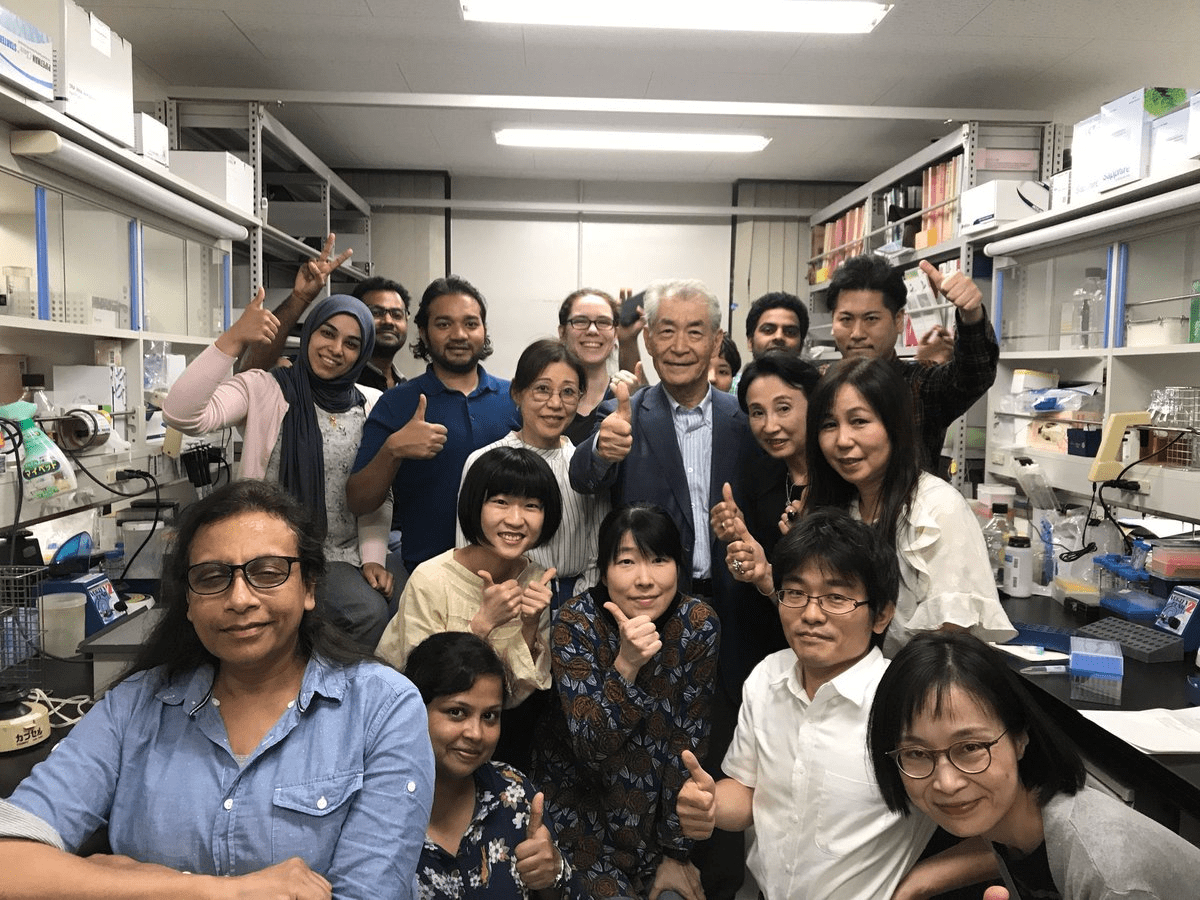
- In the photo, Honjo appears with his team after announcing that he won the 2018 Nobel Prize. The top left of the photo shows “Aza Ismail,” an Arab woman participating with Dr. Honjo’s team and being studied at the Department of Immunology and Genomic Medicine at Kyoto University.
“I want to shout loudly to draw the attention of cancer patients around the world that we have made some progress here for them.” James B. Oleson’s first statement after announcing his Nobel Prize win. It was not a surprise that American James Allison and Japanese Tasukuhongo won the 2018 Nobel Prize in Medicine. After they restored hope to all cancer fighters around the world, for their discoveries that led to unprecedented progress for humanity in treating the malignant disease. James and Tasuku succeeded in liberating and launching the immune system to attack cancer cells, by working to disable or inhibit some protein cells that suppress the work of the immune system and prevent it from attacking cancer.
Not normal news!
Humanity has long struggled with cancer. Despite the success of humans in overcoming many dangerous diseases and various types of plague, cancer remained the most ferocious and aggressive, and humanity declared its surrender to it dozens of times after thousands of researches that always reached a dead end. However, the two “Nobel scientists” did something very revolutionary. To simplify the matter more… Cancer causes the body’s cells to grow abnormally, refuse to dissolve and renew, and divide unlimitedly… The ability of these divided cells to invade and destroy neighboring tissues, or move to distant tissues in a process called metastasis; These are the characteristics of a malignant tumor, in contrast to a benign tumor, which is characterized by limited growth and the inability to invade via metastasis or metastasis. A benign tumor can sometimes develop into a malignant cancer. The body’s immune system can attack bacteria and viruses that attack the body from the outside, but the danger of cancer is that the disease arises inside the body, along with the immune cells, with such impudence and boldness that the immune system is unable to recognize those cells. Because it comes from the body itself and is not foreign to it… and even if some immune cells pay attention to the conspiracy, the cancer will soon get out of the control of the immune system and rebel against it… and win!
What were we doing?
During the past years, cancer treatment was limited to drug therapy, surgical treatment, and chemotherapy, all of which were symptomatic relievers. Even these treatments were sometimes of no use in alleviating the pain of some cancers. However, some of them won previous Nobel Prizes, because humanity was and still is desperate for any means to alleviate the consequences of this ferocious disease. The most prominent of these methods that previously won Nobel prizes were hormone therapy for prostate cancer (Huggins, 1966), chemotherapy (Elion and Hitchins, 1988), and bone marrow transplantation for leukemia (Thomas 1990). However, treating advanced cancer remained extremely difficult, and in dire need of new therapeutic strategies, until Allison and Tasuku, who worked in parallel, appeared and came up with their terrible discovery.
Look closely
Beginning in America.. James B. Allison, a physician working at the MD Anderson Cancer Center at the University of Texas in Houston. His mother died when he was ten years old from lymphoma. This was a huge impetus for Allison to get to work on finding a cure for cancer. During the 1990s, in his laboratory at the University of California, Berkeley, James B. Allison, an immunologist who was one of many scientists who observed that the protein CTLA-4 acts as a brake and inhibitor to keep the immune system in check, preventing the immune system from attacking certain cells, studied and stopped them. Allison began developing treatments based on this principle, and was able to develop an antibody that could bind to CTLA-4 and block its function. Indeed, in 2011, he received approval for a CTLA-4-based drug, ipilimumab, to treat the most powerful type of skin cancer, “melanoma.” More than 20 percent of people who use the drug have the full ability to recover from the disease now thanks to Allison’s discovery.
Japan is present
In parallel, specifically in Japan, another person was working: Tosakuhonjo, the 76-year-old Japanese immunologist, who works at Kyoto University in Japan. His close friend died of stomach cancer at a young age as well. Honjo discovered a second receptor called PD-1, which also acts as a brake on the immune system, but with a different mechanism of action: PD-1, which is another protein found on the surface of T cells. Honjo was able to precisely define its role, and explored its function in a series of experiments conducted over many years in his laboratory at Kyoto University. CTLA-4 regulates the proliferation of T cells early in the immune response, but works to inhibit and suppress those cells, while PD-1 suppresses T cells later in the immune response. What is different about PD-1, CTLA4, is the structure of the presence of the protein on the surface of the T cell, and how it binds to antibiotic cells, or attacks the virus cell if it is redirected. In animal experiments, the experiment succeeded in inhibiting the brake of the PD-1 protein, making it a promising strategy in combating cancer. In 2012, a major study showed clear effectiveness in treating patients with different types of cancer. The results were exciting, providing a possible cure for many patients with metastatic cancer, a condition previously considered untreatable. Honjo received approval for two drugs based on PD-1 inhibition, nivolumab and pembrolizumab, to fully treat melanoma and lung cancer. At the end of their journey, the 2018 Nobel Prize in Medicine was the culmination of victory in our war against cancer, and gave hope to all cancer fighters around the world. Afterwards, Dr. Honjo’s team lined up to take a memorial photo of their great achievement, with a veiled girl, Azza Ismail, an Arab, who is studying in the Department of Immunology and Genomic Medicine at Kyoto University and works within Dr. Honjo’s team, to reflect the medical reality of the Arabs, isolated in the background, after they led humanity’s discoveries for many centuries.