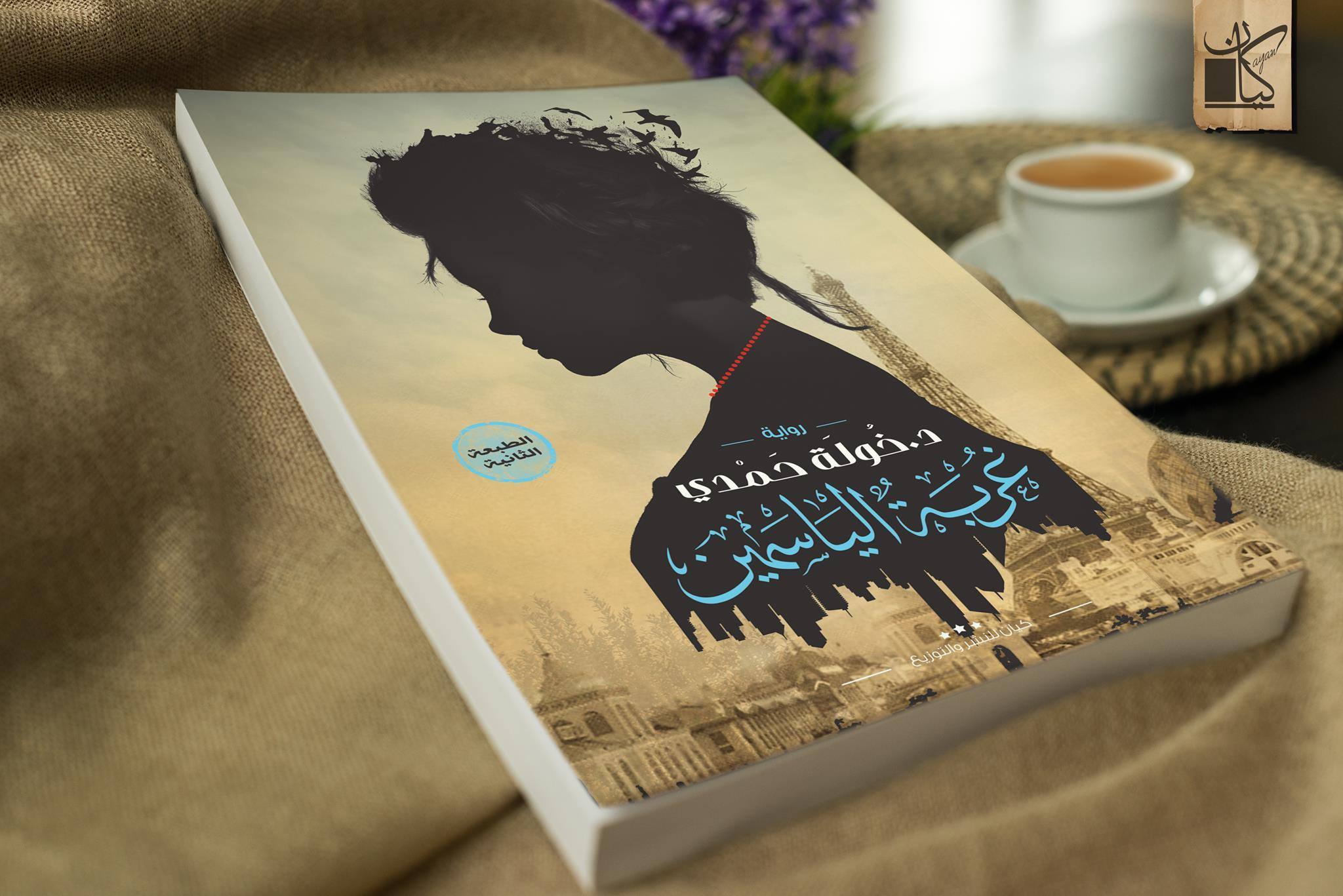
Can Europe truly embrace outsiders? It embraces them as they are, with their various cultures and principles, without the condition of complete abandonment of their identities, or compromising on their constants, or as the Europeans call it “integration”…a question explored in the 407 pages of the novel “The Exile of Jasmine”, the third novel by the Tunisian writer Khawla Hamdi, published by the Egyptian Kayan House in 2015. In her novel, the writer deals with the lives of North African expatriates in France, and what they suffer there in defending Their Islamic convictions and symbols, and it was most interested in qualified people who left their countries of origin in search of a better opportunity. But they collided with the bargaining of their principles in exchange for allowing them to remain in white society.
-
Introduction to the writer
Khawla Hamdi, a Tunisian writer, born in 1984 in Tunis, is a university professor in information technology at King Saud University in Riyadh. She obtained a degree in industrial engineering and a master’s degree from the School of Mines in the French city of Saint-Etienne in 2008, and obtained a doctorate in operations research (one of the branches of applied mathematics) from the University of Technology in Troyes, France in 2011. She published her first novel, “Where is the Escape” in 2011? 2011, then her second novel, “In My Heart is a Hebrew Female,” in 2012, which was inspired by a true story of a Tunisian Jew who converted to Islam after being influenced by the character of a Muslim child with orphan parents who bravely stood up to the occupation, and by the character of a resistant Lebanese young man who left a mark on her life. Then comes the novel “The Exile of Jasmine,” which was distinguished by its creativity and elegant writing style, which carries within it many contemporary Arab issues, such as misunderstanding of Islam and the hijab, and Western society’s racism toward them.
-
With the novel
The novel begins as usual by the writer in her approach to defending Islam and expelling the words that the West uses against them, which constitute a great nightmare. It focuses on rejecting the word terrorism, which the West associates with Islam, and tries to show the extent of the great suffering that Muslims are exposed to in foreign countries. The novel also details the crisis of Western countries’ rejection of the hijab and the suffering faced by veiled girls, especially in France, which is considered a symbol of persecution and racism against the hijab, and how the French attach the word “terrorism” to every Muslim present there. Through the events of her novel, the author raises an important question: When will the West’s racist view of Islam and Muslims stop? For how long will they consider every Muslim to be a terrorist? The author narrates these issues in smooth language and an exciting plot that links coincidences and events.
-
Characters
The novel included several main characters, most notably: Raneem Shaker: an Egyptian girl who practices as a lawyer; Yasmine: a young Tunisian woman who went to France to prepare for a doctorate in sociology; Omar Al-Rashidi: a young Moroccan who works as a researcher in the field of energy in a chemical company; and Sami Claude (Kamal Abdel Qader): Abu Yasmine, a professor who researches in the field of energy; In a company specializing in computer science, Maysaa: Haitham’s sister, Eileen: Yasmine’s stepmother, and Patrick Claude: Yasmine’s co-worker and Eileen’s brother. There are other secondary characters such as Fatima: Yasmine’s mother, Laura: Haitham’s friend, who converted to Islam with his help, Christophe Noirau and Samuel Blair: Omar’s colleagues in the research department at the chemical company, Michel Rousseau: Raneem’s former friend and her boss at the law firm in Marseille, Georges Bernard: Raneem’s boss at the law firm in Paris, Caroline: Omar’s colleague at work, David Keller: Yasmine’s boss at work, and Nader: a thief. Omar arrested him and tried to help him after learning his circumstances, Daniel Brooks: Director of the Research Department at the Chemical Company, Vivian: Raneem’s colleague, Roslyn: A forty-year-old woman who works at David’s company and is trying to commit suicide, Rayyan and Sarah: Yasmine’s brothers, Walid Al-Rajhi: Omar’s co-worker, Gustav Plummer: The chemical company’s guard, Abdel Hamid: Aunt Zuhoor’s husband, and Eric Garbial: The leader of the squad that raided Omar’s apartment.
-
Artistic and intellectual template
The novel’s events take place in three French cities, initially beginning in Marseille and Lyon and later moving to Paris. We can reduce the main heroes of the novel to Raneem, Yasmine, and Omar, all of whom are Arabs and Muslims who chose to go to France either to study or to work. In the beginning, the author focuses on each character separately to describe their features, circumstances, surroundings, intellectual background, the reasons that prompted them to emigrate, and their challenges in the new society. Then events follow until their paths intersect in the middle of the novel and their destinies become intertwined. Through this simple romantic and detective novel, the writer is essentially trying to shed light on the reality of Arabs and Muslims in Western countries, and how they interact with the circumstances and challenges they face. Some of them surrender to absolute integration and dissolve in the values and principles of the host society so that they can live in peace, and some of them cling to their values and be patient with society’s rejection of them as they are, and others hold the stick in the middle, so they cannot completely abandon their Arab Muslim identity, nor can they apply their religion in the midst of the temptations they find in the country. While another group turns to violence and crime because society does not recognize its existence at all and insists on ignoring and marginalizing it. The writer also addresses the issue of terrorism, which has become an accusation that is easy to attach to any Muslim who respects his religion and applies it in a society that believes in openness and absolute freedom, and she did not forget to allocate even a small space for new converts to Islam who are still discovering the teachings of the religion, through the character of Laura, even though it is an example that does not express every new convert to Islam.
-
Criticism of the novel
The writer’s initial bias toward the Islamic position appears in the novel from the first page, while it would have been better from an objective standpoint to make that bias come as a result of the introductions that highlight her topic. The novel’s heroes also have a great idealism that may be exaggerated at times. Through this, the writer may have wanted to present the true image of Islam in their characters, but it contradicts the principle that the writer must be neutral and objective when presenting his ideas. The novel also suffers from the amount of intersections between characters, as the reader imagines that France only includes the three families around which the events of the story revolve. Omar and Abu Yasmine work in the same field of research, Yasmine rents the house from Raneem, who in turn defends Omar, Patrick, Yasmine’s colleague in the company, is none other than her stepmother’s brother, and Nader is locked in the same cell as Omar! Despite this, the writer tried to present clean literature and realistic romance. She mentioned many love stories in which a great reversal of roles appears. She also tried to address issues of concern to Muslim youth in our current era in a wonderful manner that improves the depth of description of the French reaction to everything related to Islam and Muslims and how to deal with them. In this novel, Khawla Hamdi presents purposeful art that expresses the Islamic identity of expatriates, their morals, and their originality, a true expression of a segment of society whose problems are rarely found in this era, amidst all this momentum of obscene stories and novels and low literature that depends on shocking the reader with new ideas that he is not familiar with, or appealing to his instincts, or passing between the lines bombed ideas that destroy the soul and society, or riding the wave of fashion for the sake of fame and quick profit.