“Punishing its people.” This is how, in brief, the Kingdom of Saudi Arabia’s recent decisions towards Canada can be described, due to the latter’s criticism of the Kingdom’s human rights record and its demand for the immediate release of prisoners of conscience. The Canadian Foreign Ministry’s account had posted a tweet on Twitter supporting opponents arrested by Riyadh, and highlighting the issue of escalating arrests in Saudi Arabia, targeting human rights activists, politicians, and preachers.
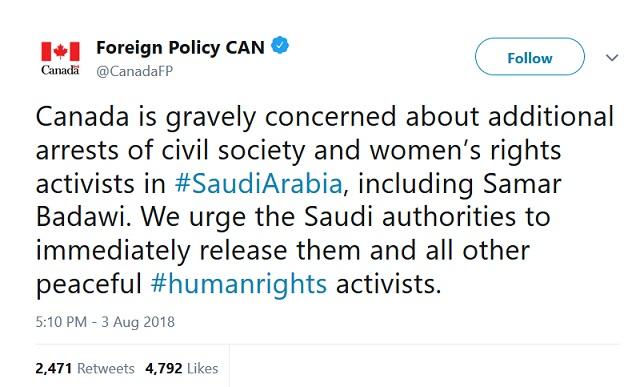
The Kingdom’s reaction to the tweet was escalatory, creating a major diplomatic crisis with Canada, rejecting any mediation to resolve it. And it popped Saudi procedures In the decision to expel the Canadian ambassador to Riyadh, cut off diplomatic and shipping relations, withdraw all of its investments in Canada, deport all of its 15,000 students on scholarship to it, and halt the treatment of its nationals on Canadian soil. Saudi Foreign Minister Adel Al-Jubeir said in a press conference in Riyadh that what he described as Canada’s interference in Saudi Arabia’s internal affairs is unacceptable, adding that his country does not accept dictates, according to his description. Al-Jubeir continued that there is nothing that can be mediated with Canada, which he considered to have made a mistake from the beginning and knows what must be done to correct it, explaining that his country is considering taking further measures against the capital, Ottawa. Al-Jubeir implicitly acknowledged the existence of forcibly disappeared people in his country, as part of his emphasis on what concerns prisoners of conscience whom Canada has demanded to be released, such as the sister of Saudi blogger Raif Badawi. The Saudi minister said that the charges against the detained activists will be announced as soon as the cases are referred to the courts.
Escalation measures
Riyadh had begun Action series “Disciplinary” towards Canada, it announced the cessation of commercial transactions with Canada, and the transfer of about 14,000 Saudi students and patients from Canadian universities and hospitals to other countries. As part of this escalation, the Saudi Health Mission in the United States and Canada has suspended all treatment programs in Canada, and is working to transfer all Saudi patients outside Canada, according to what was reported by the Saudi Press Agency. The British Financial Times quoted sources as saying that Saudi Arabia had issued instructions to its investment portfolio managers abroad to begin selling their Canadian assets. The sources explained that the directives include stocks, bonds, and cash, regardless of what the decision to sell them would cost, and indicated that the sale had actually begun since the directives were circulated.
Canadian clung
In turn, Canadian Foreign Minister Christina Freeland affirmed that her country will continue to defend human rights, citing Prime Minister Justin Trudeau “Canadians expect our government to speak forcefully, forcefully, clearly and politely about the need to respect human rights at home and abroad,” he said. Freeland stressed that what primarily worries Canadians is not the repercussions of this crisis on them, but rather the fate of 15,000 Saudi students who were informed by their government that they cannot resume their studies in Canada, as well as the case of 800 doctors and medical residents who must leave by the first of next September.
Canadian concern
Dr. Salvatore Spadafora, professor at the Academy of Medical Sciences at the University of Toronto, and supervisor of 216 Saudi doctors and residents, said in Press statement“It’s very difficult for people with families and rental contracts… They’re all putting so much effort into their studies, and then suddenly this happens.” Another professor at the university, Dr. Brian Hodges, who supervises 94 Saudis, including trained specialists, agrees with Spadafora. He believes that the priority now is to find a mechanism to help Saudi students, because “many of them have been with us for five or four years and are about to take exams.”
Limited impact
Despite the Saudi measures, the financial market in Canada was not affected at all, despite Saudi Arabia leaking reports about Riyadh’s intention to get rid of Canadian assets, as the trade exchange between the two countries does not exceed three billion dollars, while Canada obtains from Saudi Arabia only 10% of its crude oil needs. Saudi Arabia had published rumors through its media outlets saying that the Saudi Kingdom Holding Company intends to sell its 47.5% stake in the Canadian Four Seasons Hotel chain. However, the chain’s spokeswoman, Sarah Twitty, stressed that things were proceeding normally.
Alternatives and solutions
But Economists They pointed out that if the dispute between the two sides intensifies, the Trudeau government could compensate for Saudi crude from American shale oil or from Canada itself, as it possesses the third largest oil reserve in the world. Despite that, he said Press statement Oil sales to Canada will not be affected by the diplomatic crisis between the two countries. In addition, economists believe that Saudi Arabia will not take this step, especially with the assertions of Saudi Energy Minister Khalid bin Abdulaziz Al-Falih: Where are the Saudi threats? Only the possibility of the Kingdom deciding to cancel a huge military deal it concluded with Canada in 2014 regarding armored vehicles worth $15 billion can be seriously dealt with, which could cause harm to the Canadian labor market, according to London-based union leader Jim Reed. But the possibility of this escalatory step began to fade with Canadian Foreign Minister Chrystia Freeland’s statement earlier that “no Saudi step has been heard regarding the arms deal.”
They punish their students
London trade union leader Jim Reid considered… Press statement The Saudis are shooting themselves in the foot. Even if they harm some Canadian universities and institutes, they are creating chaos among their citizens, whether they are students or doctors. Robert Bothwell, a professor at the University of Toronto, considered that what Crown Prince Mohammed bin Salman is doing to harm Canada will only harm the interests of Saudi Arabia, its students, and its investments, noting that what he called “the Saudi throne” is playing with the interests of thousands of its subjects and treating them as if they were slaves, commenting: “This is very unfortunate.”
Wrong choice
See Observers Saudi Arabia may want to convey a specific message to Western countries, the content of which is that it will no longer accept criticism, especially with regard to the situation of human rights and freedoms, and that the international community must accept Saudi Arabia and the way Mohammed bin Salman rules as it is and adapt to this reality. Since King Salman’s accession to the throne of Saudi Arabia and his appointment of Mohammed bin Salman as crown prince in 2015, Saudi Arabia has entered into several crises and conflicts in the region, amid widespread criticism from Western society, especially after the Kingdom joined the Council of the United Nations High Commissioner for Human Rights. The Saudi government’s reaction to the Canadian position carries a clear message to everyone that the Kingdom of Bin Salman will not accept any criticism. However, although the message seems clear, it has raised many questions, most notably: Did Saudi Arabia choose the wrong target to convey its message to others?