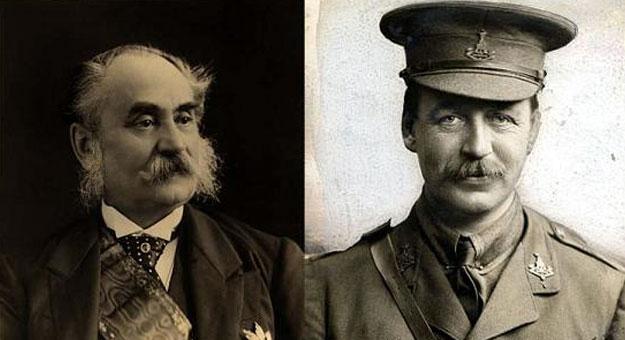
“Everyone must acknowledge that this devastation that befell the Middle East in Syria, Iraq, Yemen, and Libya was mainly caused by the map according to which the Middle East was divided.” With this brief phrase, she ended. American “Daily Beast” magazine In its report on the anniversary of the signing of the “Sykes-Picot” agreement between France and Britain, which divided the Middle East and the Arab world into small states. It seems, then, that this agreement was of great importance to occupy that prestigious position in the most burning region in the contemporary world.. So what is that agreement? Who are Sykes and Picot? What effects did it have? The Sykes-Picot Agreement was signed in 1916, and it was a secret agreement and understanding between France and the United Kingdom with the approval of the Russian Empire to divide the Fertile Arabian Crescent region between France and Britain to determine areas of influence in West Asia after the collapse of the authority of the Ottoman Empire, which had controlled this region since World War I. This agreement was reached between November 1915 and May 1916 through secret negotiations between the French diplomat François-Georges Picot and the British Mark Sykes, and was in the form of an exchange of documents of understanding between the foreign ministries of France, Britain and Tsarist Russia at the time. The agreement remained secret until its details were revealed after the Communists came to power in Russia in 1917.
Terms of the agreement
The Fertile Crescent was divided under the agreement, and France received the bulk of the western flank of the Crescent (Syria and Lebanon) and the Mosul region in Iraq. As for Britain, its areas of control extended from the southern side of the Levant, expanding eastward to include Baghdad, Basra, and all the areas located between the Arabian Gulf and the French region in Syria. It was also decided that Palestine would fall under international administration to be agreed upon in consultation between Britain, France, and Russia. But the agreement stipulated that Britain would be granted the ports of Haifa and Akko, while France would have freedom to use the port of Haifa. In return, France would grant Britain the use of the port of Alexandretta, which would have been in its possession. Later, to alleviate the embarrassment suffered by the French and British after the revelation of this agreement and the Balfour Declaration, Churchill’s White Paper was issued in 1922 to explain in a toned-down tone the purposes of British control over Palestine. However, the content of the Sykes-Picot Agreement was reaffirmed at the San Remo Conference in 1920. After that, the Council of the League of Nations approved the mandate documents for the areas in question on June 24, 1922. To satisfy Ataturk and to complete the plan to divide and weaken Syria, a new agreement was concluded in 1923 known as the Treaty of Lausanne to amend the borders approved in the Treaty of Sèvres. Under the Treaty of Lausanne, the northern Syrian territories were ceded to Ataturk’s Turkey, in addition to some areas that had been given to Greece in the previous London Treaty. This agreement and what followed it divided Greater Syria, or the Arab Levant, into countries and political entities that enshrined the borders drawn under this agreement and the agreements resulting from it: 1- Iraq, which became independent in 1932. 2- The area of the French mandate over Syria, which includes: – Syria, which effectively became independent in 1946 – Lebanon, which became independent as an independent entity in 1943. – The northern Syrian regions were annexed to the state of Türkiye 3- The area of the British mandate over Palestine, which includes: – Jordan, became an independent entity in 1946 – Palestine, the League of Nations mandate over Palestine expired on May 14, 1948, and the British evacuated it. But the next day, the establishment of Israel was announced over large parts of the borders of the British Mandate over Palestine, and the Arab-Israeli conflict began. In 1949, following the abolition of the British Mandate after the 1948 War, Palestine was divided into three political units: Israel, the West Bank, and the Gaza Strip. When the Palestinian National Authority was established as a semi-independent authority, it was established and inherited narrow parts of the borders of the former British Mandate on the West Bank of the Jordan River and the Gaza region, which belonged administratively to Egypt.
Notes about the agreement
The American magazine “The Daily Beast” published a report on the 101st anniversary of the signing of the agreement, which it described as “disastrous,” as it was first announced in the summer of 1916, and caused the invention of countries like Syria, most of which were based on sectarian divisions that caused continued tensions in the region, even after the departure of the British and French occupation from it. The magazine says that the matter began when Egypt was under British occupation in the summer of 1916, and Britain was disputing over areas of influence and control in the Middle East with France, which was also occupying many areas there. The starting point was a secret meeting between Sir Mark Sykes from Britain and M. François Georges Picot from France. The two parties negotiated to divide the Middle East cake between the two countries, to deprive Tsarist Russia of exploiting the opportunity of their struggle to enter and impose a fait accompli by controlling many of its regions. At that time, Britain controlled Egypt, Palestine, parts of the Kingdom of Saudi Arabia, which was called the Hijaz, and areas of Iraq, which had not yet declared a state. France controlled Syria, while Russia, since the days of Peter the Great, had controlled Turkey, including Constantinople and the Darendelles Strait, that channel connecting the Black Sea to the Mediterranean, which connected the Russian fleet to warm waters. But Russian control over Türkiye collapsed after the Bolshevik Revolution and secular Türkiye came to the surface, so Türkiye became outside the equation of the secret deal between Britain and France. The negotiations continued for several months, and Mr. Picot relied on his exceptional skills in diplomacy, as he was described as one of the few talented people in the international diplomatic corps, but Sir Sykes was governed by a set of obligations imposed on him by the civil and military authorities, so that he would not give up any inch of Egypt or Sudan, in which academic missions were conducting a large group of archaeological discoveries, and they were also strongly seeking to be in control of the region from the Nile to the Euphrates; In order to serve as logistical support for it in India, which it occupied at that time.
Sykes’ racism
The magazine says that before sitting at the negotiating table, Sir Sykes took advantage of his family’s large wealth to travel throughout the entire Middle East region. To find out the best places that his country should control, even his house in Yorkshire is still filled with many collectibles that he obtained from his travels from various ancient Egyptian, Babylonian, Assyrian, Arab and Persian eras. But Sykes actually had a racist view towards the Middle East in general, like the rest of the British wealthy class at that time. The British sir had a strange hobby, which was drawing caricatures, which demonstrated Sykes’ racism towards Easterners, clippings of which are still found in his house to this day. Sykes depicted Jews and Arabs with large noses, Arabs as dirty figures who never bathed, and Turks as obese merchants whose skin was filled with fat and who showed cunning and cunning. Sykes was also, according to the account of one of the British High Commissioners to Egypt, suffering from severe psychological disorders. He would laugh at strange times and cheer vigorously for any small victory he achieved. One of the High Representatives even described him as being like a comic comedian, but it was a black tragic comedy, he said.
Lawrence of Arabia
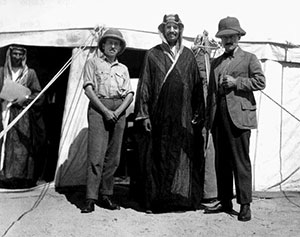
In the summer of 1916, the two men, “Sykes-Picot,” began exploiting a military intelligence man known as “Lawrence of Arabia,” and made him infiltrate the Hijaz region, to study the power of the Hashemites at the time in what was called the “Arab Kingdom,” which controlled the entire Gulf region and Iraq and was subject to Ottoman rule. Lawrence actually wore the traditional Arab dress, entered the holy cities of Mecca and Medina, and fanned the fire of strife and conflict against Ottoman rule. Shortly after, Lawrence promised both Sykes and Picot Arab independence from the mantle of Ottoman rule, and in fact pushed the Hashemites into war with the Ottomans. According to documents published by the director of Sykes’ office in London, his office in Egypt sent an urgent message at that time stating that there was no longer any way to hide the new map that had been designed for the Middle East and that the time had come for the Hashemites to wage war with the Turks. To implement the agreed upon plan. The British met to discuss the Hashemite War, and the British High Commissioner in Egypt said that the independence of the Arab Kingdom from Ottoman rule, and placing it under the rule of a single sherif or king; It would be a great danger, and it might cause great problems for Britain, France, and Russia, even if it was an ally of Britain at the moment, because the future could not be guaranteed. The Arab armies were actually able, with British assistance, to expel the Ottomans from the Kingdom of Arabia, Palestine, and Syria. These armies benefited from Lawrence’s military advice and plans, which the Arabs did not yet know about, and he surprised the Turks with them as well, and then the way became paved for implementing the awaited map.
Coup
After the war came to an end, Lawrence began leaking this new map to the Arab princes, and by December 1917, the Arab armies took control of Jerusalem and the Ottoman Empire completely collapsed, and the application of the “Sykes-Picot” agreement and the implementation of the map that the Arab princes had adopted at that time actually began. The Arab princes thought that the final results of their revolution would be positive, before they collided with the reality they produced, as the conflict actually began in implementing the agreement in a clause that stipulated: “Palestine is a national homeland for the Jewish people.” The British government insisted on considering Palestine a Jewish state in what was called the “Balfour Declaration.” The “Sykes-Picot” plan became ready for implementation after the Russian Revolution affected Moscow’s military capabilities. Lawrence called at the Paris Peace Conference in 1919 for the necessity of approving this map and agreement internationally after implementing it practically on the ground.