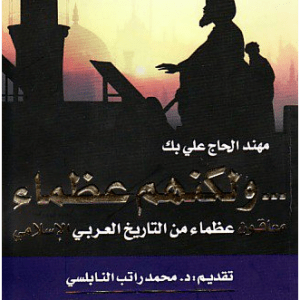
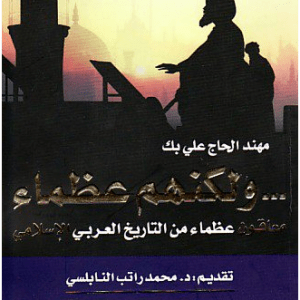
“All human beings have enough of the blessings of the Great Creator to live a happy life filled with goodness, love, and giving.” – Muhannad Al-Haj Ali Bey Who said that disability prevents a person from creativity? The author Muhannad Al-Haj Ali Bey starts from that question in his book “But They Are Great” to include in the title of his book the clear answer before listing through its pages the evidence of this greatness and its masterpieces. This is not a human development book, it is a wonderful human history book that talks about the biography of great disabled people who raise arguments against those who are negligent in the name of obstacles, circumstances, and events, and it presents true stories about the amazing ability of the weak when they seek help from God – the Almighty – and realistic stories that narrate the transcendence of the soul, the patience of the body and the sophistication of thought. The book includes biographies of famous figures in Islamic history, many of whom do not know that they were severely physically disabled. The disabled in this book are role models of faith that shine in the sky of life with hope and optimism for all people. It tells stories about the prophets and great scholars whose earnings were from the work of their hands.
Author:
Muhannad Al-Haj Ali Bek, a young Syrian author and researcher of Islamic history. This book represents the first of his historical works, which comes in 120 pages, and was printed by the Syrian “Dar Al-Fikr” Press for Publishing and Distribution in 2008, and the book was presented to him by Sheikh Muhammad Ratib Al-Nabulsi.
Sections of the book
The research was topped off with an introduction entitled “Sound Minds in Sick Bodies,” in which the author declared his astonishment at these great disabled people who overcame their physical weakness and excelled despite that. He mentioned his work in the book, which explains the status of work in Islam, its role, and the legislative view of it. Then the book falls into two chapters: The first, entitled (Disability and Illness), in which the author explains the importance of the heart and mind and their superiority over sensory power, and that through them a person creates creativity and lives a happy and generous life, and that every person possesses the means of happiness and, if he wishes, lives a life filled with goodness, love and giving, all of this under the guidance of faith, which gives him the impetus to greatness and strength. In this section, the author also addressed observations about work, industry, and craft. He mentioned rules on which a Muslim’s understanding of the meaning of earning and craft is based, and concluded with verses and hadiths that outline the theory of work and earning a living in Islam. As for the second chapter, it is entitled: (Great Disabled People from Arab-Islamic History), and it includes fifteen biographies of notable disabled people, selected by the author from among the Companions, followers, leaders, and scholars in various sciences. Among the distinguished companions, the writer chose: Abd al-Rahman ibn Awf, who was lame, Talha ibn Ubaid Allah, who had a paralyzed hand, and Abdullah ibn Umm Maktoum, who was blind, may God be pleased with them. Among the followers: Al-Ahnaf bin Qais, who had deformed legs and back, Ata bin Abi Rabah, who had multiple disabilities, and Sufyan bin Uyaynah, who was one-eyed. Among those who followed them in goodness were: the scholar of the Noble Qur’an (Al-Shatibi) who was blind, and they say he was one of the authors of recitations and was deaf, and Al-Tirmidhi was one of the authors of the six books on hadith and was blind, and Musa bin Nusayr, the conqueror of Africa and Andalusia, and he was lame, and Dawud Al-Antaki, the chief physician of his time and who was blind, and Sibawayh, the imam of grammar, because he was afflicted with sprue; It is an immune disease that affects the small intestine, so food is not digested in it. Ibn Jinni was an innovator in philology, and he was one-eyed. The writer did not limit himself to mentioning the abstract stories of the heroism of these fighters, but rather detailed some of the biographies of these notables, in addition to pointing out their creativity in their work and their mastery of it.
Book evaluation:
By reading this book, the reader obtains several benefits, the most prominent of which is knowing the truth about the amazing ability of the weak person when he seeks help from God Almighty, and imitating role models of faith that have overcome all obstacles and challenges and have made wonderful humanitarian contributions in various areas of life, shining in the sky with hope and optimism for all people.