
“Re-evaluating our view of the events of history.” The message of the movie “Case No. 23” can be summarized in this brief phrase. Its events take place at a pivotal historical stage, in a sensitive, tense location, and between two warring factions that possess all the elements of polarization and bias. You can only remember before watching the movie that its main elements are as follows:
- Time: The time of the Lebanese Civil War
- Location: The Lebanese-Israeli border
- The heroes: a Lebanese Christian and a Palestinian Muslim refugee
- The incident: A personal clash between the two heroes, which is quickly seized upon by the media and used as fuel for a sectarian war in the town
An exhausting written, photographic and acting adventure that attempts to cover all this overlap. Perhaps this explains why this film was quickly nominated for the 90th Academy Award, becoming the first Lebanese film to approach the major international award. “Case No. 23” is a French-Lebanese drama film directed by Ziad Douiri, starring Adel Karam, Kamel Al-Basha, Rita Hayek, Camille Salama, and Christine Choueiri. The film entered the main competition at the Venice Film Festival, and actor Kamel El Basha won the Volpi Cup as Best Actor. The film was nominated for Best Foreign Language Film at the Academy Awards.
Movie story:
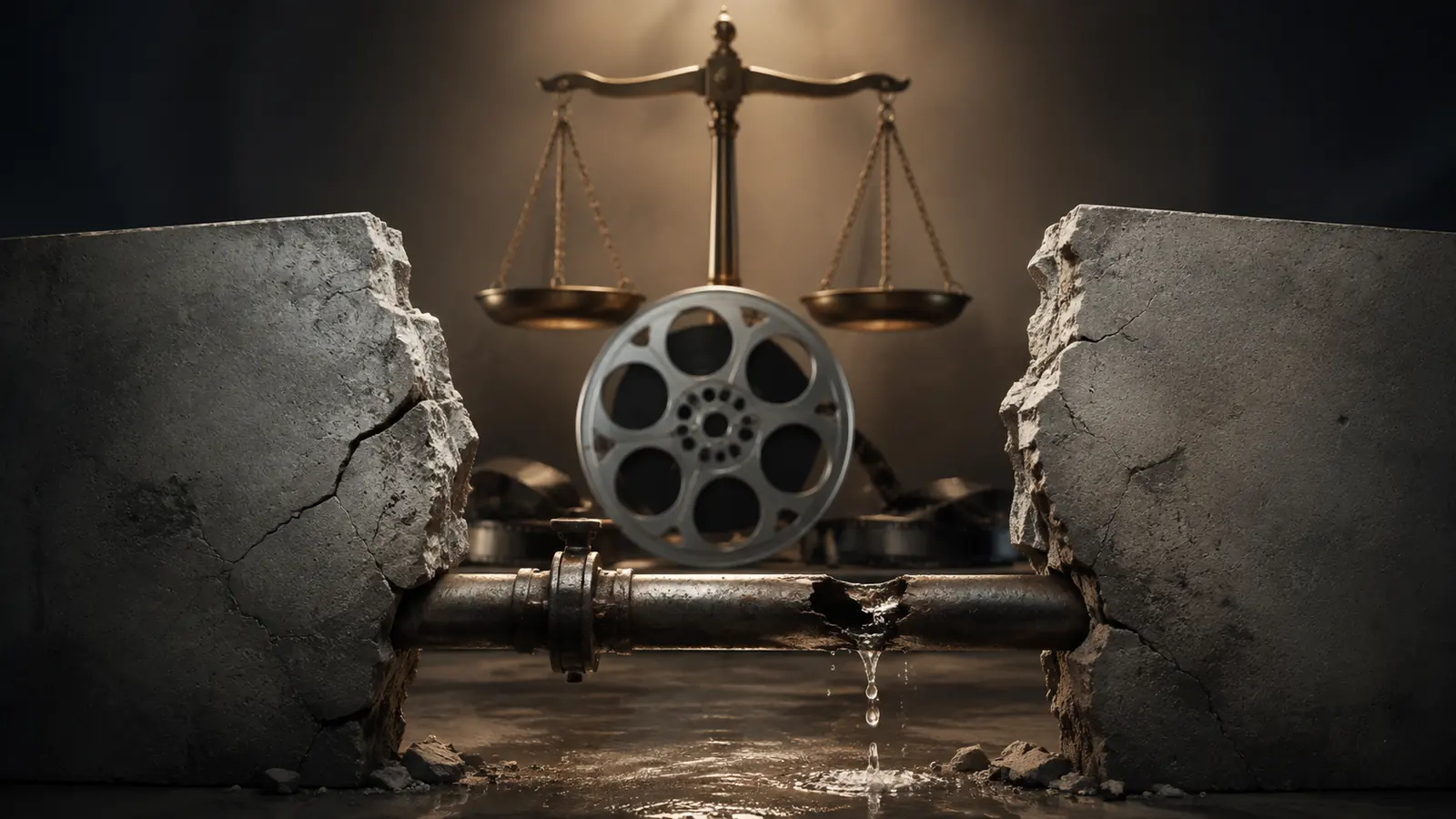
The film talks about “Tony Hanna,” the Lebanese Forces (relative to the Lebanese Forces: a military organization founded by Bashir Gemayel in 1976 to be the military arm of the Lebanese Front during the civil war), who lives in a Christian neighborhood in Beirut, and is from the town of Damour, which he left after the famous massacre in the Lebanese War, the massacre that is said to have been a response to the Karantina massacre, and was also followed by a direct response years later with the Sabra and Shatila massacre. The film also talks about Yasser, the engineer who has the misfortune of getting into a verbal altercation with Tony in a dispute over a water gutter, so he directs an obscene word at Al-Qawati, who is angry about everything and in love with the late Lebanese President Bashir Gemayel, and one of Al-Hakim’s disciples, the leader of the Lebanese Forces Party, Samir Geagea. The profanity does not go unnoticed. Tony demands an apology from the Palestinian engineer, and when the apology is impossible, the case escalates into a lawsuit in court, and here the trial begins, and ends in a trial that is beyond the control of Tony and Yasser, a trial of the history and memory of a divided society!
Technical elements:
Tony had a large share of the dialogue, while Yasser’s character remained silent, which was brilliantly performed by the Palestinian Kamel Al-Basha. His silence, with all this angry tension, was a beautiful, dazzling, and sad intensification of the Palestinian’s tragedy, at the same time that Tony’s emotional transformations were a blatant expression of the fragmentation of the soul. Tony, a devoted Christian who loves his “demure” wife, finds in Yasser a symbol of everything that memory has cruelly left in his soul, including the memories of the hideous emigration from Damour one day, and he wishes that Sharon had completely erased the Palestinians. Two men could have met at a café table in a different world if the geography of Lebanon and the memory of that geography had not brought them together with all its weight. Events escalate, everyone enters into a whirlpool of accusations that border on violence, and Yasser and Tony intersect with parallel lines that cannot meet in the first place. The two parallel lines meet in a surreal scene when Yasser’s car breaks down in front of Baabda Palace, and Tony, the skilled mechanic, fixes it with compassion and cruelty.
Multiple axes of conflict:
The conflict between the engineer and the mechanic was not alone in the film. In his amazing film, Douiri was able to employ a Lebanese-Lebanese conflict between two generations, between the character of the prosecution lawyer Magdy Wahba, who seeks to exaggerate the case to the greatest extent to serve his extreme right-wing vision, and the defense lawyer, “Nadine,” who will appear to us during the events as his daughter and defends her moderate leftist and humanitarian position. Tony’s wife, like Yasser’s wife, is the female voice of reason on both sides, and this is a smart signal from Ziad Doueiri, who co-wrote the script for the film with his wife, Joel Touma, who can be said to have a rational feminist vision of the events.
Work problem:
In the film, and in his very elegant and intelligent narration, Ziad Doueiri poses the dilemma of apology, not only in the expected apology from Yasser to Tony, but in everyone’s apology to everyone for everything. Yasser the Palestinian apologized at the end, and he received a blow similar to the blow he dealt to Tony at the beginning of the film on his rib, and when their pain was equal, when something inside them broke equally and equally, the Palestinian offered his apology and withdrew. This scene alone could have been enough to be a beautiful ending to the film, but the director always has his own vision. Yasser apologized to Tony, and the fire behind them could no longer be extinguished. The story also ended with greater apologies yet to be issued, which still carry potential embers of ignition under their ashes.