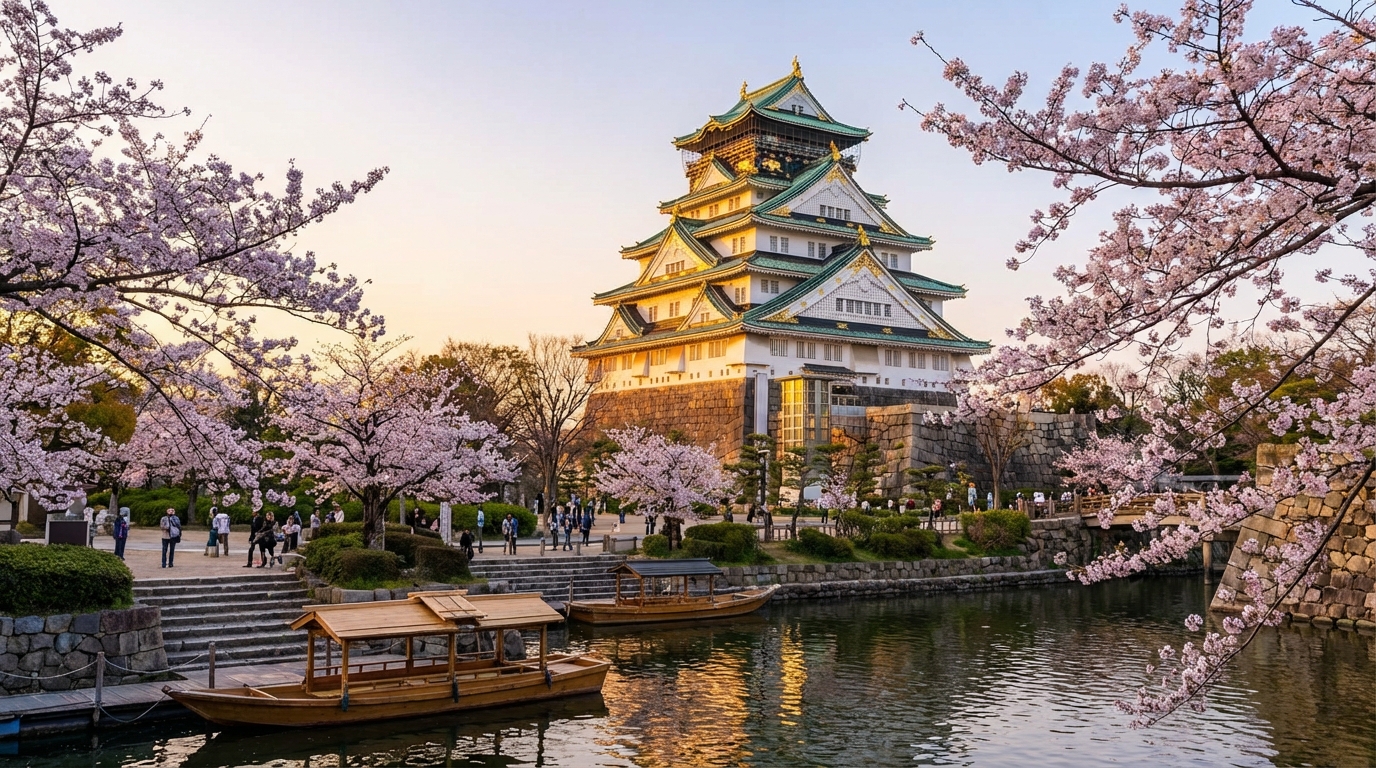
If you are taking your first steps in Japan, you will undoubtedly often hear from tour guides the name Osaka Castle Park, which is considered one of the The most famous places in Japan And East Asia, in the middle of which there is a fortress, which includes a historical museum and an observation deck. There are also two international music halls, the Osaka Castle Hall and the open-air Yagai Ongakudo Hall. Castle Park is a favorite place for Osaka locals who want to relax, as it includes a baseball field, a designated jogging track, in addition to about 300 cherry trees. It has been chosen as one of the top 100 sites for cherry blossoms in the world in terms of the beauty of its trees and the abundance of their different types. The view of the majestic castle in the background, with flowers fluttering over the surface of the stream, in addition to the jogging path through the garden, all combine to paint a wonderful artistic painting, one of the most beautiful flowers that delight the viewers.
Under the sakura trees
In 1598, General Toyotomi Hideyoshi built Osaka Castle, but it was burned to the ground during the Siege of Osaka in 1615. The forces of the Tokugawa shogunate, seeking to destroy any trace of the castle, as it existed during Hideyoshi’s reign, also created a dam and a new castle in its place. In 1931, the castle was rebuilt as we see it today, but the large gate, watchtowers and stone base, built by the forces of the Tokugawa shogunate, remain intact. The stone base of the castle was constructed of megaliths, brought from all over Japan in astonishing sizes.
Monument
To the north of the castle is a stone monument, marking the spot where Toyotomi Hideyori, son of Hideyoshi and Yodo-dono, Hideyoshi’s second wife, committed seppuku (ritual suicide). There is also a plum orchard to the east of the garden, where visitors can find more than a thousand plum trees of different types, some of which bloom early and some of which bloom late. Therefore, it is possible to enjoy watching their flowers for a long period, starting from the end of January until the beginning of March.
The castle…the most prominent landmark
Standing tall in the center of Osaka’s main city, Osaka Castle is also a must-see tourist attraction. The ramparts and fortress are the heart of Osaka Castle Park, a favorite destination for tranquility. Osaka Castle Hall hosts many events, from sports games to concerts and university entrance ceremonies. The most impressive structure of the castle is the fort. In 2017, more than 2.7 million people visited the fort, more visitors than any other Japanese castle in recent years. From the outside, the fort appears as a five-storey structure, but inside it has eight floors. The building serves as a giant warehouse, containing historical materials, including paintings and miniature models, describing Hideyoshi’s life and the social and cultural background of his era on different floors.
The remaining heritage despite the destruction: a reading of the features of Osaka Castle
The second floor includes a painting of a golden tiger, like the one that adorns the black walls, on the upper floor of the fort, and a statue that is a life-sized replica of the mythical shachihoko (head of a tiger and body of a carp), which is used to decorate the ceilings of palaces. Unfortunately, many of the castle’s buildings other than the fort were destroyed due to fire during the turmoil that accompanied the Meiji Renaissance and the bombing during World War II. However, 10 important cultural properties remain, within the main and outer castle walls. Among these properties are the Sakuramon Gate, the Otaemon Gate, and five towers, including the Tamon Tower, two storerooms, and the roof, which is located above Birkenmeisui Wells. All of these properties are original structures, which survived various fires that damaged Osaka Castle.
Remarkable presence
Osaka Castle is famous for the giant stones used to construct masugata – open spaces where soldiers used to gather – surrounded by smooth stone walls. Masugata has two gates built at right angles to each other, to prevent entry directly into the castle keep. Masugata served as a trap, forcing attacking warriors to stop before making a sharp turn, allowing the castle’s defenders to rain down a hail of bullets or spears on them. To prevent attackers from climbing the walls and escaping, huge smooth stones were used to surround these open spaces.
Osaka Castle
In general, the “Taku Ishi” rock, inside the Sakuramon Gate, is the largest in Osaka Castle, with a surface area of about 60 square meters, and weighing about 108 tons. Moving and placing this rock in its place, at a time when there was no heavy construction equipment, was a truly remarkable achievement. The Higo-ichi Rock, which is part of Kyobashiguchi Masugata, was moved by workers from the Okayama Bizen Sect. The Osaka Castle that stands today is a replica, completed in 1931. The unconventional hybrid structure consists of a fortress whose exterior design, similar to that of the original Hideyoshi Castle – as depicted in a folding panel showing the Second Siege of Osaka – is built on top of foundations built by the Tokugawa clan.