Bint Al-Shati…the name Aisha chose for her articles – Wikipedia
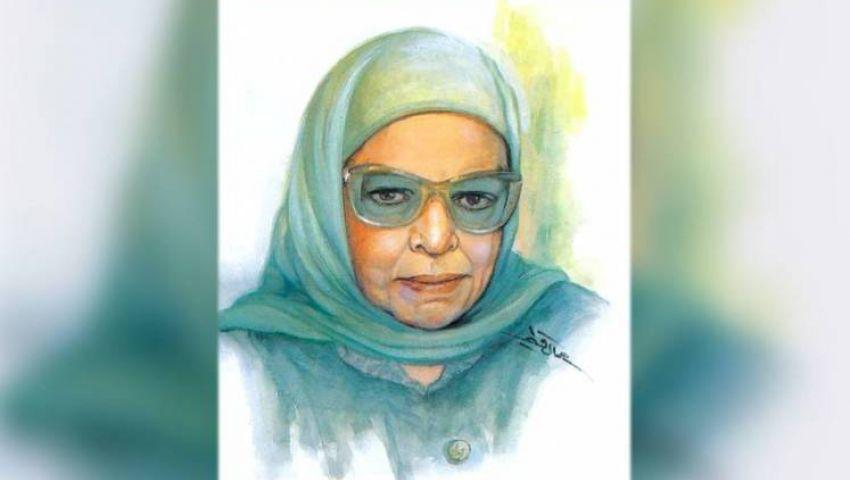
At midday on September 14, 1994, the King Faisal Prize for Arabic Literature ceremony announced the victory of a writer known to the Arab public by her pseudonym “Bint al-Shati.” Eyes were fixed on the women present, searching for who would apply for her award, thus revealing the most prominent features of her personality: Aisha Muhammad Ali Abd al-Rahman. Aisha was writing her articles under a pseudonym in a society in which it was not yet acceptable for a woman to take the lead in presenting ideas and opinions among men. She chose the title “Bint Al-Shati” because it related to her early life on the beaches of Damietta, where she was born, and in order to strengthen the relationship between her and the readers and between her articles that she used to write in Al-Ahram newspaper.
Her personality and upbringing
Aisha Abdel Rahman (1912-1998 AD), an Egyptian thinker and writer, university professor and researcher. She was the first woman to lecture at Al-Azhar Al-Sharif, and one of the first to work in journalism in Egypt, especially in Al-Ahram newspaper. She was the first Arab woman to receive the King Faisal Prize in Literature and Islamic Studies. She was born in the city of Damietta in the northern Delta of Egypt in mid-November 1912 AD. Her father was a teacher at the religious institute in Damietta, and her maternal grandfather was a sheikh at Al-Azhar Al-Sharif. She received her first education in the village book, where she memorized the Holy Qur’an, then she wanted to join school when she was seven years old. But this was refused; She received her education at home, and her superiority and brilliance began to appear at that stage when she outperformed her peers in exams, even though she was studying at home and her peers were studying at school. She joined Cairo University to graduate from the Faculty of Arts, Department of Arabic Language, in 1939 AD. This was with the help of her mother, as her father refused to allow her to go to university. She wrote a book entitled The Egyptian Countryside in her second year at university, then she obtained a master’s degree with first class honors in 1941 AD. She married her professor at the university, Mr. Amin Al-Khouly, owner of the famous literary and intellectual salon at Al-Omana School, and she gave birth to three children from him. She continued her academic career until she obtained her doctorate in 1950 AD, and it was discussed by the Dean of Arabic Literature, Dr. Taha Hussein.
Her intellectual and cognitive contribution
Bint Al-Shati was a writer, thinker, professor, researcher, and model for a Muslim woman who liberated herself through Islam. She went from being a little girl on the shore of the Nile in Damietta to a professor of interpretation and graduate studies at the Faculty of Sharia at the University of Al-Qarawiyyin in Morocco, a chair professor of Arabic language and literature at Ain Shams University in Egypt, and a visiting professor at the universities of Omdurman in 1967, Khartoum, and Algeria in 1968, and Beirut in 1972. UAE 1981 AD and the College of Education for Girls in Riyadh 1975-1983 AD. She rose through the academic ranks until she became a professor of interpretation and graduate studies at the Faculty of Sharia at the University of Al-Qarawiyyin in Morocco, where she taught there for nearly twenty years. She contributed to graduating generations of scholars and thinkers from nine Arab countries where she taught. She also went out early with her thoughts and pen into the public sphere. She began publishing when she was 18 years old in the women’s magazine Al-Nahda, and two years later she began writing in Al-Ahram newspaper. She was the second woman to write for it after the writer May Ziadeh. She had a long weekly article, and her last article was published in Al-Ahram on November 26, 1998. She had famous intellectual positions and took decisive positions in defense of Islam, leaving behind an honorable record of intellectual debates that she fought forcefully. The most prominent of which was her stance against the modern interpretation of the Holy Qur’an in defense of heritage, her support for women’s education and respect with Islamic logic and a fundamentalist jurisprudential argument without feminist rhetoric, her famous position on the Baha’i faith and her writing about the Baha’i relationship with international Zionism.
Her Published Works
Her most prominent works are: The Graphic Interpretation of the Holy Qur’an, The Qur’an and Human Issues, and Biographies of the Women of the House of Prophethood, as well as the investigation of many texts, documents, and manuscripts. She has linguistic, literary, and historical studies, the most prominent of which are: The Text of the Epistle of Forgiveness by Al-Ma’arri, Al-Khansa’, the First Arab Poet, An Introduction to the Method, and New Values for Arabic Literature. She has literary and fictional works, the most famous of which are: On the Bridge…an autobiography, in which she recorded part of her autobiography, and wrote it after the death of her husband. Amin Al-Khouly in her literary style.
Her Awards
Dr. Aisha received many awards, including the Egyptian Government Award in Social Studies and the Egyptian Countryside in 1956 AD. She also received the State Appreciation Award for Literature in Egypt in 1978 AD, the Medal of Intellectual Efficiency from the Kingdom of Morocco, and the Literature Award from Kuwait in 1988 AD. She also won the King Faisal Prize for Arabic Literature, shared with Dr. Widad Al-Qadi in 1994 AD. Many Islamic institutions also granted her membership that was not granted to other women, such as the Islamic Research Academy in Cairo, and specialized national councils, and many schools and lecture halls in many Arab countries were also given her name. Aisha Abdel Rahman died at the age of 86 years on Tuesday, December 1, 1998 AD, leaving behind a fragrant, fresh voice, and a rare and unique model of a Muslim woman who liberated herself with the teachings of Islam, and she played a major role in bringing Egyptian women from the home to the university and society.