
The January 25 Revolution.. How did the Administrative Development Study anticipate it a year before it occurred?
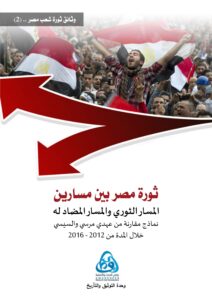
 The “Waa” Foundation for Research and Development issued its study entitled (Egypt’s Revolution between Two Tracks… The Revolutionary Path and the Counter-Track: Comparative Models from the Morsi and Sisi Reigns during the Period from 2012-2016) – represented the culmination of previous efforts in trying to partially understand the drivers of the imminent revolution, and its consequences after its actual outbreak on January 25, 2011. Among those studies that inspired the Foundation “Awareness” based its latest publication, a study conducted by Cairo University in 2009 through a scientific team under the supervision of Dr.: Ahmed Zayed, Dean of Cairo Arts, and predicted the possibility of a revolution breaking out within three years, and with the direct sponsorship of the Egyptian Ministry of Administrative Development, on which the study of the Waei Foundation relied, in making a follow-up comparison of the process of struggle between the two paths, the revolutionary path, and the path opposing it through the Morsi government and the Sisi government, which represent practical manifestations. For the outcomes of each track.. Below we highlight the study of administrative development in some detail because of the importance it represents.
-
On a burning tin:
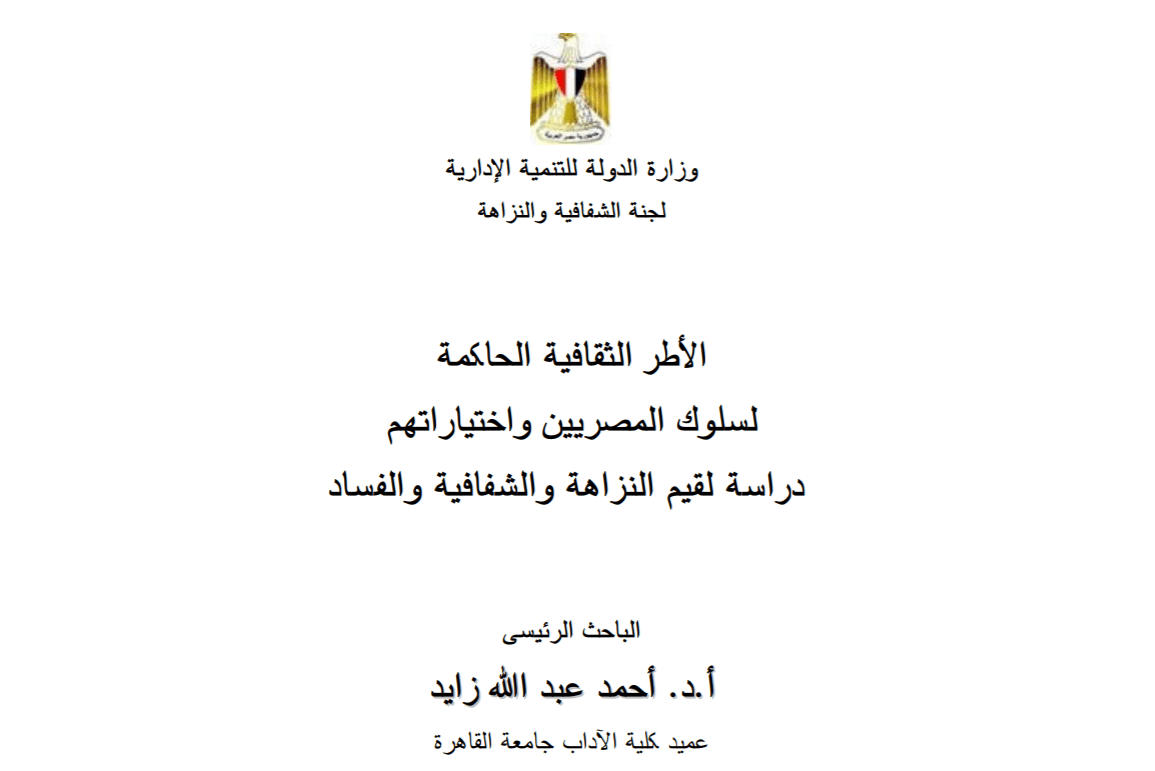
The “Waa” Foundation study was based on data and statistics from the report of the Egyptian Ministry of Administrative Development issued on 10/12/2009 entitled: “Ethical frameworks governing the behavior and choices of Egyptians…a study of the values of integrity, transparency, and corruption,” which was prepared by a research team headed by Professor Dr. Ahmed Abdullah Zayed, Dean of the Faculty of Arts, Cairo University – as one of the controlling descriptions for conducting the comparative study between the two paths. The two Egyptians struggle over the will to change. The report linked the behavior of Egyptians to the economic, political, cultural, health, and educational situation prevailing in the country and heralding a revolution knocking on the doors. It based its vision on a field study in three Egyptian governorates representing the Delta, Upper Egypt, and the peripheries. It chose a sample of 2,000 people, scientifically distributed among males and females, educated and illiterate, rural and urban, youth and the elderly… and other requirements of field survey studies. It is a significant scientific effort that was welcomed by all specialists who saw it, including United Nations organizations. The report took moral values as an input to develop its vision by asking questions: Why did Egyptians’ behavior change from concern for the public interest to giving priority to personal interests? What is the reason for the loss of values such as trust, frankness and honesty? Why do people accept bribes? Why do they resort to lying and do not confront corruption? Why was the value of belonging, transparency, participation, and teamwork lost? Why did cursing, cursing, and discontent become a common language in Egyptian speech? Many of these questions and others, which cover the report map, have varying percentages collected through analyzing the statistical results of the sample’s answers on most political, economic and social issues. Despite the importance of the report, it seems that Mubarak’s regime was not qualified to deal with these reports. Rather, the government was treating scientific studies with disdain and irresponsibility, considering them a mental luxury, and focusing on avoiding all disturbances that were not in the interest of the inheritance process. Paying attention to this scientific report and publishing it might have revealed the weakness of the regime from the point of view of those informed at the time. So they buried the report in drawers, buried their heads in the sand, and contented themselves with knowledge and knowledge!
-
Egypt is between two paths:
The Waei Foundation benefited from the conclusions of the previous study in its presentation that deals with the reality of the Egyptian situation in the form of a comparative study between the attraction of the two paths, through some issues, events and situations that represent standard models for the Egyptian situation before and after the coup, with the aim of providing some revealing glimpses in light of the study’s view of the coup as a stage of the conflict that will continue to appear and disappear until the inevitable change that the Egyptian people are thirsty for occurs. The study “Awareness” of “The Revolution Between Two Tracks” chose examples from some fields to illustrate the comparison between the two tracks and how they conflict, and the outcome of the results (the field of corruption – the economy – youth – rights and freedoms – women) included in the comparison from 2012 – 2016, which is an illumination for more detailed studies revealing the path of comprehensive and profound change along which the Egyptian revolution is moving. To view the full text of the Ministry of Administrative Development study (Click hereTo obtain your copy of the study (Egypt between Two Paths) (Click here)