
Egypt between the protest square and the prison cell: rights and freedoms in “Egypt Between Two Paths”
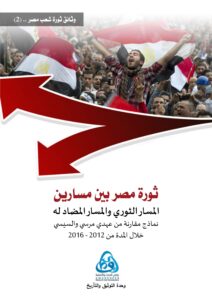
Since the army generals overthrew elected President Mohamed Morsi, human rights conditions in Egypt reached its lowest levels ever, and under media cover from Media supporting the regime The Egyptian authorities By portraying the issue of human rights as if it were an obstacle to stability Achieving security and eliminating terrorism. In light of its endeavor to build a follow-up comparison of the process of conflict between the two paths: the revolutionary path and the path opposing it through the eras of Morsi and Sisi, which represent practical manifestations of the outcomes of each path; The study by the “Wa’a” Foundation for Research and Development, entitled (Egypt’s Revolution between Two Tracks… The Revolutionary Path and the Counter-Track: Comparative Models from the Morsi and Sisi Eras during the Period 2012-2016), paid attention to the human rights and humanitarian axis between the eras of the revolution and the military coup.
-
Systematic killing… and forced disappearance:
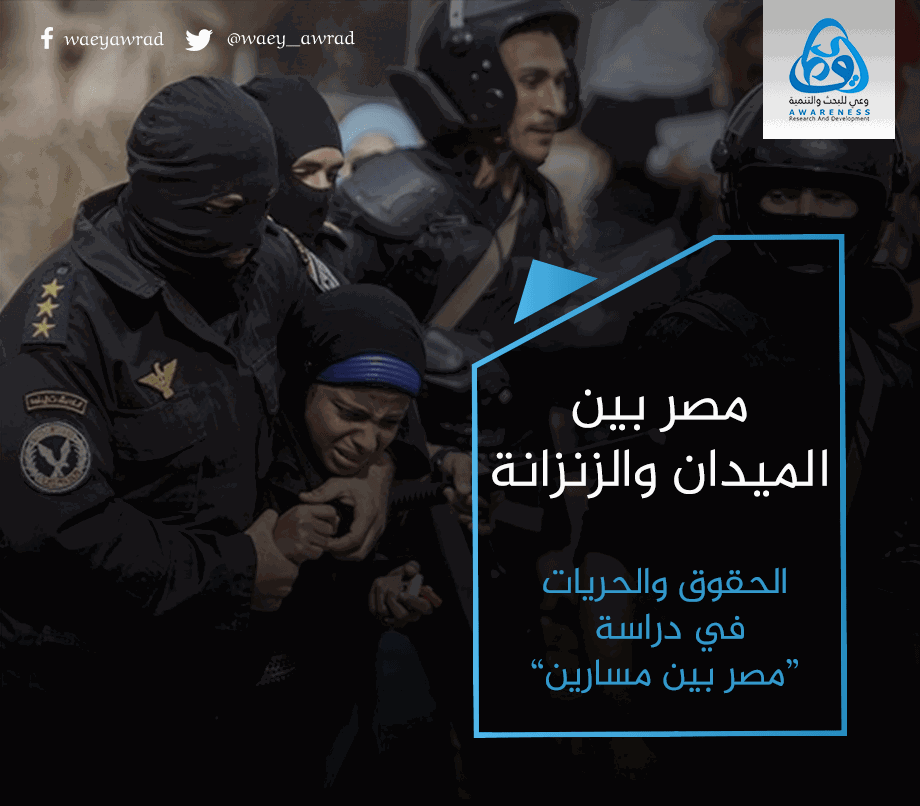
In light of the coup, the study monitored the continuation of systematic killing operations through direct liquidation, or as a result of attacks on Demonstrations and opposition gatherings, or under torture. And medical negligence inside prisons and detention centers, or even under The bombardment by heavy artillery fire and aircraft in Sinai continued, In parallel, arbitrary mass arrests; A large number of citizens were subjected to enforced disappearance. The study monitored the consistency of the Egyptian judiciary’s rulings with the security campaign, through hundreds of harsh rulings that reached To the death penalty based on fabricated evidence formulated by the security services, and issued by courts that were formed with the famous phrase (Who among you would like to try the Brotherhood?!), according to what some judges reported in their testimonies during documentation interviews conducted by the Waei Foundation, Which means the absence of neutrality, integrity, and the presence of the will for revenge. The study shed light on the situation in the Sinai Peninsula, where the continuation of the evacuation of the border area with the Gaza Strip and the accompanying All lands and farms were bulldozed, houses were demolished, and the counter-revolutionary authority continued its operations. using more lethal and less accurate weapons, So that all Sinai citizens, without discrimination, will become vulnerable to random killing, and vulnerable to To demolish their homes, and of course to arbitrarily arrest and forcibly disappear under the pretext of Suspicion without any opportunity for legal redress, or to enjoy the rights of A fair trial and prohibiting all media outlets from covering the events in Sinai.
-
Numbers and statistics:
In basing its comparison, the study relied on what local and international human rights organizations observed about human rights violations carried out by the authorities of the July 3 regime in different periods, in addition to the grave violations that occurred in prominent revolutionary stations such as: the massacres of football, Muhammad Mahmoud, and Maspero, and the dispersal of the Rabaa, Nahda, and Ramses sit-ins, and others in all fields of the nation and the revolution.
-
Corrupt judiciary:
Regarding the independence of the judiciary, the “Awareness” study presented the report of the International Commission of Jurists entitled “The Egyptian Judiciary is a Tool of Repression” issued in 2016, which indicated that the Egyptian judiciary – one of the last lines of defense – had failed during the period of the crisis in Egypt (i.e. after the July 3 coup) in performing its basic mission of protecting the rule of law and human rights, and that the interventions of the executive authority that had been in place for a long time in the judicial system Egyptian law, as well as the laws supporting this intervention, reduced the ability of the judiciary to act as a neutral and independent arbitral body that protects human rights. The report confirmed that the judiciary and prosecution in Egypt have become viewed as an essential tool to suppress political opponents, journalists, and human rights defenders. The report also shed light on how judges who dared to speak in favor of the independence of… The judiciary and the rule of law led to unfair disciplinary procedures that resulted in the transfer of some of them and the isolation of others. He even imprisoned great judicial figures, such as Counselor Mahmoud Al-Khudairi.
-
Multiple violations:
Regarding political detention, the study was based on the report “Political Detention in the Arab Republic of Egypt” issued by the Arab Organization for Human Rights in Britain on September 25, 2014, which stated that the number of arrest cases from July 2013 until the end of July 2014 reached more than 28,741 detainees, including all segments of Egyptian society, and did not distinguish between minors and adults, or men and women, so everyone fell victim to arbitrary detention, including At least 3,686 minors are detained. As for enforced disappearance, the study referred to the report of the Egyptian Commission for Rights and Freedoms on enforced disappearance in the period from 2013 to 2015, in which it showed that the tightening security grip on the Egyptian political street, the desire to control political life by security institutions, immunity from accountability, the impunity of officials after the revolution of January 25, 2011, and the weakness of popular control over the work of state agencies – led to the return of repressive practices, including enforced disappearance in a widespread manner. Widespread methodology by security agencies, especially the national security sector; After June 30, 2013, Egypt witnessed massive human rights violations on a large scale, some of which were systematic, documented by human rights organizations in Egypt, and condemned by international organizations in light of the spread of hate speech and incitement by many media institutions affiliated with the repressive regime. During the year 2015, the National Council for Human Rights received 50 complaints about forcibly disappeared citizens whose whereabouts were unknown. In this context, the “Freedom for the Brave” campaign report documented 163 cases of forced disappearance, including 66 cases of enforced disappearance in accordance with international standards, and 64 cases of unlawful detention, in addition to 31 cases that the Council was unable to follow up on. It is noteworthy that the “Awareness” study aims to raise awareness of the facts of the conflict between the paths of revolution and coup in a language based on numbers and statistics related to the Egyptian situation carried out by specialists in scientific centers, field studies, and summaries of recognized international organizations in economics, politics, human rights, and others. The study relied on a group of diverse sources, theoretical and field studies that dealt with the Egyptian situation in all its details during the various stages of the revolution, and included statistics, comparisons and critical analyzes by experts and specialists, including economic reports such as: reports of the Central Bank of Egypt, the World Bank, the European Union, the Economist magazine, reports of the Ministry of Administrative Development in Egypt, the Central Auditing Organization, human rights organizations, the Mobilization and Statistics Authority, documentary reports and periodical books, and analysis of Political and economic speeches and statements issued by relevant authorities and other sources. To obtain your copy of the study (Egypt between two paths) (Click here)