
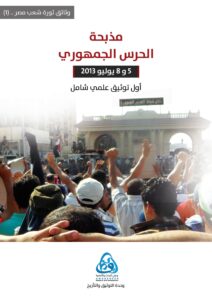
On the anniversary of the Republican Guard events, Al Jazeera Mubasher hosts Awareness’s director to discuss the first encyclopedia documenting them
Playing connects your browser to YouTube. Privacy
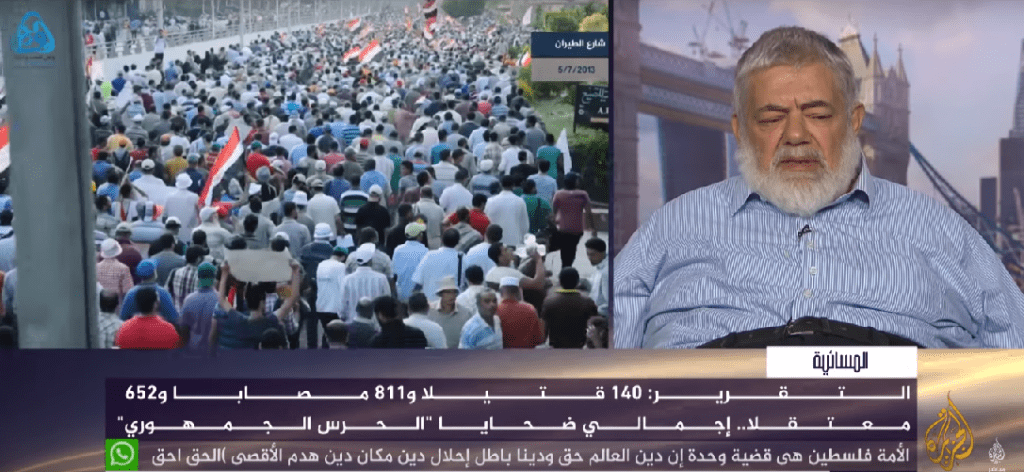
On the fifth anniversary of the events of the Republican Guard, “Al Jazeera Mubasher” hosted, on July 8, 2018, Dr. Muhammad Farid Al-Shayyal, founder of the Waaa Foundation for Research and Development, to talk about the first encyclopedic documentary work on the massacre that occurred after the coup of July 3, 2013 in Egypt, which is known as (the Republican Guard Club Massacre), in which 140 martyrs and 811 were wounded, in addition to 652 political detainees from the peaceful protesters in front of the House. Guard, on July 5 and 8, 2013.
During his speech, Dr. Al-Shayyal explained the circumstances of the incident, the nature of the protesters, and the motives for their participation in the demonstrations rejecting the military coup against elected President Mohamed Morsi, stressing that the security forces surprised the peaceful protesters by firing live bullets at them, resulting in dozens of martyrs and hundreds of wounded.
Regarding the reasons for the difference in the numbers of victims documented by the encyclopedia from the official government data, Dr. Al-Shayyal said that the regime was in a dispute with the protesters, and he was accused of committing the incident, which led him to deliberately reduce the extent of violations and marginalize the victims, which the scientific team was keen to overcome through various sources, including communication with direct sources of victims of violations and eyewitnesses.
Dr. Al-Shayyal confirmed that the most prominent obstacle facing the documentation team was the authorities’ deliberate concealment of information, which was overcome by referring to different sources, investigating them, and comparing them.
Regarding the reliability of the information contained in the encyclopedia, Dr. Al-Shayyal said that the work team relied on a clear methodology that requires communicating with direct sources of the narratives and corroborating their testimonies repeatedly from witnesses to the incident. He confirmed that the team was able to collect most of the official documents available about the event, video clips, photos, etc., and they were described and archived within the encyclopedia’s media.
Dr. Al-Shayyal pointed out that the role of the Foundation does not stop at counting the numbers and enumerating the victims, but rather the documentation process comes within a larger plan to create popular awareness, which is the name that the Foundation has chosen for itself, noting that documentation work is considered a historical mission to preserve the complete truth and protect it from forgery, distortion, or concealment.
Dr. Al-Shayyal also explained the importance of the massacre and the reasons for choosing it to be the subject of the institution’s first documentary publication, pointing out that the shots from that massacre were an early indication of the approach that the coup regime would take against its peaceful opponents, and a prelude to internal and external public opinion for the major massacre that followed weeks later during the dispersal of the Rabaa and Nahda sit-ins.
Al-Shayyal concluded his speech by emphasizing the Foundation’s intention to complete its documentation plan to preserve the events of the region during that period through archived documents using an accurate scientific methodology that preserves for future generations the right of impartial access to the course of events, far from partisan affiliations and far from official narratives that are ideological to enhance the aspirations and goals of the ruling authority.