
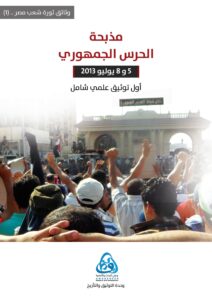
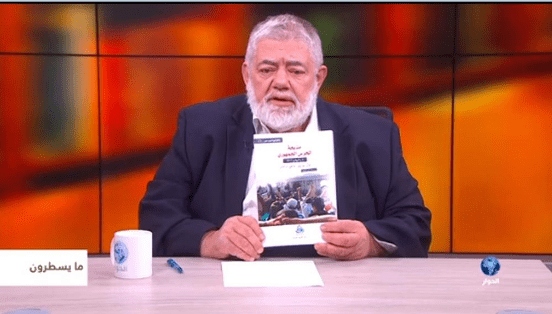
Dr. El-Shayyal recounts the full story of the Republican Guard massacre on Al Hiwar
In the first work of its kind since the massacre, Dr. Farid Al-Shayyal, founder of the Waei Foundation for Research and Development, gave way to a detailed review of the scenes of the two massacres at the Republican Guard Club, which occurred on July 5 and 8, 2013, against peaceful protesters in front of the Republican Guard Club. Its repercussions continued for three consecutive days, and paved the way for internal and external public opinion for the occurrence of the major massacre. Dispersal of the Rabaa al-Adawiya sit-in, on August 14, 2013.
Dr. Al-Shayyal was a guest on the “What They Control” program shown on Al-Hiwar satellite channel, on August 25, 2018, to document the massacre, which was the subject of the institution’s first documentary release, reviewing the preliminaries of the massacre, the nature of the protesters, the motives for their participation in the demonstrations rejecting the military coup against the elected president, Mohamed Morsi, and the reasons for the protesters’ decision to head to the vicinity of the club, while emphasizing their complete peacefulness, and targeting them in a way that Violent and unprovoked by army forces.
Regarding the symbolism of the Guards massacre, Dr. Al-Shayal explained the importance of the event and the reasons for choosing it to occupy the subject of the institution’s first documentary publication, pointing out that the shots from that massacre were an early indication of the approach that the coup regime would take against its political opponents, and a prelude to internal and external public opinion for the major massacre that followed weeks later and ended with the dispersal of the Rab’a and Nahda sit-ins, and the violent confrontations that coincided with it against those protesting against the dispersals at the level of Republic on that day.
After that, Dr. Al-Shayyal reviewed the documentary work on the massacre, issued by the institution, which was titled “The Massacre of the Republican Guard…The First Comprehensive Scientific Documentation,” explaining the efforts of its work team and their methodology in documentation, and the difference between it and news reporting and eyewitness testimonies, while explaining the specificity of the massacre, and its internal and external repercussions, revealing that the encyclopedia’s work team included researchers from several specializations who worked to collect, revise and edit the encyclopedia’s materials, and it took Their exact work took about a year and ten months.
According to the organization’s documentation, about 140 martyrs, 800 injured, and 652 political detainees were killed in the massacre. Al-Shayyal described the massacre as a “retaliatory liquidation,” as the number of protesters was not large at the time of the massacre, as most of the protesters returned to Rabaa Square at night to spend the night in tents, and the protesters did not pose any danger or threat, considering that the number of victims reveals that most of those present Because of the massacre, they emerged as either martyrs, wounded, or detainees.
Dr. Al-Shayyal pointed out that the work team relied on a clear methodology that requires communicating with direct sources of the stories and repeatedly corroborating their testimonies from potential witnesses to the incident, stressing that the team was able to collect and document dozens of testimonies in video clips that are archived within the encyclopedia media.
Dr. Al-Shayyal explained that the role of the Foundation does not stop at counting the numbers and enumerating the victims, but rather the documentation process comes within a larger plan to create popular awareness, which is the name that the Foundation has chosen for itself, noting that documentation work is considered a historical mission to preserve the complete truth and keep it resistant to forgery, distortion and alteration.
Al-Shayyal concluded his speech by emphasizing the Foundation’s intention to complete its documentation plan to preserve the events of the region during that period through archived documents with a precise methodology that preserves for future generations the right of impartial access to the course of events, away from official ideological narratives to enhance the aspirations and goals of the ruling authority.