
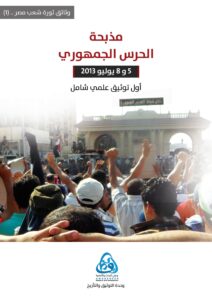
Awareness launches its first documentary publication on the Republican Guard events
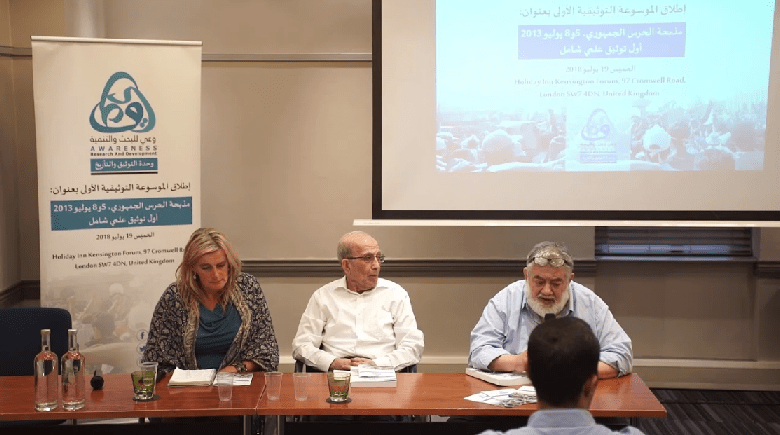
At a scientific symposium in the British capital, London, the Waaa Foundation for Research and Development launched on July 19, 2018, its first documentary encyclopedia, which was titled (Encyclopedia of the Republican Guard – July 5 and 8, 2013 – the first comprehensive scientific documentation), and it dealt with documenting the facts of the first massacre that occurred after the coup of July 3, 2013 in Egypt, known in the media as the “Republican Guard Club Events.”
The ceremony was opened by the founder of the “Wa’i” Foundation for Research and Development, Professor Mohamed Farid Al-Shayal, a professor of Islamic history at British universities, reviewing the preliminaries of the massacre, the nature of the protesters, the motives for their participation in the demonstrations rejecting the military coup against elected President Mohamed Morsi, and the reasons for the protesters’ decision to head to the vicinity of the club, while emphasizing their complete peacefulness, and their unjustified targeting by the army forces.
Regarding the symbolism of the Guards massacre, Dr. Al-Shayyal explained the importance of the massacre and the reasons for designating it as the subject of the institution’s first documentary publication, pointing out that the shots from that massacre were an early indication of the approach that the coup regime would take against its peaceful opponents, and a prelude to internal and external public opinion for the major massacre that followed weeks later and ended with the massacre of the dispersal of the Rabaa and Nahda sit-ins.
After that, Dr. Al-Shayyal reviewed the documentary work issued by the institution, explaining the efforts of its work team and their methodology in documentation, and the difference between it and news reporting and eyewitness testimonies, while explaining the specificity of the Republican Guard massacre, and its internal and external repercussions, revealing that the encyclopedia’s work team includes 40 to 50 young people who worked on collecting and revising the encyclopedia’s materials, and their meticulous work took about a year and ten months, stressing that it comes within its plan to chronicle Contemporary events in the Middle East region, especially the Arab Spring events.
Dr. said. Al-Shayyal, during his response to an intervention from the audience, said that the work comes in 5,000 pages, the most prominent topics of which were briefly reviewed in 400 pages, to represent the first large documentary encyclopedia adopted by the Foundation to document the events of the Arab Spring and the Middle East region, stressing that the Foundation tried to be completely neutral in its first documentary encyclopedia, pointing out that the encyclopedia documented various testimonies from the parties to the massacre and was not limited to Islamists alone, and that the full copy of The release includes a verbatim transcription of dozens of complete testimonials from their owners from different orientations.
After that, Professor Adel Salahi, Director of the Al-Furqan Islamic Heritage Foundation, gave a speech in which he praised the publication, comparing Western societies’ view and appreciation of human life, with the Arab view, which has begun to wake up every morning to news of killings and increasing numbers of victims.
Salahi stressed that the ugliest invention produced by mankind throughout its history is tyranny, and that the Arab Spring came to eliminate the consequences of this tyranny that dominated the Arab region.
In her speech, Dutch journalist Rena Nietjes expressed her appreciation for the Foundation’s documentary contributions, stressing that she was present at the events of the Republican Guard massacre, which she described as horrific, denying that the demonstrators had any initiative to attack the security forces that showered them with bullets.
Nietges considered that the encyclopedia is an “academic documentary work,” noting the importance of documenting Egyptian political and social events, and commenting that the Egyptian regime is trying in every way to falsify the events that the Egyptians witnessed and are still living with their consequences.
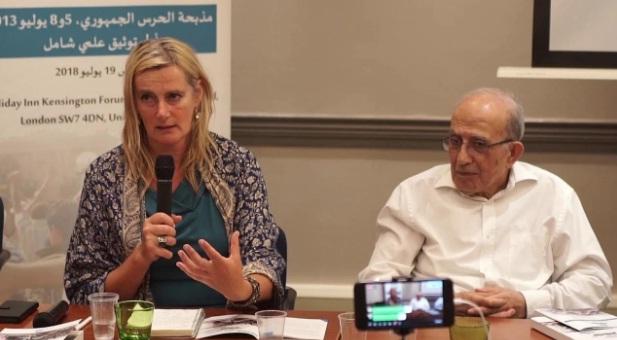
She cited what happened to her while covering the events in Egypt in 2013, when she took refuge in her country’s embassy, while Egypt classified her on terrorist lists. She confirmed that the Egyptian Foreign Minister himself helped her escape from Egypt because he was preparing for a foreign tour in Europe to improve the image of the coup, which clearly confirms the repressive regimes’ discomfort with any attempt to document and publish their crimes.
At the end of the scientific forum, the attendees confirmed that the publication is an academic documentary work on Egyptian political and social events, and an important step to document, preserve and archive important events in contemporary history.
It is noteworthy that the documentary work consists of 5,000 pages, the most prominent topics of which were briefly reviewed in 400 pages, representing the first large documentary encyclopedia adopted by the Foundation to document the events of the Arab Spring and the Middle East region.
The publication provides a descriptive study of the incident, including an introduction, sections on the martyrs, the injured according to medical reports, detainees, witness testimonies, qualitative documents, photos and videos, media echoes, and political reactions, in addition to human rights reports, legal procedures, and creative works. Then came the conclusion, including recommendations, then appendices, sources and references.
The release included 14 terms and descriptors, approximately 1,000 field photographs, approximately 1,100 videos, including more than 70 hours of broadcast, 175 illustrative figures, including drawings of the place and scans of documents, and 35 tables displaying statistical percentages and lists of martyrs, the injured, detainees, and others.
The release also monitored the data of 140 martyrs in a unified document collected from 42 authority lists. A brief and condensed biography was written that included all the martyrs, occupying 200 pages, as well as a unified document for the injured, which amounted to more than 800 registered casualties based on 62 authority lists and approximately 652 detainees.
The encyclopedia also documented 57 artistic, literary, and creative works, varying between professional work and spontaneous expression, with a number of public activities that documented the massacre, which were classified into several different forms and genres of expression. Then, it concluded the summary with some recommendations, appendices, and a list of sources and references.